










The Spatial and Ergonomic Geometry of Curved Corner Desks
Traditional rectangular office setups often struggle to balance reachable surface area with spatial efficiency. When planning an ergonomic setup, a curved corner computer desk fundamentally alters workstation geometry by eliminating the restrictive, sharp ninety-degree inside junction. Instead of creating a dead zone in the deepest corner of a room, a contoured inner arc draws the primary seating position inward. This geometry places monitors, peripheral gear, and active documents within a natural, semicircular forearm reach envelope.
Opting for a curved shaped desk rather than a harsh angular design also softens room circulation. In open-plan living areas or hybrid guest-bedroom offices, sharp furniture edges can impede walkways and create visual tension. A rounded corner computer desk smooths peripheral traffic paths while maximizing corner utility. For those interested in curating a compact corner home office layout, contouring the work surface provides an expansive feeling without encroaching heavily into main pathways.
Contour Form Factors: Inner Cockpit Curves vs. Rounded Wing Returns
Curved desk profiles are engineered with distinct structural silhouettes, each suited to specific room dynamics and workflows:
- Inner Cockpit Contours: Featuring a concave cutout along the user-facing edge, this curved corner desk top profile allows the chair to glide closer to the workstation core, supporting relaxed forearm placement during keyboard and mouse tasks.
- Dual-Arc L-Transitions: Replacing the abrupt inner seam of conventional right-angle desks, a sweeping interior curve connects the main deck to the side wing, making it effortless to pivot between primary typing tasks and secondary writing or tablet zones.
- The Rounded L-Desk with Outer Radius: An l-shaped desk with rounded end softens the exposed return wing that projects outward into the room. This rounded exterior edge eliminates sharp hip-height corners along entryways.
- Continuous Radial Executive Profiles: High-presence curved l-shaped office desk configurations feature sweeping arcs along both the inner operator zone and outer visitor-facing front, creating an organic focal point for executive rooms.
Comparing these profiles against a broader versatile computer desk collection highlights how contour designs optimize corner footprints compared to standard straight-edge desks.
Dimensional Footprint Tiers: From Compact Nooks to Executive Workstations
Selecting the right desk scale requires balancing available floor dimensions against hardware requirements:
Compact Corner Nooks
Designed for compact spaces, a small curved corner desk typically features symmetrical wing depths tailored for single-monitor setups or laptop docks. These units tuck neatly into alcoves without dominating the room's visual boundary.
Mid-Scale Corner Workstations
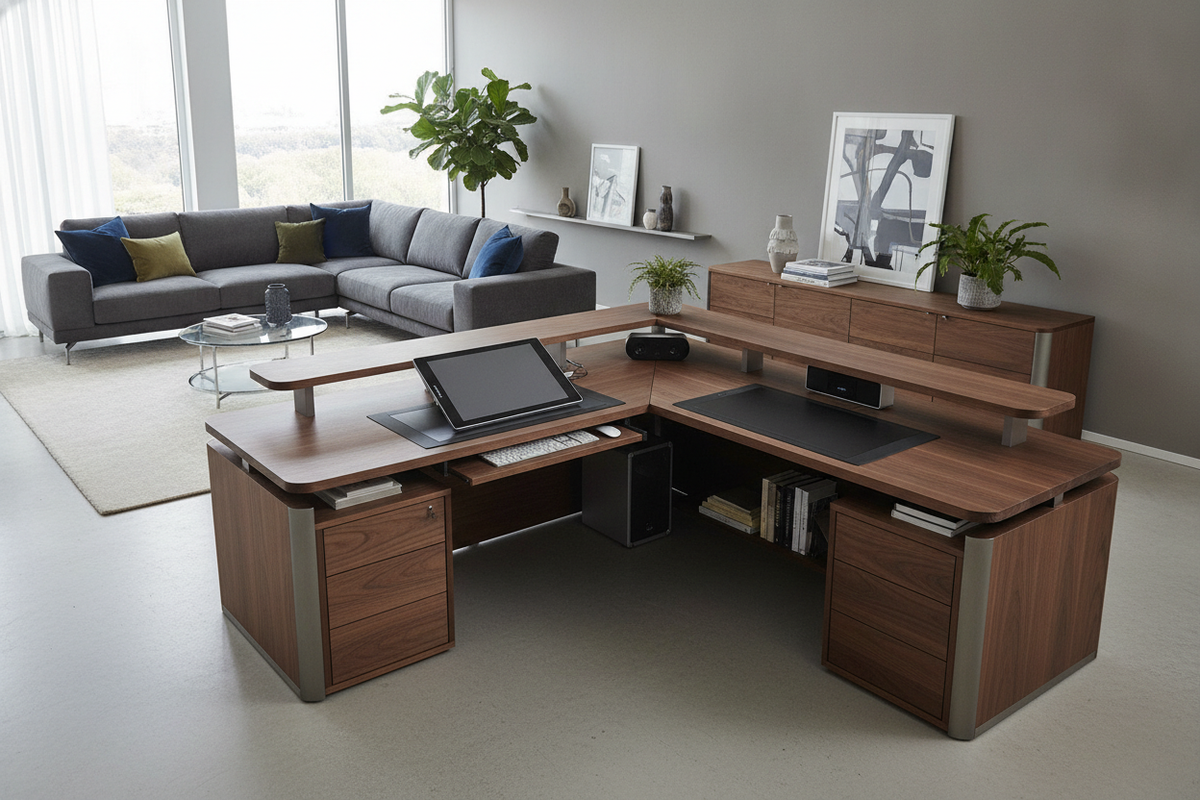
For dedicated home offices, choosing a dedicated corner computer desk with integrated storage offers an optimal balance between dual-monitor support, secondary drafting wings, and built-in filing capacity. These layouts provide deep corner apex space, ideal for positioning monitor risers or multi-screen display arms.
Expansive Executive Corner Layouts
A full-scale curved corner office desk or extended curved l-shaped office desk provides generous surface real estate for multi-display arrays, desktop audio interfaces, task lighting, and dedicated physical paper management, while maintaining wide knee wells underneath.
Storage Integration, Leg Clearance, and Cable Architecture
Integrating storage into a curved or angled workstation requires deliberate spatial planning to avoid impeding leg movement. Because corner desks draw the user into the central apex, under-desk pedestals must be positioned along outer wing perimeters rather than directly under the corner curve.
Choosing a corner workstation with generous shelving and cabinetry positioned along the outer wings keeps the central knee well completely open. This allows unrestricted chair swivel across both desk wings. Cable routing along a curved corner computer desk benefits from corner grommets and perimeter cable trays that channel wiring cleanly behind the apex leg structure, keeping power bricks and cords off the floor.
Material Performance, Frame Mechanics, and Corner Stability
A stable corner workstation relies on robust joinery and balanced load distribution across the rear angled framework:
- Engineered Wood and Melamine Laminates: High-density composite boards finished with scratch-resistant, water-repellent laminates provide durable work surfaces with smooth, seamless edges along contoured cuts.
- Reinforced Metal Substructures: Triangular corner apex braces and powder-coated steel leg assemblies prevent surface deflection, particularly when supporting heavy multi-monitor mounts near the rear corner.
- Edge Banding and Contoured Molding: Smooth edge banding on a rounded corner computer desk prevents peeling and provides a comfortable resting edge for forearms during prolonged writing or typing.
Room Placement Strategies and Traffic Flow Optimization
A contoured desk adapts well to multiple interior arrangements:
The Corner Alcove Anchor
Placing the desk firmly into a room's 90-degree corner takes advantage of perimeter structural walls. This anchors power cabling close to wall outlets while leaving the center of the room open for seating, bookshelves, or storage cabinets.
The Floating Peninsula Layout
In larger home offices, positioning one wing of an l-shaped desk with rounded end against a wall while extending the rounded wing outward divides open spaces naturally. The smooth outer curve guides foot traffic effortlessly around the desk rather than creating an obstacle.
When deciding between open corner desk configurations and enclosed options, reviewing concealed armoire workstation strategies can help determine whether an open contoured surface or a hideaway cabinet best matches your household lifestyle.
Curved Corner Workstation Selection Framework
To choose the ideal curved corner desk, consider this strategic checklist before finalizing your layout:
- Measure Corner Clearance: Confirm wall run lengths along both perpendicular walls, accounting for baseboards, wall heaters, and window sills.
- Evaluate the Chair Swivel Envelope: Ensure there is ample clearance from the inner desk arc to rear walls or nearby storage units to allow comfortable chair movement.
- Map Peripheral Hardware: Determine whether monitor arms will clamp onto the rear corner apex or sit on an elevated riser shelf.
- Balance Open and Closed Storage: Pair open display shelving for quick-access tech accessories with closed drawers for confidential paperwork to maintain an uncluttered surface.


Leave a comment
This site is protected by hCaptcha and the hCaptcha Privacy Policy and Terms of Service apply.