










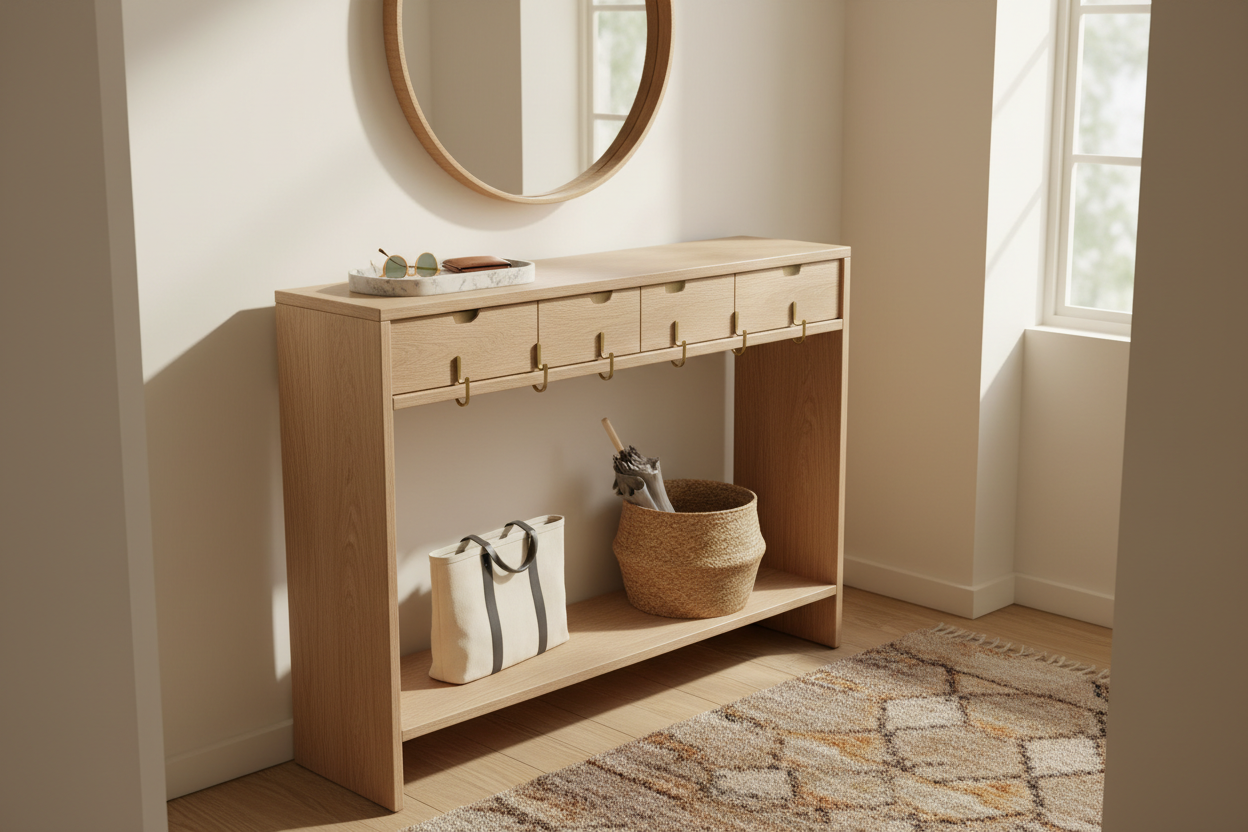
Walking through your front door should feel like a relief, not a navigational challenge. Yet, for many of us living in apartments or older homes, the entrance is often an afterthought—a narrow strip of floor that barely accommodates a doormat, let alone furniture. However, that lack of square footage doesn't eliminate the need for a landing strip. You still have keys to drop, mail to sort, and a need to set the tone for your home's interior. Finding the right small table for entrance way setups is less about filling space and more about claiming it intentionally.
The solution lies in scaling down without sacrificing utility. You don't need a grand mahogany piece to make a statement. A slim profile, a strategic height, and perhaps a hidden drawer can transform a chaotic dumping ground into an organized vignette. The goal is to find a piece that hugs the wall tightly while offering just enough surface area to be useful.
My Battle with the Non-Existent Foyer
I learned the value of verticality the hard way in my first city apartment. The "foyer" was essentially a three-foot square patch of laminate flooring immediately greeted by a coat closet door on the right and a radiator on the left. For the first six months, I tossed my keys into a bowl on the floor, which I inevitably kicked over at least once a week. It was frustrating and messy.
I eventually hunted down an antique demi-lune (half-moon) table that was only ten inches deep. It looked impossibly narrow in the store, but once I wedged it next to the door frame, it changed everything. It was just large enough for a lamp and a small ceramic tray. That experience taught me that even an extra small entryway table can anchor a room. It stopped the visual clutter from migrating into the living room and gave me a specific ritual for coming home: lock door, keys in tray, lights on.
Measuring for the Tightest Spaces
Before you fall in love with a piece of furniture online, grab a tape measure. In tight quarters, an inch can mean the difference between a functional hallway and a bruised hip. You need to measure not just the wall width, but the clearance for traffic flow. A good rule of thumb is to maintain at least 36 inches of walking path if possible, though in tight city corridors, you might be working with 30 inches.
Check the swing of your front door. Does it open inward against the wall where you want to place the furniture? If so, you need a piece that is shallower than the distance from the wall to the open door, or you risk banging the handle against your new table every time you come home. This is where the search for the best small entryway tables gets technical; depth is usually your biggest constraint. Look for "console" or "sofa table" depths of 10 to 12 inches rather than the standard 16 to 18 inches.
Choosing the Right Shape for Your Layout
The footprint of your furniture dictates how the room feels. Sharp corners can be aggressive in a narrow hall, while curves tend to soften the space and allow for easier movement around the piece.
The Slim Console
A small foyer console table is the workhorse of narrow hallways. These are typically rectangular and long, providing a decent amount of surface area without protruding too far into the room. If your hallway is long but narrow, this is your best bet. It draws the eye down the hall, elongating the space. Look for open bases with long legs to keep the area looking airy; a solid block of wood can make a small entry feel claustrophobic.
The Round or Demi-Lune
If you have a corner spot or a very short wall, a round pedestal table or a half-moon shape works wonders. These are excellent as a dedicated side table for keys. Because they lack sharp corners, you are less likely to bump into them when rushing out the door with groceries. They also break up the monotony of straight lines found in doors and hallways.
The Floating Shelf
Sometimes, the floor space is simply not there. If you have a radiator, a low vent, or a pet feeding station that takes up floor real estate, mounting a shelf at waist height is a brilliant hack. It functions exactly like a small entry door table but with zero footprint. You can mount a mirror above it to mimic the look of a full console setup.
Functionality: What Do You Actually Need?
A table in the entryway has to earn its keep. Since the surface area is limited, you cannot treat it as a display shelf for your entire knick-knack collection. Determine the primary problem you are solving.
If mail pile-up is your nemesis, look for a table with a lower shelf. You can place a basket there to catch envelopes and catalogs, keeping the top surface clear. If you are constantly losing smaller items like lip balm or transit cards, a table with a shallow drawer is non-negotiable. This keeps the visual noise down while keeping essentials within reach.
For those who need a spot to put on shoes, a tall, spindly table won't help. You might consider a sturdy, low bench that acts as a surface for bags but can also support weight. However, for most people searching for a small table for entrance way areas, the priority is a drop zone for hand-held items.
Styling Your Mini Drop Zone
Once you have your furniture, styling it requires restraint. On a large buffet, you might have a lamp, a stack of books, a plant, and framed photos. On an extra small entryway table, that amount of decor will look like a mistake. Stick to the rule of three.
Start with lighting. A tall, slender lamp adds height and warmth. If the table is too small for a lamp base, install a wall sconce above it. Next, add the functional container—a bowl, tray, or box for keys and coins. Finally, add one organic element, like a small succulent or a vase with a single stem. This brings life to the space without overwhelming it.
Mirrors are a tiny entry's best friend. Hanging a mirror directly above your side table for keys does double duty: it allows you one last look before you leave, and it bounces light around the dark hallway, making the area feel twice as big. Ensure the mirror is proportional to the table; it shouldn't be wider than the furniture below it.
Material Matters
In a high-traffic zone, durability counts. Glass and acrylic (Lucite) tables are fantastic for small spaces because they are visually weightless—they disappear into the room, making the space feel larger. However, they show fingerprints and dust easily. If you have kids or pets, a distressed wood or metal finish might be more forgiving. Metal frames with stone or wood tops offer a nice balance of sturdiness and slim profiles, often found in the best small entryway tables on the market today.
Your entryway sets the expectation for the rest of your home. Even if that entry is just a sliver of wall behind a door, treating it with care makes coming home a better experience. By measuring carefully and prioritizing function, you can turn a cramped corner into a welcoming command center.
Frequently Asked Questions
How tall should an entryway table be?
Standard console table height usually falls between 30 and 36 inches. This height is comfortable for dropping keys without bending over, and it aligns visually with the lower half of most wall art or mirrors. If you place it behind a sofa that backs up to the entry, ensure the table is no taller than the sofa back.
Can I use a radiator cover as an entryway table?
Absolutely. If your radiator is near the door, a custom or store-bought cover is a smart way to reclaim that space. It provides a safe, heat-resistant surface for mail and keys while hiding the unsightly metal fins of the heater.
What if my door opens directly into the living room with no hallway?
Create a "phantom" entryway by placing a small table perpendicular to the wall next to the door handle side. This acts as a subtle room divider, creating a visual pause between the entrance and the living area. Alternatively, place a slim console against the back of a sofa if it faces the door.

Leave a comment
This site is protected by hCaptcha and the hCaptcha Privacy Policy and Terms of Service apply.