










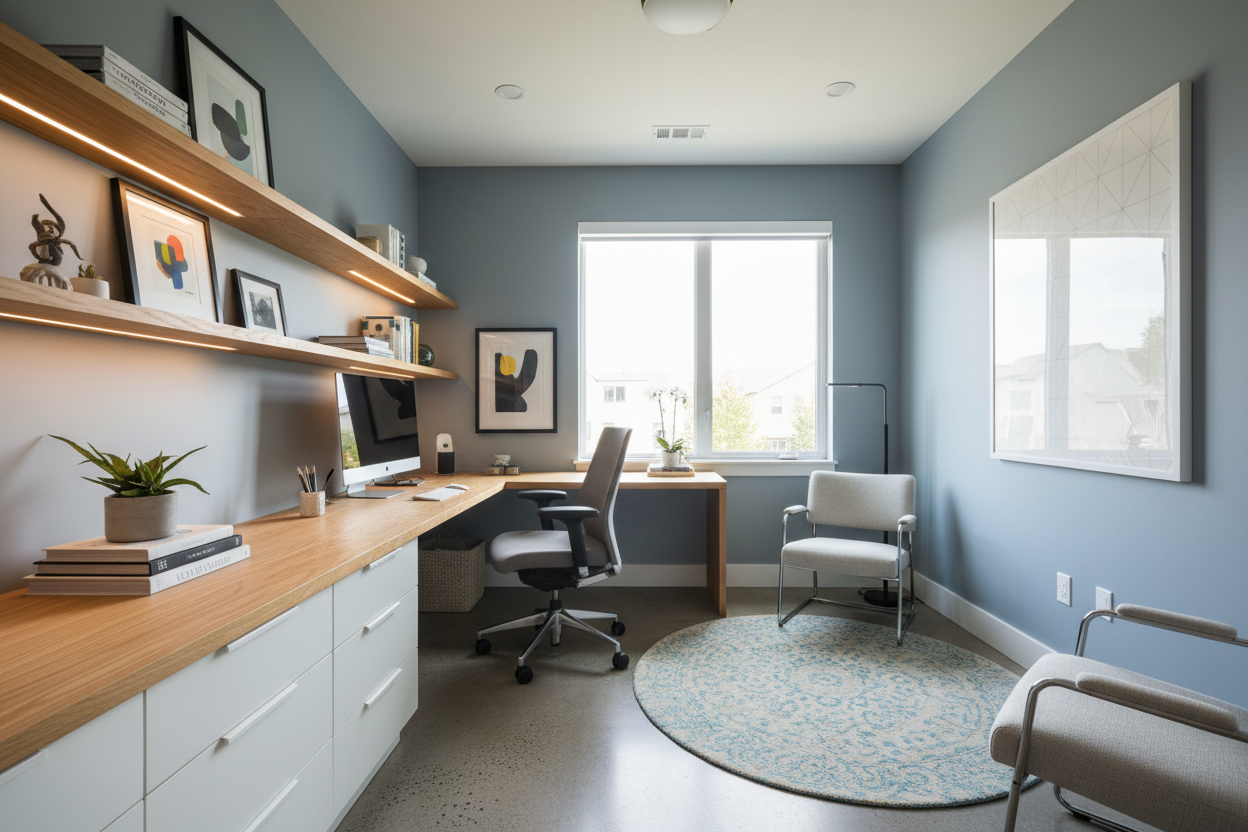
Staring at an empty 120-square-foot room can feel deceptive. It is neither expansive nor tiny; it sits in a challenging middle ground that requires precise intention. Many homeowners struggle here, assuming they have enough room for an executive suite setup, only to find themselves navigating a cluttered maze. The secret to a successful 10x12 office layout lies not in what you can fit inside, but in how you manipulate the negative space to create flow.
Quick Decision Guide: Key Layout Principles
- The Command Position: Place your desk facing the door, but not directly in line with it, to establish authority and reduce visual fatigue.
- Vertical Utilization: In a 10x12 footprint, floor space is premium. Opt for tall bookcases or wall-mounted shelving units.
- Traffic Flow: Ensure a minimum of 36 inches of clearance behind your desk chair for comfortable movement.
- Scale of Furniture: Avoid heavy, dark wood pieces. Choose legs that show the floor (mid-century styles) to make the room feel larger.
- Lighting Zones: Rely on layered lighting—ambient, task, and accent—rather than a single overhead fixture.
Strategic Space Planning
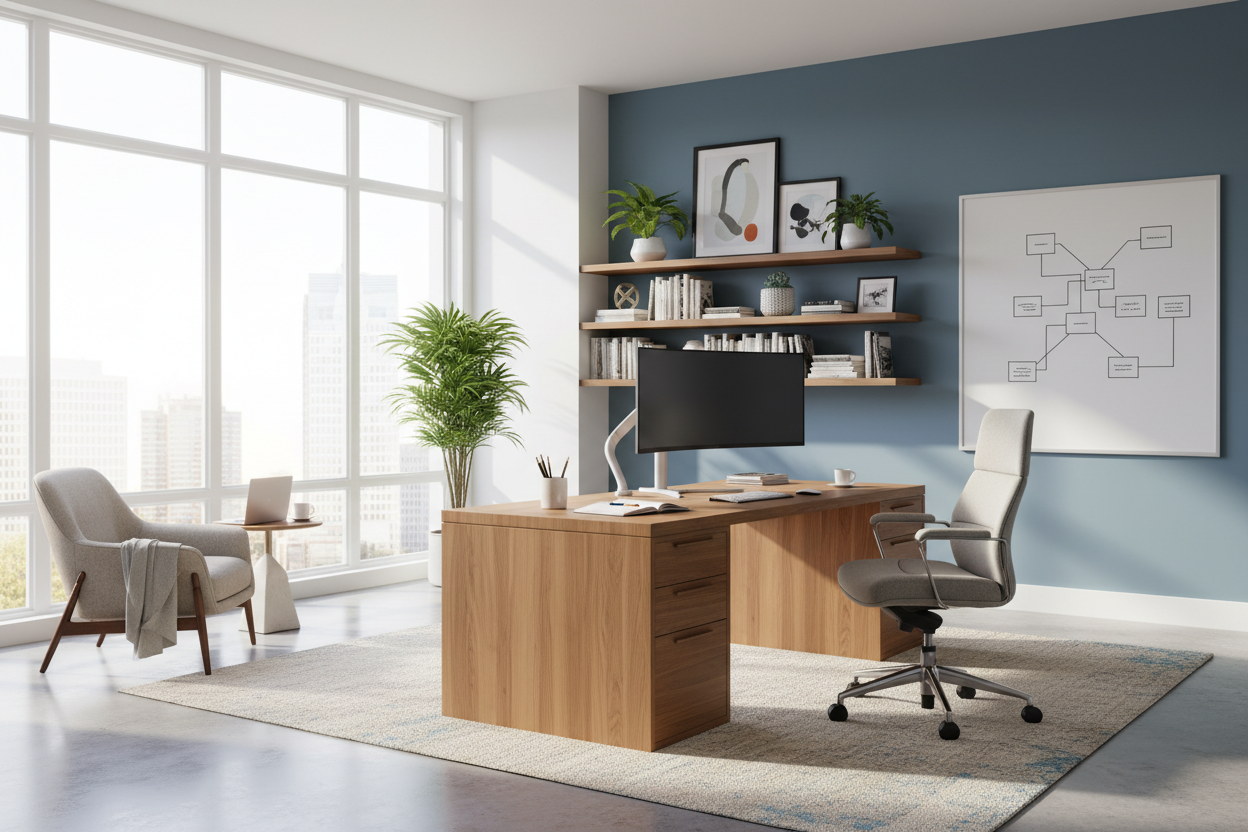
When designing a 10 x 12 office, the biggest hurdle is the desk placement. The instinct is often to push the desk against a wall to "open up" the center. While this works for multi-purpose rooms, a dedicated office benefits from "floating" the desk perpendicular to the longest wall or facing the room. This arrangement allows you to utilize the wall behind you for credenzas or storage, creating a professional backdrop for video calls.
The "L" vs. The "I" Configuration
If you require significant surface area for blueprints or multiple monitors, an L-shaped desk fits naturally into one corner. However, ensure the return (the side part of the desk) doesn't block the room's entry flow. Alternatively, a simple rectangular writing desk (the "I" configuration) offers more flexibility and makes the 10x12 office feel airier.
Choosing the Right Materials and Aesthetics
Materiality dictates the visual weight of the room. In a space of this size, solid mahogany or heavy oak can absorb light and shrink the room. Instead, consider:
- Glass or Acrylic: These materials are visually invisible, allowing the eye to travel through the furniture to the walls, expanding the perceived space.
- Light Woods and Metals: White oak, ash, or brushed brass finishes reflect light and maintain a sophisticated, airy palette.
- Textured Rugs: Ground the space with a rug that is sized correctly. A common error is choosing a rug that is too small (e.g., 5x7). In a 10x12 room, an 8x10 rug is usually the sweet spot, unifying the furniture.
Ergonomics and Visual Balance
Functionality must never be sacrificed for aesthetics. Your chair needs to support long hours of work without dominating the room. Look for high-performance task chairs with a slim profile rather than bulky, overstuffed leather executive chairs. Visual balance is achieved by distributing weight; if you have a tall bookshelf on the north wall, balance it with a piece of art or a floor lamp on the south wall to prevent the room from feeling "tipped" to one side.
My Personal Take on 10x12 Office Layouts
I recently worked on a project for a client in a renovated brownstone who insisted on bringing his grandfather's massive partner's desk into a standard 10 x 12 office. On paper, it fit. In reality, it was a disaster. The moment we placed it, the room felt claustrophobic.
The specific issue wasn't just the size, but the "knee-knock" factor. We realized that once the desk was centered, he barely had 28 inches to roll back his chair. Every time he stood up, he hit the credenza behind him. We eventually swapped it for a floating desk with slender brass legs and a shallow depth of 24 inches. The difference was immediate. The room could breathe again. The lesson? Always tape out your furniture on the floor before buying. That extra six inches of clearance is the difference between a cramped closet and a luxury workspace.
Conclusion
Designing a 10x12 office requires a delicate balance of scale and style. By prioritizing flow, selecting visually light materials, and adhering to ergonomic standards, you can curate a workspace that feels customized and expansive. It is time to stop working around your furniture and start making your furniture work for you.
Frequently Asked Questions
What is the best desk size for a 10x12 office?
For a floating layout, a desk between 48 to 60 inches wide and 24 to 30 inches deep is ideal. This preserves walkability around the perimeter while offering ample workspace.
Can I fit a guest chair or sofa in a 10x12 office?
A full sofa is likely too large and will impede traffic flow. However, a loveseat or a pair of slim accent chairs can fit comfortably against a short wall, provided the desk is not too deep.
How do I handle lighting in a room this size?
Avoid relying solely on a ceiling fan light kit, which casts unflattering shadows. Install a dimmer switch for overheads, add a dedicated task lamp for the desk, and consider a floor lamp in the corner to wash the walls with light, making the room appear wider.


Leave a comment
This site is protected by hCaptcha and the hCaptcha Privacy Policy and Terms of Service apply.