






A 65-inch TV needs a TV stand about 61 to 69 inches wide, because the screen is about 57 inches wide and the stand should extend 2 to 6 inches past it on each side. For the height, aim for a stand top of roughly 20 to 24 inches, which puts the center of the screen near seated eye level.
If you are buying a new TV or replacing a stand, the size on the box won't help much, because TVs are sold by diagonal size and a stand that's too small can look wrong or even tip. This TV stand size guide gives the numbers for 43, 50, 55, 65, 75 and 85 inch screens, then covers feet placement, weight capacity, depth and soundbars. With your measurements in hand, you can compare them with the FUFU&GAGA TV stand collection.
Key takeaways
- Measure the TV, not the diagonal size: the TV width is about 87% of its advertised size.
- Width: add at least 4 inches to the TV width (2 inches per side). Adding up to 12 inches gives more visual balance.
- Feet: the TV's base must sit fully on the top.
- Height: the center of the screen should land near seated eye level, commonly quoted as 41 to 42 inches from the floor.
- Weight: a stand's TV size limit and its weight capacity are separate numbers. Check both.
TV stand size chart: what size TV stand for 65 inch TV sets and other sizes?
| TV size | Approximate screen width | Approximate screen height | Suggested minimum stand width | Roomier stand width |
|---|---|---|---|---|
| 43 inch | 37.5 in | 21.1 in | 42 in | 50 in |
| 50 inch | 43.6 in | 24.5 in | 48 in | 56 in |
| 55 inch | 48.0 in | 27.0 in | 52 in | 60 in |
| 65 inch | 56.7 in | 31.9 in | 61 in | 69 in |
| 75 inch | 65.4 in | 36.8 in | 70 in | 78 in |
| 85 inch | 74.1 in | 41.7 in | 79 in | 87 in |
The chart is plain 16:9 arithmetic. Approximate width = diagonal x 0.872, and height = diagonal x 0.49. The suggested minimum is the width plus 4 inches and the roomier figure is the width plus 12 inches, both rounded up.
These are approximate dimensions, so your specific TV will differ a little. TCL gives 56.7 by 31.9 inches for a 65 inch TV and notes that the frame can add to that. Samsung's 65-inch Q60D measures 1450.9 mm, or about 57.1 inches. Before you buy, check the TV's dimensions on the maker's spec sheet, or measure the TV's actual width from the left edge of the frame to the right edge.
How wide should a TV stand be? The golden rule
The golden rule is that a TV stand should be wider than the TV. Beyond that, published advice varies. BGR asks for at least a few inches more in total, with a 60-inch stand for a 57-inch TV. SlashGear suggests about 3 inches of space from the edge of the stand. Gear Patrol says 2 to 3 inches per side if the TV should be the focal point, and 6 to 12 inches per side if the stand should carry more of the look.
There is no official standard, so the chart uses 2 to 6 inches per side as the ideal range. That means 4 to 12 inches wider than the TV in total, and the ideal TV stand width for a 65 inch TV comes to 61 to 69 inches. A longer stand is fine if the wall has room.
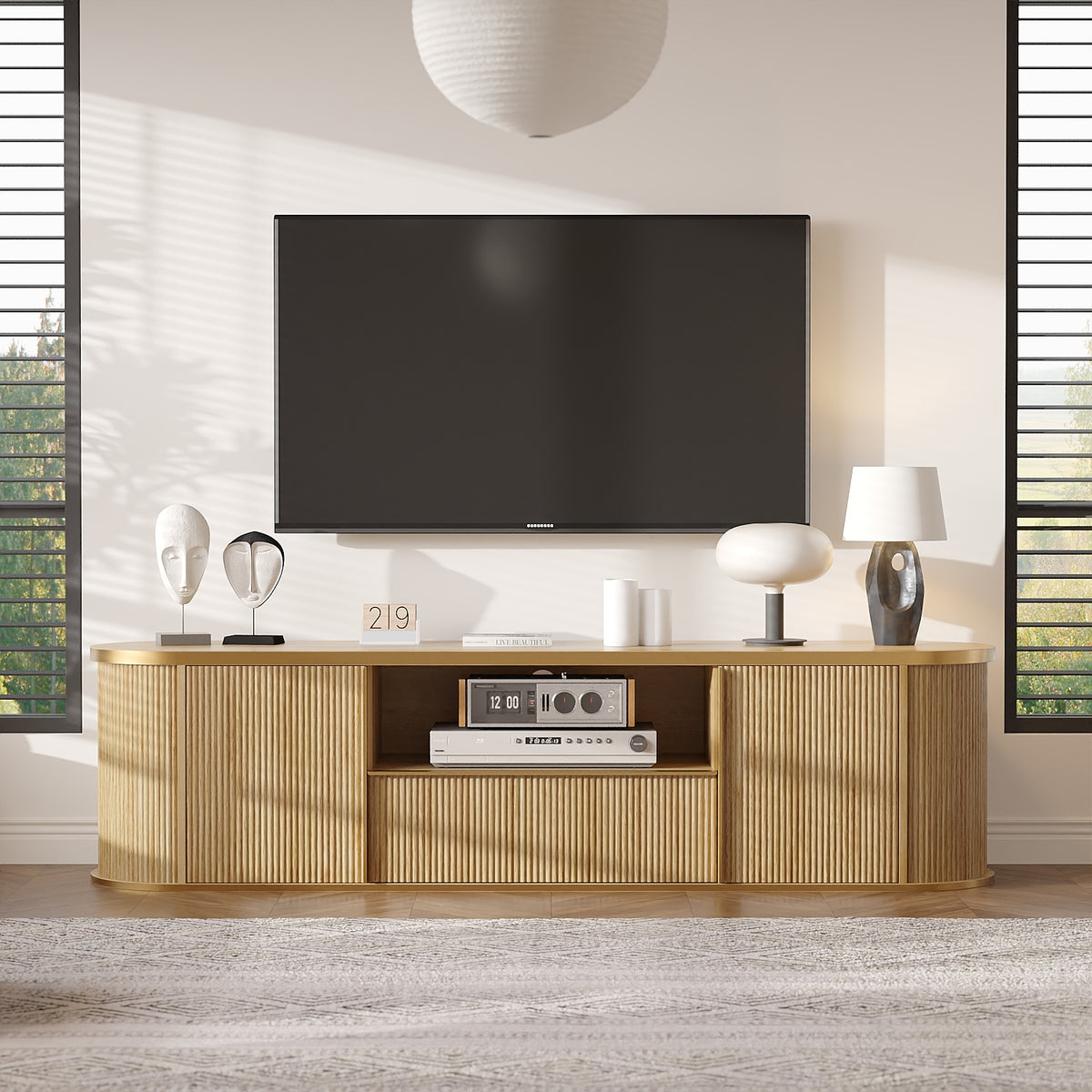
A wider stand gives visual balance, leaves room for a lamp, speakers or media devices beside the TV, and helps stability: SlashGear warns that a stand that is too small risks the TV tipping over. The right TV stand should also suit the room's style, but fit comes first.
Can a TV sit on a stand narrower than the screen?
Sometimes, but only if the feet fit, and Gear Patrol calls "not narrower than the TV" the one rule that holds for everyone. What decides the physical fit is the TV's base, not the TV width.
TV feet placement varies a lot within one size. Samsung's 65-inch Q60D has a stand 1076.3 mm wide, or about 42.4 inches. A 65-inch Sony A80L has a stand width of 46.61 inches in its standard position and 33.35 inches in its narrow position, according to Sony's published answers.
For example, a TV with wide-set feet can need a longer top than a center-pedestal set of the same size. Measure from the outside of the left foot to the outside of the right foot, then compare that with the flat, usable part of the top, since rounded or stepped ends reduce it. Each foot should sit fully on the surface.
What is the ideal TV stand height?
The ideal TV stand height puts the center of the TV screen at seated eye level, which helps prevent neck strain and gives a better viewing experience. CE Pro gives about 42 inches from the floor to the center of the screen as a rule of thumb for screens up to 85 inches, and Gear Patrol says about 41 inches. Both assume average seating, so sit where you normally watch and have someone measure from the floor to your eyes.
To work out your own TV stand height: eye level, minus half the TV screen height, minus the gap between the stand top and the bottom of the picture. Samsung's height figures with and without the stand show a gap of about 1.6 inches on the 65-inch Q60D, and the table rounds that to 2 inches.
| TV size | Half of screen height | Stand height for a 42 in center |
|---|---|---|
| 43 inch | 10.5 in | About 29.5 in |
| 50 inch | 12.3 in | About 27.7 in |
| 55 inch | 13.5 in | About 26.5 in |
| 65 inch | 15.9 in | About 24 in |
| 75 inch | 18.4 in | About 21.6 in |
| 85 inch | 20.8 in | About 19.2 in |
Bigger TVs need a lower stand, because the extra height already lifts the center.
Is 20, 29, 32 or 35 inches too high for a 65 inch TV?
This table assumes a 65 inch TV, a 2-inch gap and a viewer 8 feet away with eyes at 42 inches. CE Pro's rule of thumb is no more than 15 degrees of vertical viewing angle, so all of these pass, but comfortable viewing gets harder as the number grows.
| Stand height | Center of picture | Offset from eye level | Viewing angle at 8 ft | Verdict |
|---|---|---|---|---|
| 12 in | 29.9 in | 12.1 in below | About 7 degrees | Low profile; you look slightly down |
| 20 in | 37.9 in | 4.1 in below | About 2 degrees | Not too low |
| 24 in | 41.9 in | On target | 0 degrees | Close to ideal height |
| 29 in | 46.9 in | 4.9 in above | About 3 degrees | Slightly high |
| 32 in | 49.9 in | 7.9 in above | About 5 degrees | High for a sofa |
| 35 in | 52.9 in | 10.9 in above | About 6.5 degrees | Too high for most sofas |
| 40 in | 57.9 in | 15.9 in above | About 9 degrees | Only for tall seating or viewing from a bed |
A low stand is still a fair choice, since the offset stays small at a normal viewing distance. A taller stand suits a bedroom or high seating, where eye level is higher.

How much weight capacity does a TV stand need?
A stand's weight capacity must exceed the total weight of the TV and everything else on top. Samsung lists its 65-inch Q60D at 21.3 kg with the stand, about 47 lb, and the 85-inch Q60D at 42.5 kg, about 94 lb. Those are single models, so look up your own setup. Our TV stand weight capacity guide covers typical weights by size and how to add up a full setup.
Add the TV, soundbar, gaming consoles and any décor, then compare the total with the stated limit. Whether a stand is solid wood or engineered wood, trust that number, not the material.
Check the TV size limit and the weight limit separately. Our 78.7-inch media console, for example, is listed for TVs up to 85 inches with an 80 lb weight capacity, so an 85-inch set as heavy as that Samsung would be over its limit even though the width fits.
How deep should a TV stand be?
A TV stand must be deeper than the TV's base, with space left to push the TV back from the front edge. Samsung's stand depth is 274 mm, about 10.8 inches, on the 65-inch Q60D and 345.1 mm, about 13.6 inches, on the 85-inch model. Most floor-standing consoles in our range are 15.7 to 19.7 inches deep, while wall-hung units run 11.2 to 13.8 inches.
For storage inside the stand, measure the deepest device you own, such as a receiver, and leave room behind it for plugs and airflow. In a tight room layout, a shallower stand saves floor space, but check the TV's base first.
Soundbars, gaming consoles and cable management
A soundbar placed in front of the TV must fit under the screen. Compare the bar's height with the gap under your screen: at about 1.6 inches on the 65-inch Q60D, a taller bar would cover the bottom of the picture. Some TVs offer a raised setting for this, such as the soundbar position on the Sony A80L. Otherwise, use a lower shelf or mount the bar on the wall.
A soundbar also adds depth, so allow for the base plus the bar. Built in cable cut-outs or a removable back panel make cable management easier in any media setup.
How much wall space and floor space do you need?
Mark the stand's dimensions on the floor with painter's tape to create a quick mock-up. Key considerations are walking room, door swing, outlets and windows that could cause glare.
TCL puts the viewing distance for a 65 inch TV at 6.5 to 8.9 feet, and cites a Society of Motion Picture and Television Engineers recommendation for a screen that fills 30 to 40 degrees of your field of view. Check that viewing distance before you settle on a spot, since it decides how much of the picture quality you see.
With a wall mounted TV, the stand no longer carries the TV, so feet and weight don't matter. You can choose it for storage and style, though a wider stand still looks more balanced. If the only spot is one corner of the room, see our guide on how to mount a TV in the corner.
Buying checklist
- Find the TV's dimensions on the spec sheet: width, height with stand, depth and weight.
- Choose a stand at least 4 inches wider than the TV, and up to 12 inches wider for a roomier look.
- Confirm the top is wider than the outside of the TV's feet.
- Measure seated eye level and work out the stand height with the formula above.
- Confirm the stand is deeper than the TV's base, with space to push the TV back.
- Stay under both the stated weight capacity and the TV size limit.
- Check soundbar height against the gap under the screen.
- Plan the anchoring, and buy anti tip straps if none are in the box.
Our picks by TV size
These FUFU&GAGA stands all state a TV size limit in their specs. Check each one against your own TV and the chart.
50.4-inch lifting TV stand
This cabinet holds a TV of up to 50 inches on a remote-controlled lift that raises it from 28.7 to 68 inches high, with four memory settings. It's finished on all sides, so it can stand at the foot of a bed, and a TV anti-tip kit is included. It is 15.7 inches deep.
Best for: 43 to 50 inch TVs in a bedroom, where the screen height needs to change.
63-inch floating TV stand with LED lights
This wall-mounted unit is listed for TVs up to 70 inches with a 55 lb weight capacity, and it's 13.8 inches deep. A 65 inch TV leaves about 3 inches per side. Because it hangs on the wall, it clears the floor and lets you set the height yourself. Three drawers and remote-controlled LED strips round it out.
Best for: 55 to 65 inch TVs in smaller rooms.
71-inch high-gloss TV stand with LED base
This sleek 70.9-inch stand leaves about 7 inches per side around a 65 inch TV. It's listed for TVs up to 70 inches and holds up to 150 lb, with four large drawers for game consoles and cables. It's 15.7 inches deep and 11.8 inches tall, so expect the 12-inch row in the height table.
Best for: a 65 inch TV when you want a low profile look.
82.7-inch marble-look TV stand with built-in outlet
At 21.7 inches tall, this stand puts the center of a 75 inch TV at about 42 inches, using the 2-inch gap above, and leaves about 8.6 inches per side. It's listed for TVs up to 85 inches with a 120 lb weight capacity, and has three drawers, two cabinets, cable management and a power outlet on the top panel.
Best for: 75 inch TVs, and 85 inch TVs where you want the screen near eye level.

106.3-inch adjustable-width TV stand
This stand measures 106.3 inches wide and has an expandable design, so you can size it to your wall. It's listed for TVs up to 85 inches and has the highest limit in this group at 300 lb, plus three drawers and two shelves for media storage. It's 15.7 inches deep.
Best for: 85 inch TVs and heavy setups.
| Stand | Width x height | TV size limit | Weight limit | Tip-over device in box (per spec) |
|---|---|---|---|---|
| 50.4-inch lifting | 50.4 x 39.3 in | 50 in | Not stated | TV anti-tip kit: yes; cabinet device: no |
| 63-inch floating | 63 x 9.8 in | 70 in | 55 lb | Yes |
| 71-inch high-gloss | 70.9 x 11.8 in | 70 in | 150 lb | No |
| 82.7-inch marble-look | 82.7 x 21.7 in | 85 in | 120 lb | Yes |
| 106.3-inch adjustable | 106.3 x 15.4 in | 85 in | 300 lb | No |
How to keep a TV and stand from tipping
Stability is the top concern in a home with kids, so treat it as part of choosing a TV stand. The U.S. Consumer Product Safety Commission's Anchor It! guidance says TVs should only be placed on furniture designed to hold a television, and that TVs that aren't wall mounted should still be anchored to the wall. It also says to remove items that tempt kids to climb, such as toys and remote controls, from the top of the TV and furniture.
If anchoring isn't possible, CPSC advises placing the TV on a sturdy, low base, pushing it back as far as possible and keeping cables and cords out of reach. CPSC estimates that emergency departments treated an average of 17,800 tip-over injuries a year from 2020 to 2022. Follow the maker's instructions for both the TV and the stand.
FAQ
How wide is a 65 inch TV?
A 65 inch TV is about 57 inches wide and 32 inches tall, and the frame can add a little. It is about 8.7 inches wider than a 55-inch TV, so an old stand may no longer fit.
Will a 65 inch TV fit on a 55-inch stand?
It isn't a good match. The screen would overhang by about 1 inch on each side, and that only works if the feet sit fully on the top. The same applies to a 75-inch TV on a 65-inch stand. For a safer fit and better balance, use the minimum widths in the chart.
Can a 55-inch TV fit on a 48-inch stand?
A 55-inch TV is about 48 inches wide, so a 48-inch stand matches it with no margin. It can work if the feet fit and the weight capacity is high enough, but the chart's 52-inch minimum looks better.
What size TV stand do I need for a 75 inch TV?
A 75 inch TV is about 65.4 inches wide, so choose a stand 70 to 78 inches wide and about 21.6 inches tall. For an 85 inch TV, the recommended width is about 79 to 87 inches.
Is a 65 inch TV too big for a living room?
Usually not, as long as you can sit about 6.5 to 8.9 feet away, the range TCL gives, and have at least 61 inches of wall width for the stand. Taping the outline on the wall shows how the TV size will feel in the room.
Ready to compare sizes? Browse all FUFU&GAGA TV stands with your measurements in hand.


Leave a comment
This site is protected by hCaptcha and the hCaptcha Privacy Policy and Terms of Service apply.