










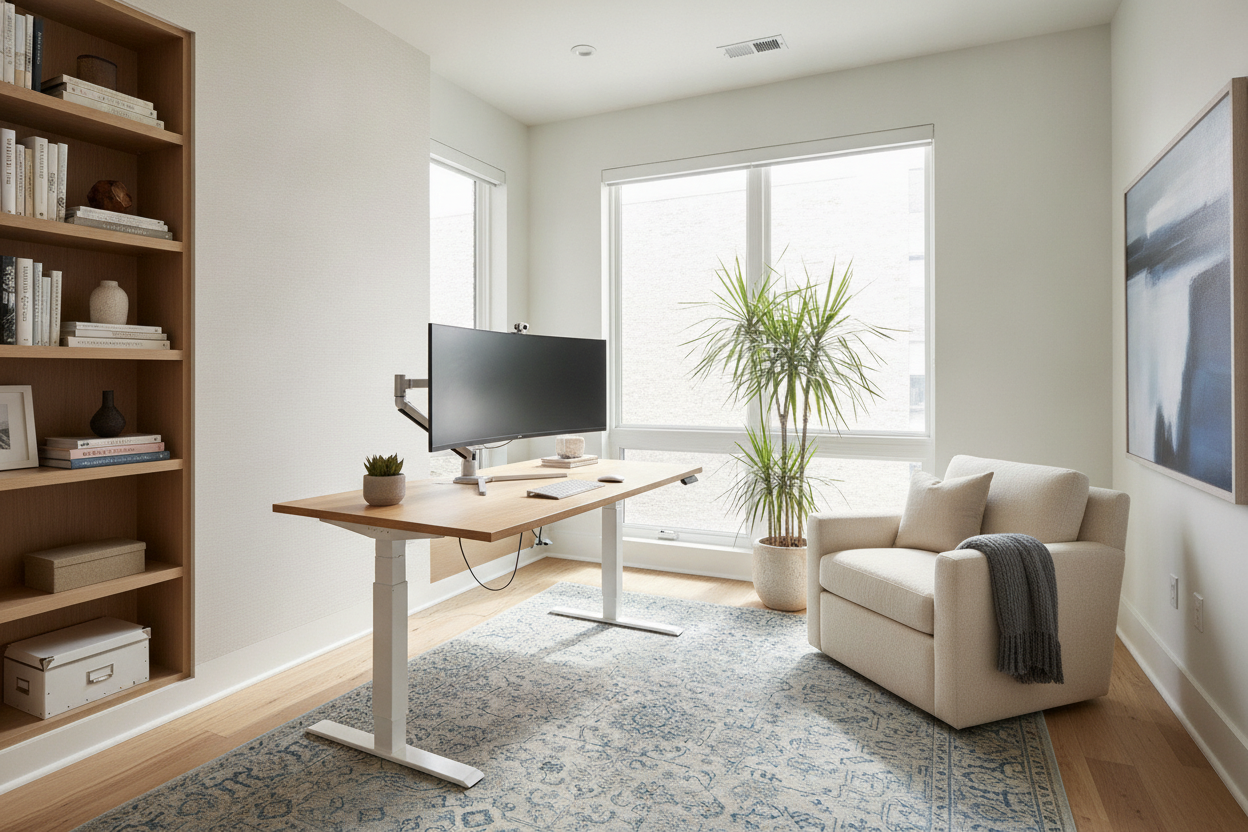
I spent three years working from a folding card table before I finally upgraded to a motorized frame. I thought it would solve everything, but instead, my living room looked like a server room at a mid-sized tech firm. If your standing desk home office ideas consist of just shoving a slab of wood against a wall and hoping for the best, you're likely staring at a mess of wires and a room that feels half-finished.
- Floating your desk can actually make a small room feel bigger by maintaining sightlines.
- Pair skinny metal legs with 'heavy' furniture like solid wood credenzas to ground the room.
- Under-desk storage is non-negotiable for keeping the 'standing' view clean.
- Cable management requires extra slack—don't snap your laptop port because the cord was too short.
Stop Shoving the Desk Against a Blank Wall
Most people treat their desk like a naughty child in a timeout corner. You find the first empty stretch of drywall and push the desk flush against it. This is a mistake. It makes your home office standing desk ideas feel boxed-in and creates a dead zone behind your monitors. If you have the space, try floating the desk in the middle of the room or perpendicular to a window.
When you rethink your desk placement, you realize that facing the door or a window makes the work day feel less like a prison sentence. In my 600-square-foot apartment, I angled my desk 45 degrees in a corner. It felt weird for exactly ten minutes, then I realized I could finally see my plants and the TV while I worked. It broke the 'office' feel and made it a part of the home.
The Visual Weight Problem: Balancing Metal Legs with Heavy Furniture
Standing desk office design has a major flaw: the legs are usually thin, industrial T-frames. When the desk is raised, it looks like a giant spider standing in your room. This 'top-heavy' look is what makes the space feel cluttered and unstable. To fix this, you need to anchor the room with pieces that have real visual weight.
I recommend incorporating warm home decor like a thick wool rug or a chunky oak bookshelf nearby. If you have a motorized desk with a thin laminate top, place it next to a piece of furniture that actually touches the floor—no more spindly legs. This contrast stops the room from looking like a temporary cubicle farm. I use a 2.5-inch thick butcher block top on my frame just to give it some 'heft' so it doesn't look like it'll blow over in a breeze.
The Awkward Gap: Designing for Both Sitting and Standing Heights
The biggest challenge with a standing desk office layout is the 'void.' When you raise that desk to 42 inches, everything underneath it is exposed. Most home office layout ideas with standing desk setups forget that you need to design for the 20-inch gap that appears when you stand up. If you have a trash can and a bunch of dust bunnies under there, everyone is going to see them.
Use low-profile rolling cabinets or even a large potted snake plant to fill that negative space. If you are using a desk with memory preset controller, you can actually plan your wall art around your heights. I hung my gallery wall so that the bottom frame is perfectly cleared by my monitors when the desk is at its max height. It looks intentional, not accidental.
Creating Zones in Multi-Use Living Rooms
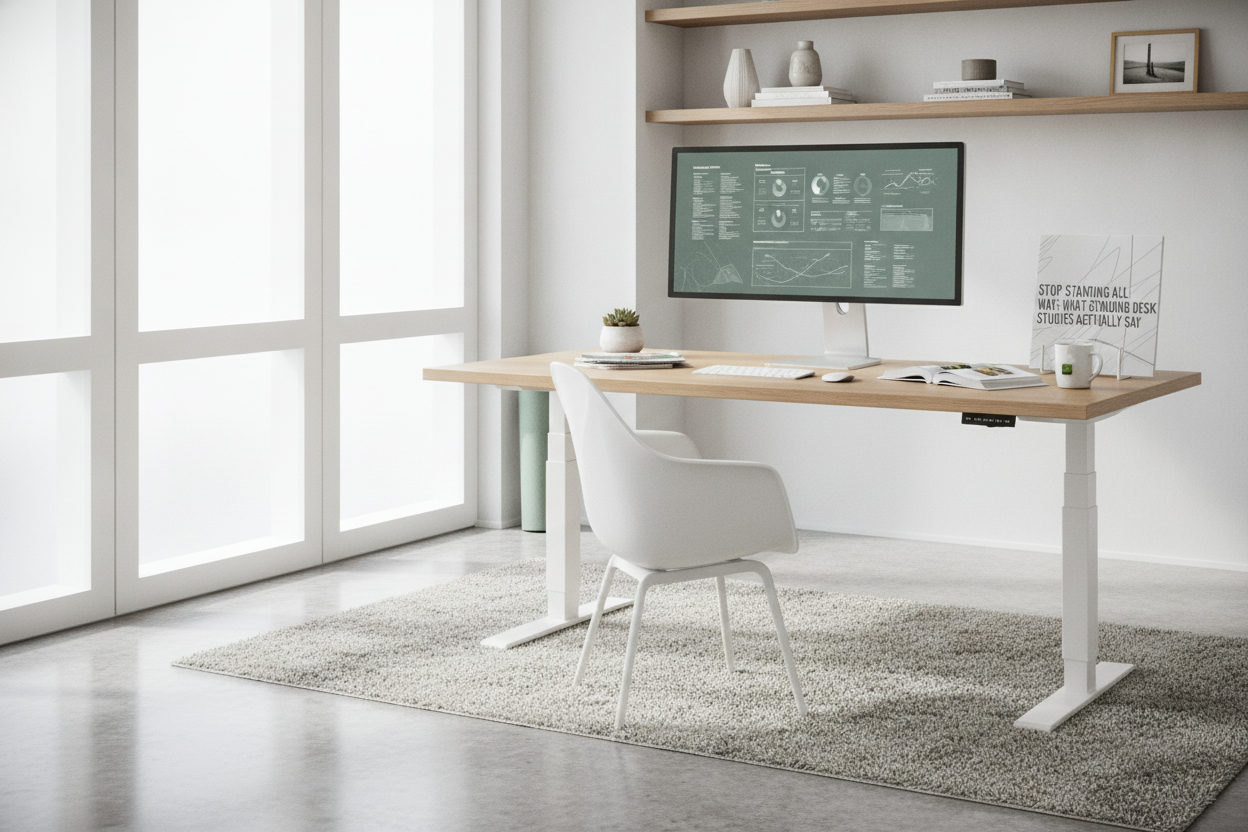
If your office is also your living room, you need a standing desk home office layout that doesn't scream 'I LIVE AT WORK.' Use a rug to define the office zone. Even a small 4x6 rug under the desk and chair creates a psychological boundary. When I'm off the rug, I'm off the clock.
I’ve also seen great stand up desk office ideas using open-backed shelving as a room divider. It blocks the view of the monitors from the sofa without cutting off the light. If you're in a bedroom, please, for the love of sleep, don't face the desk toward your bed. Face it away so you aren't staring at your mounting to-do list while trying to drift off.
The Reality of Cable Management When Your Desk Moves
Here is the truth: a standing desk is a cable's worst nightmare. You can't just zip-tie everything to the leg because the desk needs to move. I learned this the hard way when I raised my desk and watched my expensive speakers get yanked off the edge because the wires were too tight. This is one of the most common standing desk setup mistakes people make.
You need a cable tray that attaches to the underside of the desktop. Everything—your power strip, your bricks, your hub—should live in that tray. Only one single power cord should ever go from the desk to the wall. Buy a 10-foot braided extension cord and give it plenty of slack. If it looks like a 'snake' on the floor, you're doing it right. If it's taut, you're one button-press away from a disaster.
My Biggest Setup Regret
I once bought a 72-inch desk for a room that was only 90 inches wide. I thought 'more space is better,' but I couldn't even walk around the thing. I felt trapped. I eventually swapped it for a 48-inch top and realized that having 12 inches of 'breathing room' on either side made the whole apartment feel twice as big. Don't over-buy on the desktop size if your room is small.
FAQ
Where should I put a standing desk in a small room?
Perpendicular to a window is best. It gives you natural light without the screen glare you get from sitting directly in front of one, and it keeps the desk from dominating the main wall.
How do I hide the wires on a standing desk?
Mount a power strip to the bottom of the desk. Plug everything into that, then use a 'cable spine' or a simple mesh sleeve to guide the one main power cord down to the outlet.
Can I put a standing desk on carpet?
Yes, but it might wobble more than on hardwood. Use a heavy-duty chair mat to create a stable base for both the desk feet and your office chair.

Leave a comment
This site is protected by hCaptcha and the hCaptcha Privacy Policy and Terms of Service apply.