





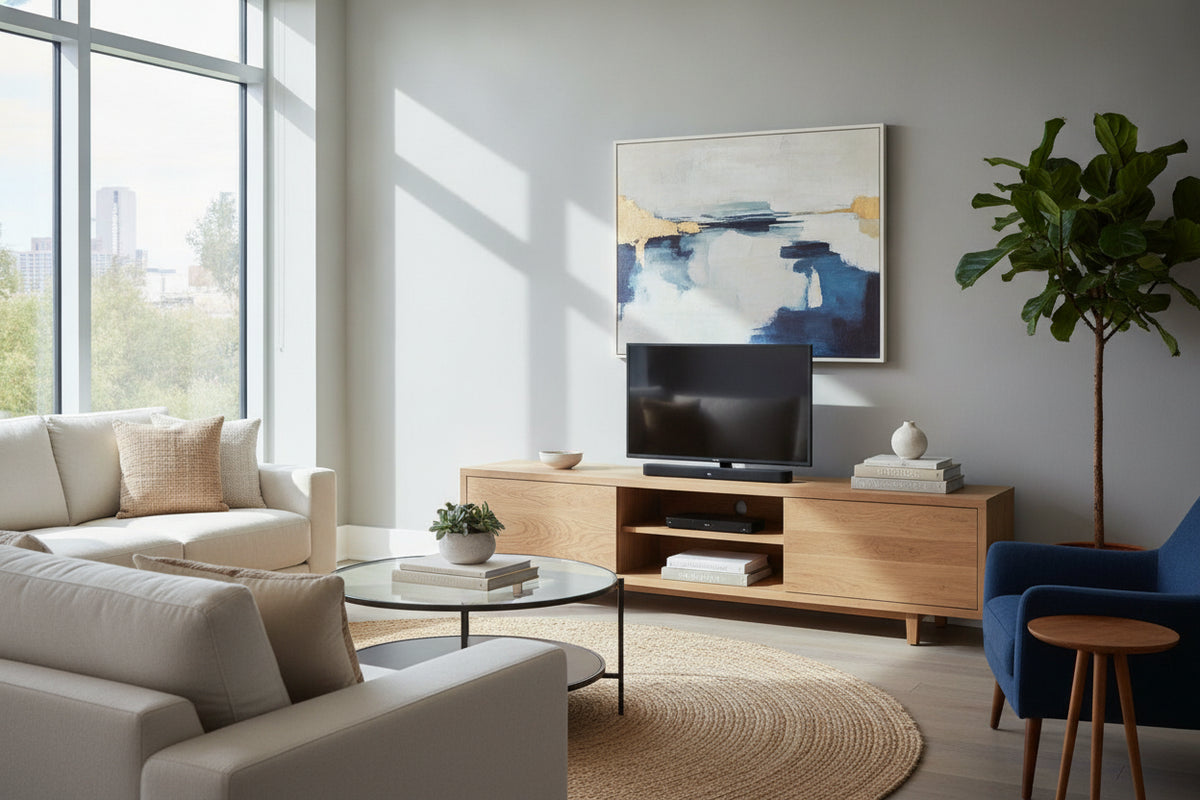
A "24 inch TV stand" can mean a stand 24 inches deep, 24 inches high or 24 inches wide, and each solves a different problem. A deep stand makes room for an ultra-short-throw projector, a big AV receiver or a turntable with its lid open; a 24-inch height puts the middle of a 55- to 75-inch screen near seated eye level; and a 24-inch width only suits a TV of about 27 inches or less.
Decide which number you mean, then check the listing's W x D x H. Below: each meaning with the math, then five stands from the FUFU&GAGA TV stands collection and which "24 inch" need each one meets.
| "24 inch" means | Problem it solves | What to measure first |
|---|---|---|
| 24 in deep | Room for a UST projector, a deep TV base, an AV receiver or a turntable | Device depth plus plugs or lid, and the walkway in front |
| 24 in high | Center of a 55- to 75-inch screen near seated eye level | Your seated eye height and the TV's screen height |
| 24 in wide | A small TV in a kitchen, dorm, guest room or corner | The TV's width and the spacing of its feet |
A stand listed at 60 x 24 x 18 inches (W x D x H) is 60 inches wide, 24 inches deep and 18 inches high: a low, extra-deep console. If a title just says "24 inch", find that line first.
Key takeaways
- Depth: the TVs and receivers checked below fit a 15.7-inch top. What truly needs about 24 inches is an ultra-short-throw projector throwing a very large picture.
- Walkway: a 24-inch stand takes 8.3 inches more floor than a 15.7-inch one.
- Height: a 24-inch-high stand puts the center of a 65-inch screen at about 41.5 inches, close to the 42 inches often quoted for seated viewing.
- Width: a 24-inch-wide stand fits screens up to about 27 inches, with the feet fully on the top.
- Our range: the most common FUFU&GAGA TV stand depth is 15.7 inches; the deepest in this guide is 19.7 inches.
What needs a 24 inch deep TV stand?
Less than you might think. Even the 85-inch TV below needs only 13.6 inches for its feet. What pushes a stand past 20 inches is gear that must sit a set distance from the wall. Depths from the makers' own pages:
| Item | Depth it needs | On a 15.7 in top | On a 19.7 in top |
|---|---|---|---|
| 65-inch Samsung Q60D on its stand | 10.8 in | Fits, 4.9 in spare | Fits |
| 85-inch Samsung Q60D on its stand | 13.6 in | Fits, 2.1 in spare | Fits |
| Denon AVR-X1300W receiver | 13.3 in plus plugs | Fits, 2.4 in for plugs | Fits |
| Denon AVR-X3800H receiver | 14.9 to 15.3 in plus plugs | Only with an open back | Fits |
| Pro-Ject Debut Carbon EVO turntable | 12.6 in; 15.9 in lid open | Open lid is 0.2 in too deep | Fits |
| Epson LS800 UST projector, 100-inch picture | 17.3 in from the wall | No | Fits, 2.4 in spare |
| Same projector, 120-inch picture | 20.2 in | No | No, 0.5 in short |
| Same projector, 150-inch picture | 24.6 in | No | No |
A deep TV base. Samsung's 65-inch Q60D measures 1450.9 x 872.2 x 274.0 mm with its stand, so its feet need about 10.8 inches of depth on a footprint of about 42.4 x 10.8 inches (Samsung). The 85-inch Q60D needs 345.1 mm, about 13.6 inches, on a footprint about 55.9 or 44.1 inches wide, depending on the foot position (Samsung). Check the "with stand" depth on your TV's spec sheet.
An AV receiver. Denon lists its AVR-X1300W at 13.3 inches deep (Denon) and its AVR-X3800H at 14.9 to 15.3 inches depending on the antenna setup (Denon). Plugs stick out behind that, so a receiver needs extra depth or an open back.
A turntable. Pro-Ject's user guide gives the Debut Carbon EVO as 415 x 118 x 320 mm, and 415 x 365 x 405 mm with the dust cover open (Pro-Ject). The lid swings back, so the top must be about 15.9 inches deep, not 12.6, and the guide asks for a level, low-resonance surface such as wood.
An ultra-short-throw (UST) projector. This is the real case for a 24 inch deep TV stand: the projector sits on the furniture just in front of the wall it projects onto. Epson lists its EpiqVision Ultra LS800 at 27.4 x 6.2 x 13.4 inches (W x H x D) and says it sits 17.3 inches from the wall for a 100-inch picture (Epson). ProjectorCentral's review measured the front at 20.2 inches out for a 120-inch image and 24.6 inches for 150 inches (ProjectorCentral).
No deep receiver, turntable or UST projector? A standard 15- to 16-inch stand, or a shallower one, will do.
How much walkway does a deep TV stand cost?
Every inch of depth comes out of the path in front. A useful benchmark is the 36-inch minimum clear width for an accessible route in the ADA Standards, which may narrow to 32 inches only for stretches of up to 24 inches, such as doorways (U.S. Access Board). Homes don't have to meet it, but it is a useful yardstick.
| Wall to coffee table or sofa | 13.8 in stand | 15.7 in stand | 19.7 in stand | 24 in stand |
|---|---|---|---|---|
| 54 in | 40.2 in path | 38.3 in path | 34.3 in path | 30 in path |
| 60 in | 46.2 in path | 44.3 in path | 40.3 in path | 36 in path |
| 66 in | 52.2 in path | 50.3 in path | 46.3 in path | 42 in path |
The path is the distance minus the stand depth. A 24-inch stand needs 60 inches from the wall to the nearest obstacle to keep 36 inches clear; a 15.7-inch stand needs 51.7. If you only need room for a soundbar and a streaming box, our 12 inch deep TV stand guide shows how much floor a shallow stand gives back.
How deep are most TV stands?
There is no single standard, so measure each listing. The most common depth among FUFU&GAGA TV stands is 15.7 inches, and the stands in this guide run from 13.8 to 19.7 inches; none is close to 24. A UST projector at 120 inches or more needs a deeper piece made for it; a 15.7- to 19.7-inch top covers the other gear above.
Is a 24 inch high TV stand the right height?
For many living rooms, yes. CE Pro's rule of thumb is about 42 inches from the floor to the center of the screen for seated viewing, for screens up to 85 inches, with no more than 15 degrees of vertical viewing angle (CE Pro). Add three numbers: stand height, the gap under the picture, and half the screen height. A 16:9 screen is about 0.49 times its diagonal tall, and the gap on the 65-inch Q60D is about 1.6 inches (872.2 minus 831.4 mm, with and without its stand).
| TV size | Half screen height | Center on a 24 in stand | Compared with 42 in | Angle at 8 ft |
|---|---|---|---|---|
| 43 in | 10.5 in | 36.1 in | 5.9 in low | 3.5 degrees |
| 50 in | 12.3 in | 37.9 in | 4.1 in low | 2.5 degrees |
| 55 in | 13.5 in | 39.1 in | 2.9 in low | 1.7 degrees |
| 65 in | 15.9 in | 41.5 in | 0.5 in low | 0.3 degrees |
| 75 in | 18.4 in | 44.0 in | 2.0 in high | 1.2 degrees |
Every row is well inside CE Pro's 15 degrees, and a 24 inch tall TV stand comes closest to 42 inches for 55- to 75-inch TVs; smaller screens suit a taller stand. Eye height varies, so measure yours from where you sit; in bed it is higher. Our TV stand size chart works out stand height for every TV size.
No floor stand in this guide is 24 inches high. The closest are 17.3 inches (a 65-inch picture centered at about 34.8 inches, 4.3 degrees low at 8 feet) and 31.4 inches (about 48.9 inches, 4.1 degrees high), both inside the limit. A wall-mounted stand lets you choose: a 9.8-inch-high floating stand with its top at 24 inches has its bottom 14.2 inches off the floor.
24 inch wide TV stand: what size TV fits?
A 16:9 screen is about 0.872 times its diagonal wide. A 24-inch TV is about 20.9 inches wide and 11.8 inches tall (24 x 0.872 and 24 x 0.49), and a 27-inch TV about 23.5 inches wide, so both fit a 24-inch top. A 32-inch set doesn't: Samsung's 32-inch N5300 is 28.9 inches wide and 6.4 inches deep on its stand and weighs 9.5 lb (Samsung spec sheet), 4.9 inches wider than the stand.
The rule that matters most: the stand must be wider than the TV's feet, with both feet fully on the top. For visual balance, choose a stand at least as wide as the screen. CPSC's Anchor It campaign says televisions should only be placed on furniture designed to hold a television, and that TVs not mounted on the wall should still be anchored (CPSC Anchor It).
None of the FUFU&GAGA TV stands in this guide comes close to 24 inches wide. For a small TV in a corner, a wall mount is often neater; see our guide to mounting a TV in the corner.
Safety: anchor deep, tall and small stands
CPSC reports an average of 17,800 tip-over injuries a year treated in emergency departments from 2020 to 2022, and 217 tip-over deaths from 2013 to mid-2023; 71% of those killed were children (CPSC). It advises anchoring the TV to the wall or, if that isn't possible, setting it on a sturdy, low base pushed as far back as you can, which a deeper top makes easier, and storing heavier items on lower shelves.
- Anchor the stand, even a low one, and buy an anti-tip kit if the listing says none is included. Our anchoring guide shows the steps.
- Strap the TV to the wall or the stand, or mount it on the wall.
- Keep the receiver and other heavy gear on the lowest shelf.
24 inch TV stand buying checklist
- Decide which dimension you need: depth, height or width.
- Depth: each device's depth plus plugs or an open lid, compared with the top.
- Walkway: wall to the nearest obstacle, minus stand depth, ideally 36 inches or more.
- Height: stand height plus the gap plus half the screen height, compared with your eye height.
- Width: both TV feet fully on the top; the stand at least as wide as the screen.
- Weight: TV, soundbar, receiver and decor under the stand's weight capacity.
- Safety: a tipover restraint in the box, or an anti-tip kit.
Our picks: the deepest stands, a low stand and a compact one
Dimensions and features come from each listing; depth is overall depth.
90.6" Modern Farmhouse TV Stand with Glass Doors (19.7" deep)
The deepest stand in this guide, at 90.6" W x 19.7" D x 31.4" H, listed for TVs up to 88 inches. It is 4.3 inches short of 24, but its top takes an Epson LS800 for a 100-inch picture with 2.4 inches to spare (19.7 - 17.3), a turntable with its lid open, or a 15.3-inch receiver with 4.4 inches behind it. Storage is three cabinets, including a glass-door center cabinet, four drawers on metal slides and two adjustable shelves that move in 1.25-inch steps, with cable openings in the center sections. A tipover restraint is included.
"24 inch" needs: the closest to 24 inches deep; taller than 24 inches high.
Best for: a UST projector up to a 100-inch picture, or a receiver and turntable on one long top, in a farmhouse-style room.
Skip it if: your projector needs a 120-inch picture (20.2 inches from the wall), or you want a 24-inch-high top. The weight capacity in its specs looks low for a stand listed for TVs up to 88 inches and has been flagged for confirmation, so ask customer service to confirm it for your TV and gear before you buy.

102.4" TV Hutch Large Entertainment Center with Storage Cabinets (17.4" deep)
A four-piece wall unit: a 57-inch console for TVs up to 55 inches, two tall piers and an overhead bridge. Its specs give 82.3" H x 104.3" W x 17.4" D overall (the title says 102.4 inches, so plan for the larger figure). The specs give only overall sizes; if the console uses the full 17.4 inches, it holds a 15.3-inch receiver with 2.1 inches spare. Storage is 5 drawers on metal slides, 5 cabinets with magnetic catches and 6 interior shelves, with cable management, an 800 lb total weight capacity and tipover restraint hardware.
"24 inch" needs: second-deepest here, 6.6 inches short of 24.
Best for: a 50- or 55-inch TV framed by shelves, with a receiver and media below.
Skip it if: your TV is over 55 inches, or you need the console's own capacity or the height under the bridge: the specs give neither (the 800 lb is for the whole unit). The bridge also rules out a UST projector, which needs the wall above clear.
89.4" Wood TV Stand with Three-Color LED Strip (17.3" high)
A long console at 89.4" W x 15.7" D x 17.3" H in brown or black, listed for TVs up to 88 inches with a 100 lb total weight capacity. It is the tallest low console in this guide. Two drawers on metal slides with safety stops sit beside open shelves, and a plug-in LED strip has white, natural and yellow light. The listing includes an anti-tipping device and all assembly tools.
"24 inch" needs: 6.7 inches lower than 24 inches high; its 15.7-inch depth fits a 13.3-inch receiver with 2.4 inches for plugs.
Best for: a large TV on wide feet, with a soundbar and decor beside it.
Skip it if: your TV and gear add up to more than 100 lb, or your turntable's open lid needs more than 15.7 inches.

71" Minimalist High Gloss TV Stand with LED Ambiance (11.8" high)
The low pick: 70.9" W x 15.7" D x 11.8" H, listed for TVs up to 70 inches with a 150 lb weight capacity. Four large drawers on metal slides with safety stops hold game consoles and controllers, and a plug-in LED strip lights the base in three colors. One person can assemble it.
"24 inch" needs: not 24 inches high. A 65-inch TV on its feet would center at about 29.3 inches, 12.7 inches below 42 (7.5 degrees at 8 feet).
Best for: a wall-mounted TV over a long, low console, or a room with low seating.
Skip it if: you want a TV on its feet at sofa eye level, or your TV is over 70 inches. The listing says no tipover restraint is included, so buy an anti-tip kit.
63" Floating TV Stand with LED Lights and 3 Drawers (compact)
The compact pick at 63" W x 13.8" D x 9.8" H, in white or black, listed for TVs up to 70 inches with a 55 lb weight capacity. It mounts on the wall, so you choose its height: with its top at 24 inches, its bottom sits 14.2 inches up and the floor stays clear. Three drawers have safety stops, LED strips switch between warm and cool light by remote, and the listing says a tipover restraint and screws are included.
"24 inch" needs: the only pick you can set at 24 inches high; not deep.
Best for: a smaller living room or bedroom that wants a 24-inch-high top and more floor.
Skip it if: your TV and devices together would exceed 55 lb: a 65-inch Q60D at about 47 lb leaves only 8 lb, so mount a large TV on the wall above it. A receiver deeper than 13.8 inches won't fit.

Compare the picks
| Stand | W x D x H | Max TV | Tipover restraint | "24 inch" need it meets |
|---|---|---|---|---|
| 90.6" farmhouse | 90.6 x 19.7 x 31.4 in | 88 in | Included | Deepest: UST at 100 in, turntable, receiver |
| 102.4" TV hutch | 104.3 x 17.4 x 82.3 in | 55 in | Included | Second-deepest, wall unit |
| 89.4" LED console | 89.4 x 15.7 x 17.3 in | 88 in | Anti-tipping device listed | Tallest low console |
| 71" high gloss | 70.9 x 15.7 x 11.8 in | 70 in | Not included | Low, under a wall-mounted TV |
| 63" floating | 63 x 13.8 x 9.8 in | 70 in | Included | Mount it at 24 in high |
If you'd rather have closed storage around the TV, our post on whether entertainment centers are out of style looks at modern wall units and consoles. To compare every width, depth and height, browse the full TV stands collection.
FAQ
Is a 24 inch deep TV stand too deep?
For a TV alone, usually. The 65- and 85-inch Samsung Q60D need 10.8 and 13.6 inches. A 24-inch depth makes sense for an ultra-short-throw projector throwing a picture of about 150 inches. It costs 8.3 inches of walkway compared with a 15.7-inch stand.
What size TV fits a 24 inch wide stand?
A screen up to about 27 inches: a 27-inch 16:9 TV is about 23.5 inches wide. A 32-inch TV is about 28 to 29 inches wide, so it overhangs. Both feet must sit fully on the top, and the TV should be anchored or strapped.
How deep should a TV stand be for an AV receiver?
At least the receiver's depth plus room for its plugs. Denon lists its AVR-X1300W at 13.3 inches and its AVR-X3800H at 14.9 to 15.3 inches, so a 15.7-inch top suits the first; the second needs an open back or a deeper stand. Leave the open air around it that its manual asks for.

Leave a comment
This site is protected by hCaptcha and the hCaptcha Privacy Policy and Terms of Service apply.