










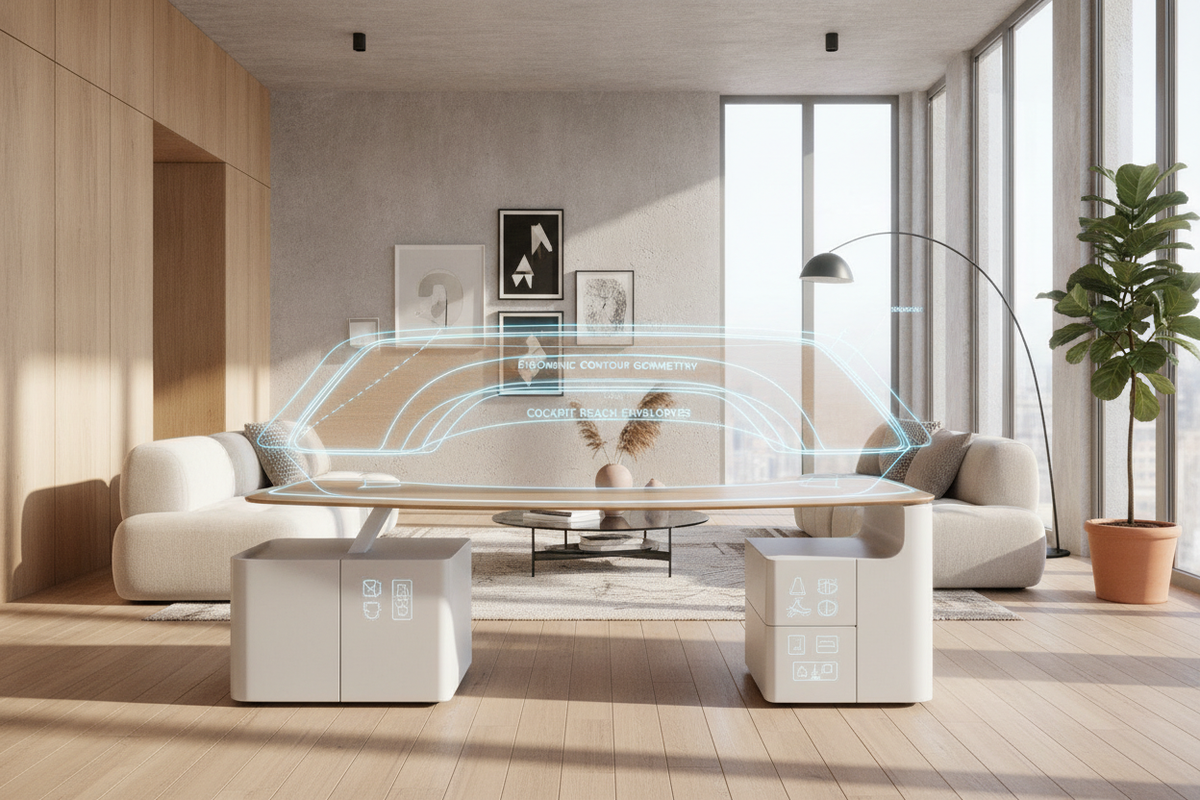
Standard linear desktops have long defined modern home workspaces, yet linear perimeters often force awkward torso twists and strained reaching patterns. An architectural approach to the curved standing desk reimagines the workstation as an intuitive cockpit. By matching natural human arm sweeps with contoured surfaces and height-adjustable frames, a standing desk curved layout improves physical comfort while establishing a refined focal point in contemporary interiors.
The Architectural Anatomy of a Curved Standing Desk
The distinction between a conventional rectangular desk and an ergonomic curved desk centers on spatial geometry. Rather than presenting an unyielding straight edge, a contoured desk incorporates concave front insets and balanced side arcs that envelope the user. This geometry shortens the distance between the body and frequently used tools, minimizing unnecessary leaning.
Contoured work surfaces generally follow three distinct archetypes:
- Subtle Front-Edge Scallops: Gentle concave curves along the front boundary that allow the user to step into the desk perimeter without sacrificing significant surface square footage.
- Deep Wraparound Cockpits: Pronounced radial curves that extend forward along both flanks, providing dedicated zones for secondary peripherals, note-taking, and active tasking.
- Asymmetric Corner Arcs: Fluid, directional curves designed specifically for corner transitions or L-shaped configurations, optimizing room flow while retaining expansive primary surface depth.
Ergonomic Reach Zones and Posture Geometry
Biomechanical efficiency relies on respecting the body's natural reach envelope. When working at an ergonomic desk product with a curved front edge, the central inset positions the torso closer to the keyboard and pointing devices. This placement allows the upper arms to hang naturally from the shoulders, supporting relaxed spinal alignment whether sitting or standing.
Surface edge detailing is equally critical for sustained daily comfort. Hard, square desktop edges can create pressure points along the forearms and wrists during prolonged typing sessions. Contoured desktops frequently utilize beveled undercut profiles or smoothly rounded waterfall edges. These smooth transitions distribute contact pressure across a broader surface area, fostering fluid arm transitions across the desktop.
Furthermore, a curved front contour naturally aligns with wide-angle sightlines. Users pairing their workstations with ultrawide displays or dual-monitor configurations find that the curved perimeter mirrors the optical arc of their screens, keeping displays equidistant from the eyes across the entire field of view.
Dimensional Planning and Room Fit Categories
Integrating a curved sit-stand workstation requires evaluating available floor area, clearance zones, and workflow needs. Contoured desks generally align across three distinct room-fit categories:
- Compact Contoured Footprints: Ideal for micro-offices, urban apartments, and shared living spaces. These streamlined builds provide essential ergonomic curvature while maintaining a modest profile that avoids encroaching on traffic corridors.
- Mid-Size Balanced Proportions: Versatile formats, such as a well-proportioned standing desk product, strike a balance between generous dual-screen capacity and efficient spatial footprints for dedicated home offices.
- Expansive Executive Spans: Wide-format solutions, exemplified by a substantial standing desk product, offer deep peripheral wings tailored for multi-monitor arrays, analog drafting, and extensive administrative workflows.
When planning dimensional placement, always account for dynamic height transitions. Sit-stand desks require unobstructed vertical clearance along surrounding walls, window frames, and adjacent case goods to ensure smooth, collision-free movement throughout the workday.
Material Selection, Edge Craft, and Kinetic Frame Dynamics
The structural integrity of a curved desktop depends on quality core materials and protective surface finishing. Engineered composite substrates provide dense, uniform foundations that resist seasonal warping under fluctuating indoor humidity. High-durability thermal laminate veneers and thermofoil wraps offer seamless coverage across complex organic edges, shielding against moisture and surface wear.
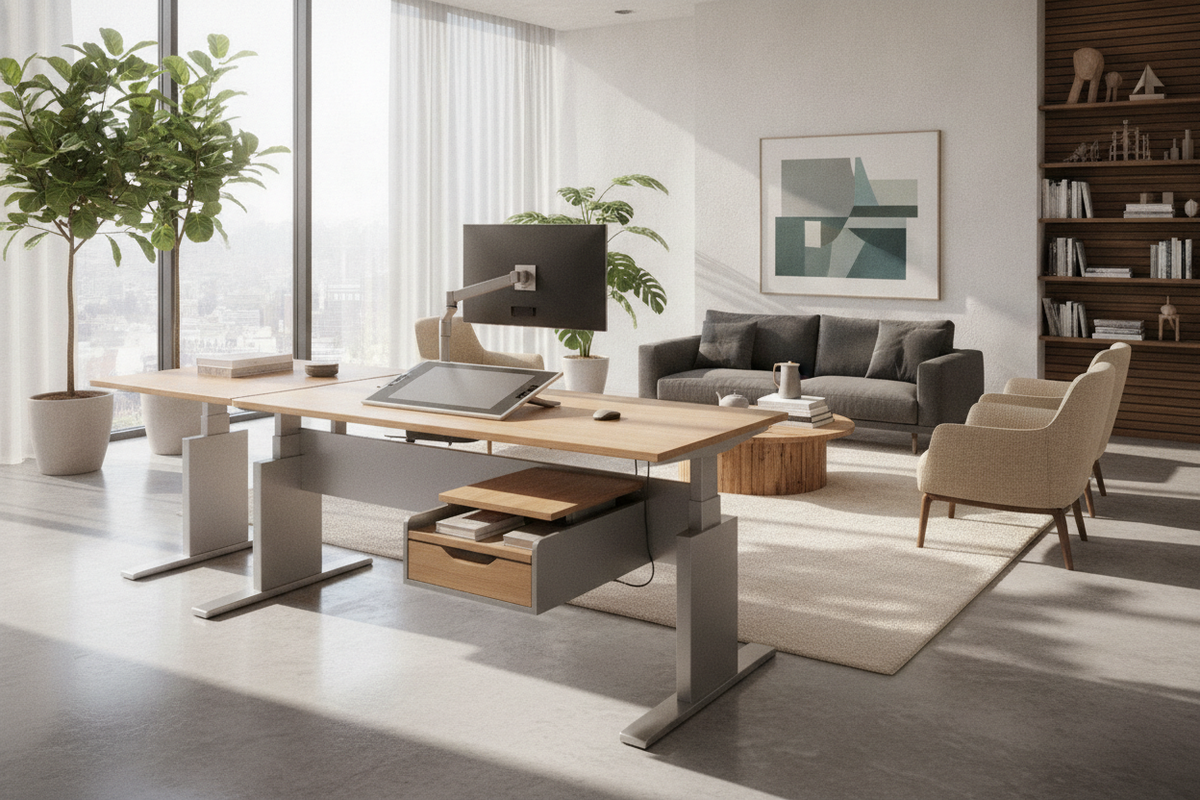
Underneath the surface, the lifting columns and motorized underframe must account for shifted centers of gravity. Because a curved desk cutout shifts the user's working mass inward, heavy-gauge steel leg columns with reinforced dual-motor systems and wide stabilizing feet are recommended to prevent frame deflection and surface wobble at extended standing elevations.
Storage Synergy: Harmonizing Contoured Desks with Office Furniture
A freestanding contoured desk performs best when paired with thoughtful modular storage that maintains an uncluttered surface. Exploring strategic ways for standing desk guide styling helps integrate motorized furniture seamlessly into broader room schemes.
Consider these harmonious storage pairings:
- Low-Profile Mobile Pedestals: Compact filing cabinets on casters tuck neatly beneath the desk wings when seated and glide clear during standing routines without obstructing frame legs.
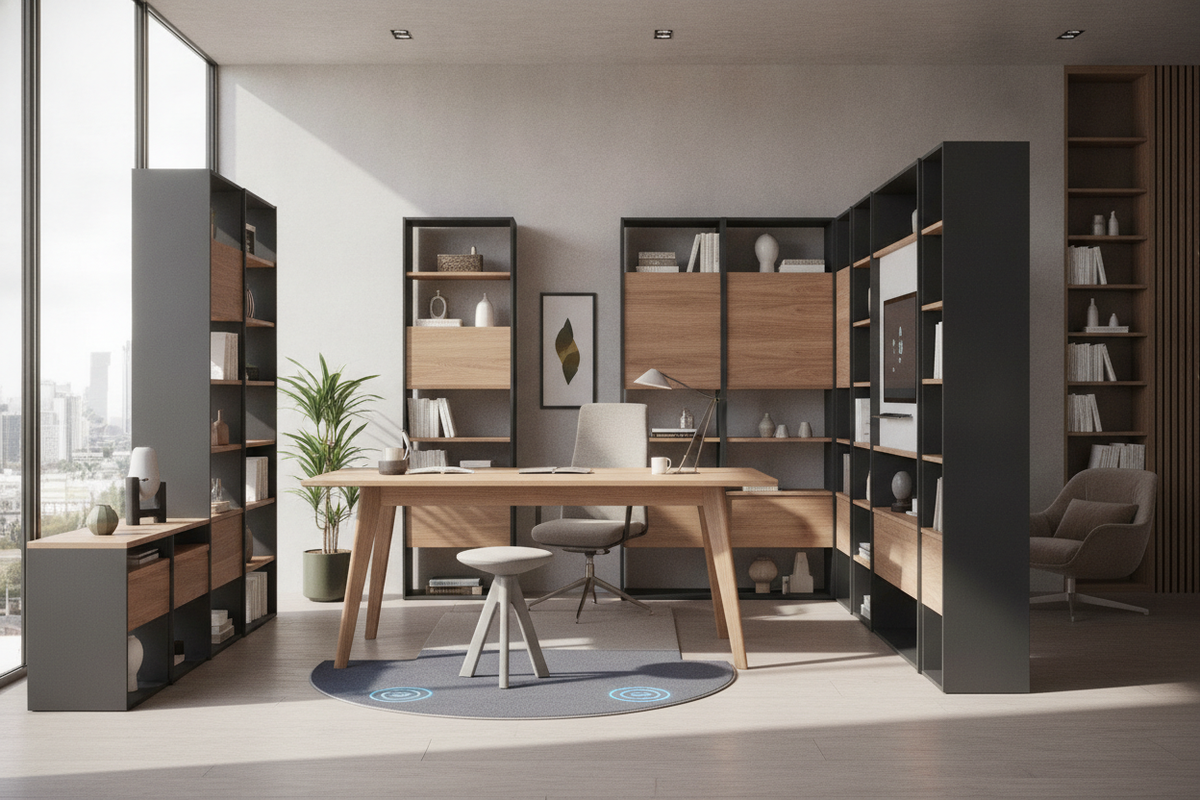
- Stationary Credenzas and Lateral Cabinets: Positioned along perimeter walls behind the main desk, matching credenzas provide ample storage for reference binders, tech hardware, and office essentials.
- Vertical Bookcases and Display Towers: Tall open shelving units placed perpendicular to the desk establish balanced spatial zones, framing the curved workstation as the room's central command hub.
Cable Routing and Peripherals on Curved Perimeters
Managing cords and accessories on a contoured profile requires flexible hardware solutions. Articulating under-desk cable spines expand and contract cleanly with the vertical motion of the desk, guiding wiring from floor outlets to the underside of the desktop without snags.
For peripheral mounting, inspect the rear perimeter profile. While the front features an ergonomic concave arc, the rear edge should offer sufficient flat surface depth for secure monitor arm clamps and power strip mounting brackets. Integrated desktop grommets positioned near the rear corners keep cords routed directly beneath the desktop, preserving a clean aesthetic.
Decision Matrix: Selecting Your Ideal Curved Standing Desk
To choose the right curved standing desk configuration for your space, evaluate your setup against key spatial and workflow criteria:
- Define Primary Work Tasks: Determine whether your daily routine centers on compact laptop operation, multi-screen coding, or expansive analog sketching requiring extended lateral reach.
- Assess Room Circulation: Ensure the organic sweep of the desk allows at least three feet of walkway clearance, drawing inspiration from comprehensive standing desk guide recommendations for open-concept layouts.
- Coordinate Finishes and Accents: Pair wood grains, neutral matte tones, and frame powder-coats with complementary storage cabinets, ergonomic task seating, and ambient lighting to create a unified interior aesthetic.

Dejar un comentario
Este sitio está protegido por hCaptcha y se aplican la Política de privacidad de hCaptcha y los Términos del servicio.