











Purchasing an office workstation online brings the distinct convenience of doorstep transit, yet navigating flat-pack logistics requires thoughtful planning. When evaluating options that include desk free shipping, considering the journey from parcel dispatch to final assembly helps ensure a seamless transition into your workspace. Furniture delivery involves unique carton geometry, protective packaging layers, and spatial coordination within your entryway and hallways.
Demystifying Free Shipping for Desks: Flat-Pack Logistics and Transit Profiles
Modern desk delivery generally relies on flat-pack engineering, wherein full-sized surfaces, structural frames, and leg assemblies are broken down into dense, rectangular cartons. Standard parcel carriers handle the majority of compact to mid-sized workstations, delivering directly to porches, apartment corridors, or front entryways. For larger executive desks or expansive corner units, multi-box configurations or freight delivery arrangements are frequently utilized to ensure manageable parcel weights.
Understanding packaging density is critical when planning for delivery day. Dense flat packs protect interior panels with high-density edge guards, internal foam spacers, and multi-wall corrugated cardboard. Before finalizing your order, consulting a comprehensive shipping resource provides clarity on expected dispatch windows, package handling policies, and carrier tracking protocols to prevent unexpected delivery hurdles.
Spatial Geometry and Dimensional Tiers for Online Desk Selection
Selecting the right desk scale online requires balancing tabletop area against room circulation pathways. Evaluating workstations by dimensional tiers allows you to align personal workflow needs with available floor space.
Compact Workstations (Under 40 Inches) for Urban Alcoves and Multi-Use Nooks
Compact workstations excel in multi-purpose living areas, bedroom nooks, and urban apartments where floor area is at a premium. These streamlined units typically arrive in a single, manageable carton that easily navigates tight stairwells and compact elevators. They provide dedicated space for laptops, basic writing materials, and a single peripheral screen while preserving open walkway clearances.
Mid-Scale Workstations (40 to 55 Inches) for Dedicated Home Offices
Mid-scale desks represent the standard footprint for balanced productivity. These surfaces readily accommodate dual monitors, desk pads, task lighting, and peripheral accessories without feeling cramped. In standard home offices, this size profile leaves ample perimeter room for desk chairs to swivel freely and allows standard file pedestals to nest neatly alongside the desk legs.
Expansive Executive and L-Shaped Configurations (55+ Inches)
Expansive corner units, executive desks, and L-shaped workstations cater to multi-device workflows and administrative tasks. Because of their extended surface area and multi-leg geometry, these models often ship in separate parcels that arrive together or sequentially. Planning room placement in advance ensures that power outlets, window illumination, and entry doors remain unobstructed once the framework is assembled.
Material Engineering, Package Density, and Transit Resilience
Flat-pack desks combine diverse structural materials engineered to withstand transit stresses while offering long-term stability. Durable engineered wood panels finished with high-pressure melamine or thermal-fused laminates resist surface wear, moisture rings, and everyday scratches. These composite panels provide uniform density, reducing the risk of structural warping during seasonal humidity shifts.
Structural support is commonly reinforced by powder-coated tubular steel frames, integrated crossbars, and reinforced cam-lock joinery. During transit, steel elements are often bundled separately within the master carton to prevent metal-on-wood friction. Paying attention to these material details ensures that your flat-pack desk maintains rigid structural alignment throughout years of daily use.
Unboxing, Room Preparation, and Systematic Assembly Workflows
Assembling a flat-pack desk is straightforward when approached with organized preparation. Designating a clean staging zone before opening the carton protects both your new furniture panels and existing flooring.
- Clear the Perimeter: Create an open staging area in the destination room to minimize the need to move the fully assembled desk across thresholds.
- Protect the Floor: Lay down the opened shipping carton or a soft blanket to cushion the desktop surface during initial upside-down assembly.
- Sort Hardware Components: Group cam locks, dowels, machine screws, and leveling feet into shallow trays or designated zones before starting.
- Hand-Tighten First: Thread structural screws loosely until all frame components are aligned, then tighten fasteners evenly across the entire frame.
- Lift with Care: Enlist a second person to flip the assembled desk upright, lifting directly by the main structural frame rather than pulling upward on the desktop overhang.
Workspace Storage Architecture: Pairing Desks with Modular Organizers and Cabinetry
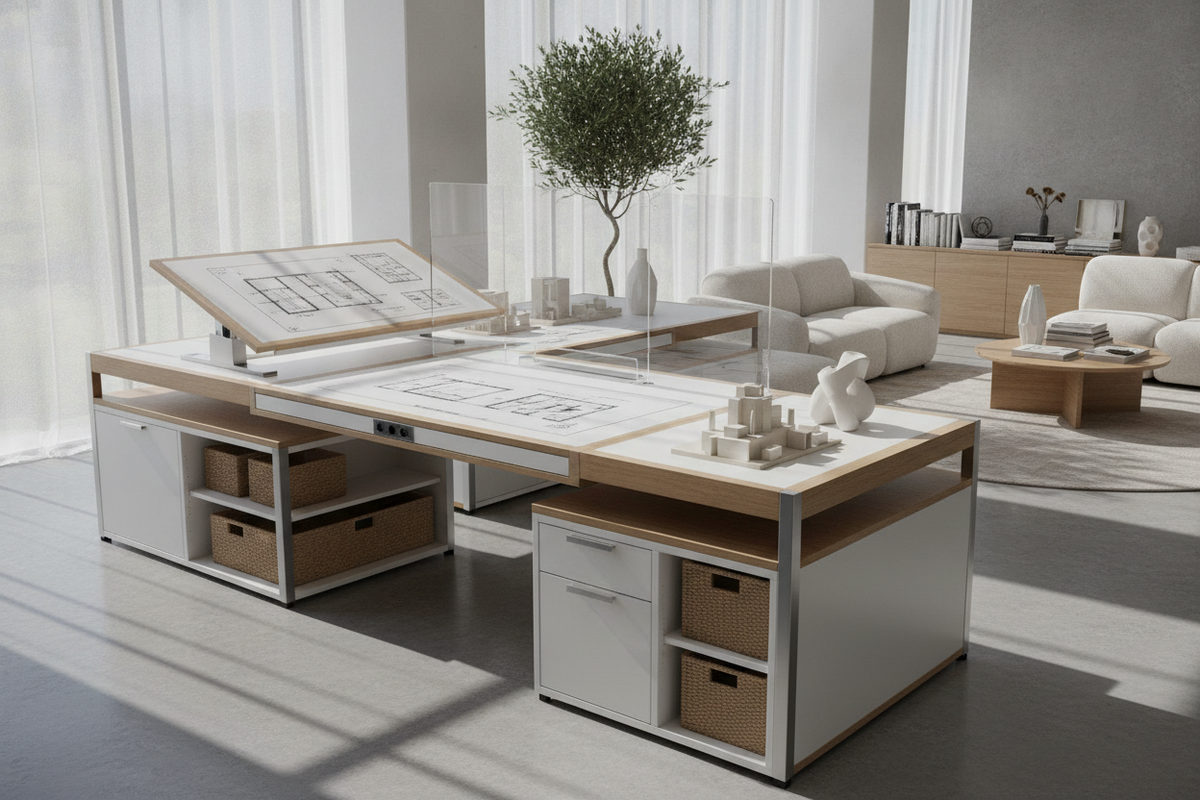
A minimalist desk surface provides a clean foundation, but sustained productivity depends on auxiliary storage systems. Integrating matching mobile drawer units, floating shelves, or under-desk caddies prevents paper piles and cord clutter from encroaching on primary work zones.
Using desktop trays, cable routing channels, and vertical sorters keeps everyday tools within arm's reach while maintaining visual calm. To explore practical methods for arranging accessories and enhancing surface aesthetics, reviewing our desk free guide offers actionable styling insights tailored to contemporary work environments.
Enclosed Storage Alternatives: Integrating Armoires and Document Systems
When an open-concept desk does not provide sufficient containment for extensive paperwork, physical archives, or reference libraries, pairing your workspace with dedicated cabinetry creates a balanced room layout. Dedicated storage furniture allows you to conceal administrative supplies at the end of the workday, establishing clear boundaries between personal relaxation and professional focus.
For structured record-keeping, adopting dedicated file sorting systems prevents desktop accumulation. Consulting our practical free desk guide helps establish efficient document routines that maintain clear, organized desktop surfaces over the long term.
Decision Matrix: Evaluating Desk Value Beyond the Shipping Label
While complimentary transit offers convenient economic value, a well-chosen desk should satisfy comprehensive spatial, ergonomic, and aesthetic criteria. Assessing the complete package ensures lasting satisfaction with your workspace investment.
- Carton Dimensions versus Entryway Clearances: Verify that shipping boxes can navigate tight turns, doorways, and stairways.
- Ergonomic Clearance: Ensure adequate knee-well depth, leg clearance, and compatibility with adjustable office chairs.
- Integrated Cable Routing: Look for grommet holes, underside trays, or modesty panels designed to conceal power adapters and wiring.
- Visual Cohesion: Match wood tones and metal hardware finishes with existing room storage and accent cabinetry for a unified interior aesthetic.


Dejar un comentario
Este sitio está protegido por hCaptcha y se aplican la Política de privacidad de hCaptcha y los Términos del servicio.