










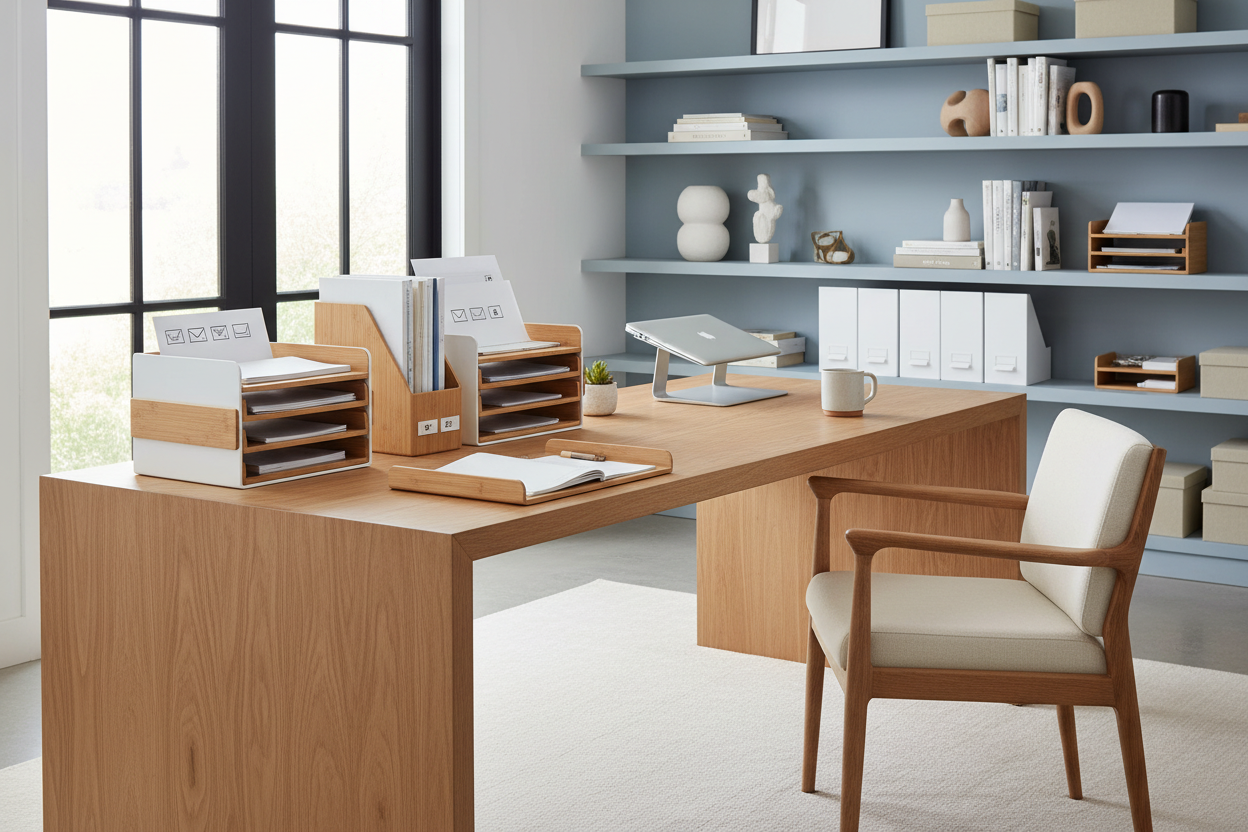
We have all been there. You spend weeks curating the perfect home office, selecting a beautiful mid-century walnut desk and an ergonomic chair. It looks like a magazine spread on Monday morning. But by Friday afternoon, your beautiful workspace is buried under a mountain of utility bills, client invoices, and kids' permission slips.
The missing link in most home offices isn't more square footage; it is a dedicated office paperwork organizer. Without a physical boundary for incoming documents, papers naturally spread to fill whatever flat surface is available. After 15 years of designing residential workspaces across North America, I can tell you that managing visual clutter is just as important as choosing the right desk lamp. Let's break down how to choose a piece that actually works for your workflow without ruining your room's aesthetic.
Quick Decision Guide
- Measure your desk depth: If your desk is shallower than 24 inches, opt for vertical or wall-mounted storage to preserve your workspace.
- Match the material to your habits: Opaque materials hide messy stacks, while clear acrylic or wire mesh requires strict organization to look tidy.
- Keep it in arm's reach: Having a paper organizer nearby is crucial; if you have to stand up to file a document, you will likely just leave it on the desk.
- Categorize by urgency: Look for a system with at least three tiers: 'Action Needed,' 'To File,' and 'Archived.'
Space Planning: Finding the Right Layout
Desktop vs. Wall-Mounted Solutions
The biggest mistake I see clients make is buying bulky office paper organizers that eat up their primary work zone. If you have a standard 60-by-30-inch executive desk, a horizontal tray system works beautifully. However, in small apartments or suburban bedrooms converted into offices, desk real estate is precious.
For compact spaces, vertical paper organizers for office environments are far superior. Utilizing the wall space directly above your monitor with a hanging office paper shelf keeps active documents visible but off your working surface. Proper office paper storage should feel like a natural extension of your desk, requiring no awkward reaching or twisting.
Material Matters: Coordination and Visual Weight
Choosing the Right Finish
Your paper office organizer shouldn't look like an afterthought you grabbed from a big-box corporate supply store. It needs to speak the same design language as your room. If your home office features warm woods and leather accents, a solid wood or vegan leather organizer adds a layer of texture and sophistication.
For modern, minimalist spaces, powder-coated steel or matte acrylic works well. Just be mindful of transparency. Clear acrylic office supplies paper organizer sets look incredibly chic when perfectly styled, but they put your clutter on display. If you are someone who tends to shove receipts into piles, opt for solid, opaque materials that conceal the mess.
Functionality: Building a System That Lasts
Buying the product is only half the battle; the other half is establishing a workflow. Traditional paper racks for office use often become graveyards for forgotten documents. To prevent this, assign a strict rule to each tier or slot.
Effective office storage paper management relies on limitation. When a tray gets full, that is your physical cue to shred, file, or digitize. Do not buy a towering, ten-tier organizer unless you are running a high-volume mailing room. For most residential needs, three to four compartments provide the ideal balance of categorization and simplicity.
Designer's Honest Take: Lessons from My Own Desk
Early in my career, I fell in love with a stunning, vintage brass wire office paper rack. It had a gorgeous patina and looked incredibly architectural sitting on my desk. I bought it immediately, convinced it would solve my messy habits.
I learned the hard way that open wire trays are completely unforgiving. Because the sides were open, smaller receipts and envelopes constantly slipped through the gaps or flopped over, making the stack look even messier than if it were just sitting flat on the desk. Furthermore, seeing the messy edges of the papers through the wire completely ruined the clean visual lines of my workspace. I eventually swapped it for a solid, matte black wood organizer. It isn't as 'architectural,' but it hides the messy edges of my documents, and my stress levels drop the moment I sit down. Sometimes, the best paper storage for office spaces is the one that hides your flaws.
Frequently Asked Questions
How do I clean and maintain my organizer?
Dust is the enemy of any desk setup. For wood or metal organizers, a weekly wipe with a microfiber cloth is sufficient. If you use an acrylic organizer, avoid ammonia-based glass cleaners, which can cause the plastic to cloud over time. Use a damp cloth with mild soap instead.
What size organizer do I need for standard mail?
Ensure the internal dimensions of your trays are at least 10 by 13 inches. This allows standard letter-sized paper, manila folders, and oversized mailers to lay completely flat without curling at the edges.
Is a paper organizer office setup necessary if I am mostly digital?
Yes. Even in highly digitized homes, physical mail, tax documents, and handwritten notes still accumulate. A small, single-tier organizer acts as a physical inbox, preventing those few essential papers from getting lost under your keyboard or coffee mug.

Dejar un comentario
Este sitio está protegido por hCaptcha y se aplican la Política de privacidad de hCaptcha y los Términos del servicio.