


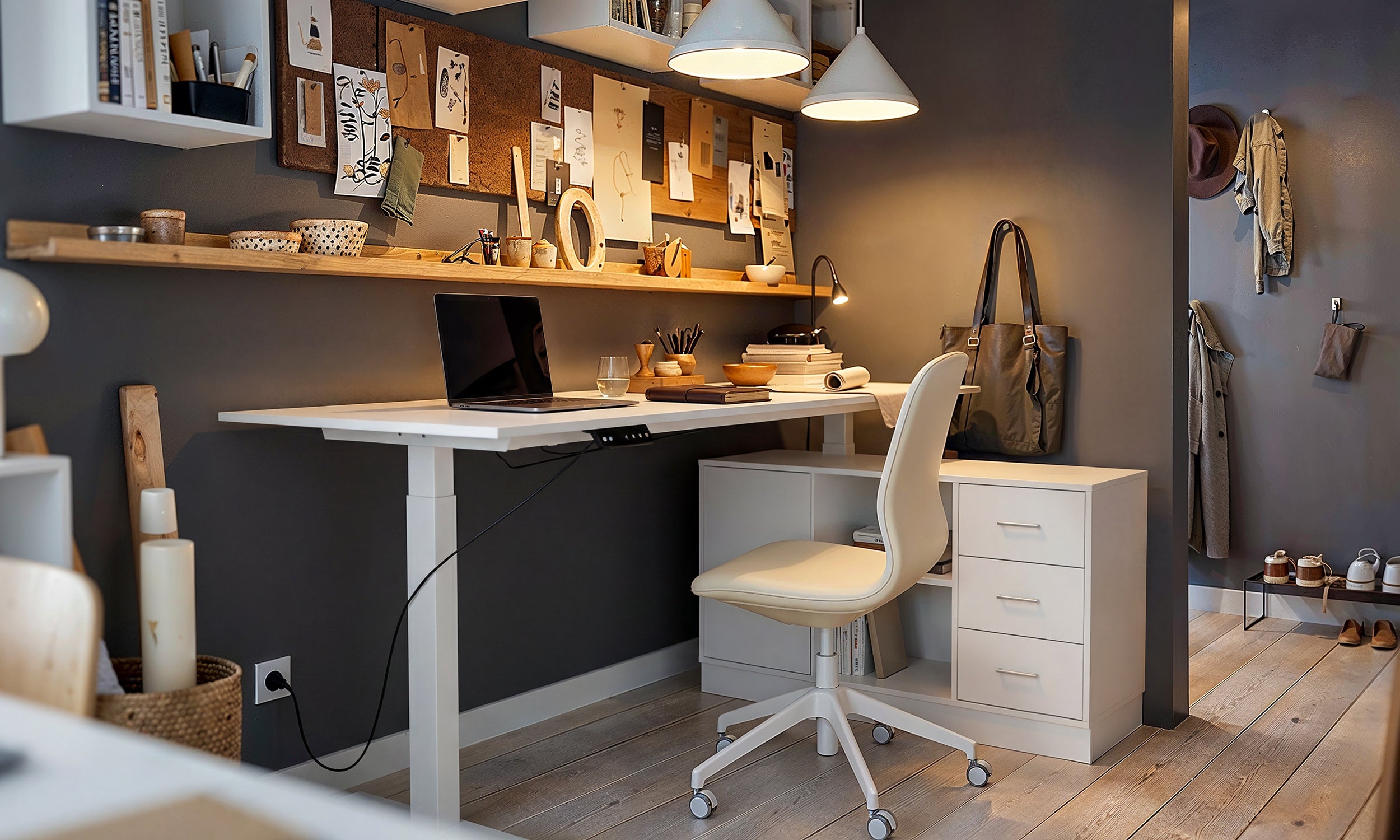
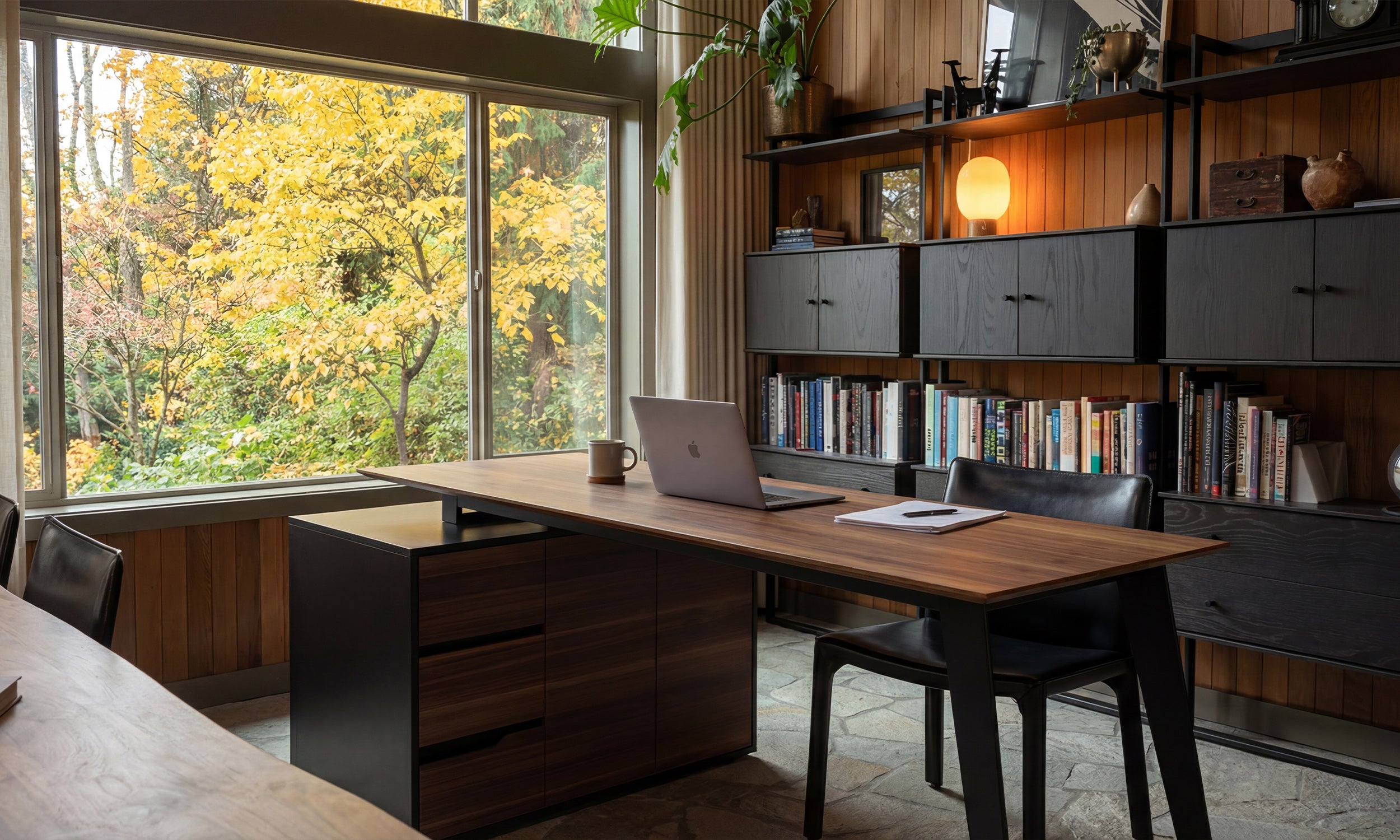



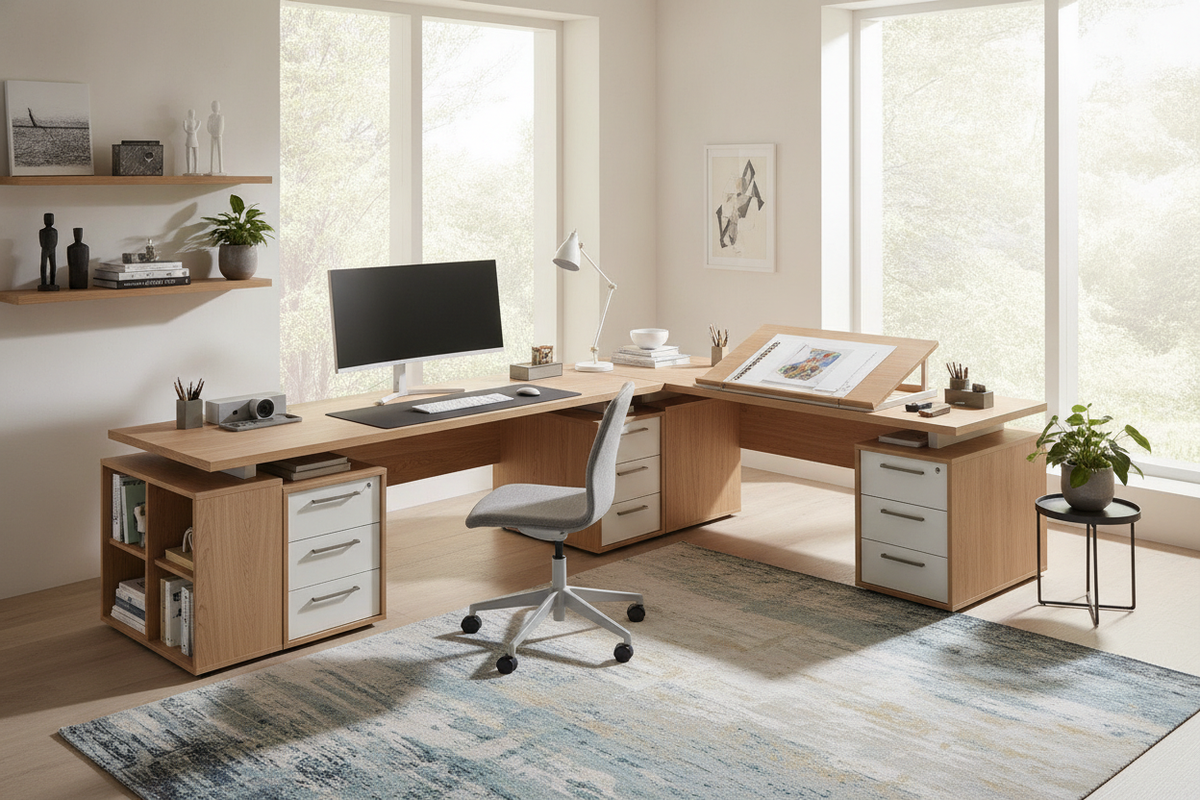
A left handed desk is not a special product. It is an ordinary desk whose storage, return and clear writing area sit where a left-hander needs them: drawers within left reach or on a side you choose at assembly, the L-shaped return on the left so the writing arm has surface under it, and task light coming from the right so the hand does not shade the page.
About one person in ten is left-handed: a 2020 meta-analysis in Psychological Bulletin puts the best overall estimate at 10.6% (summary on the University of Bristol research portal). This guide covers which side each part of the desk should go on, how much room a left-side mouse gets, and five desks from the FUFU&GAGA home office collection that are reversible or have no handed side.
Key takeaways
- Return: on your left as you sit if you write by hand a lot; either side if you mostly type.
- Drawers: left for reach, right for legroom. A side you choose at assembly, or drawers under the top, settles it.
- Mouse: a regular keyboard is about 18 inches long, so a 47.2-inch desk leaves 14.6 inches on each side of it.
- Light: lamp on the right, opposite the writing hand; screen at right angles to the window.
- Reversible: trust the word only when the listing says the storage or return installs on either side.
What makes a desk left-handed?
A desk suits a left-hander in one of three ways.
| Desk type | What it means for a left-hander | What to check |
|---|---|---|
| Reversible | The listing says the cabinet, hutch or return installs on the left or the right | Whether you choose once at assembly or can swap later |
| Symmetrical | Drawers under the top, a pedestal on both sides, or no storage: the same from either end | Depth for writing; where any control panel or cable opening sits |
| Fixed on the left | The return or pedestal is built on the left and stays there | The drawing, to confirm the side as seen from the chair |
In shop listings, left-handed desk, left return or left pedestal describe the desk, not the person: they say which side the return or drawers are on. Go by the drawing, not the label. In this guide, reversible means only that the listing says in words that the storage or return installs on either side.
Which side should the return go on an L-shaped desk?
For a left-hander who writes by hand, the return of an L-shaped desk belongs on the left as you sit. The reason is plain geometry: the left forearm rests to the left of the page, so that is where surface is needed, and turning left puts a notebook or drawing tablet under the writing hand, not across the body.
Put the keyboard and monitor on the main run and handwriting on the left return. OSHA's computer workstation guide says the monitor should generally sit directly in front of you, with the keyboard, phone and mouse inside the primary work zone (OSHA desk guidance).
If you mostly type, the side matters less: let the window, door swing and nearest outlet decide.
The 54.3-inch L-shaped corner desk in our picks takes 54.3 inches along one wall and 40.9 inches along the other, and its listing says you choose the cabinet side before assembly. In a recess between two walls, the left wall is the one that stops a left elbow; our alcove desk guide covers side clearance.
Should the drawers be on the left or the right?
Both answers are right, for different people.
- Drawers on the left put pens and paper under the hand that uses them. The cost is legroom on that side.
- Drawers on the right keep the left knee space and the left end of the top clear. The cost is reach across the body.
- Drawers under the top, set across the front, are within reach of either hand and leave both sides open.
- No drawers, with a rolling cart or cabinet beside the desk, lets you move the storage when your habits change.
Whichever you choose, protect your leg space. OSHA's purchasing checklist asks for under-desk clearance at least 20.8 inches wide and 17.6 inches deep at the knees (OSHA purchasing guide), and its desk page says that space should stay free of files, CPUs, books and storage. A pedestal belongs beside your legs, never in front of them.
Mouse on the left: how much room beside the keyboard?
OSHA's advice is to keep the mouse close to the keyboard, because reaching for it pulls the elbow away from the body (OSHA pointer and mouse guidance). Here a left-hander has a small built-in advantage. The Canadian Centre for Occupational Health and Safety (CCOHS) gives about 18 inches for a regular keyboard and about 14 inches for a shorter one without a number pad, and notes that the extra keys sit to the right of the letters (CCOHS on mouse placement). That is 18 - 14 = 4 inches of keys on the right, so a mouse on the right starts about 4 inches further from the letters than a mouse on the left.
What the desk supplies is width. Subtract the keyboard from the desk width and halve the rest: for a 47.2-inch desk and an 18-inch keyboard, (47.2 - 18) / 2 = 14.6 inches on each side.
| Desk width | Each side of an 18-inch keyboard | Each side of a 14-inch keyboard |
|---|---|---|
| 39.4 in | 10.7 in | 12.7 in |
| 47.2 in | 14.6 in | 16.6 in |
| 51.2 in | 16.6 in | 18.6 in |
| 54.3 in | 18.15 in | 20.15 in |
| 63 in | 22.5 in | 24.5 in |
On a narrow desk, sliding the keyboard a few inches to the right moves the spare width to the side where the left hand works.
For hardware, OSHA suggests a pointing device that fits the hand that will operate it, or one made for either hand. It also notes that most keyboards have the 10-key pad fixed on the right, which can limit left-handed workers, and that keyboards with the keypad on the left and stand-alone keypads exist (OSHA keyboard guidance).
Where should the light come from?
From the right. The University of California's task lighting sheet puts it in one line: place the lamp opposite your writing hand to minimize shadows on your work surface (UC task lighting sheet, PDF). For a left-hander that is the right side of the desk. A lamp on the left throws the shadow of the hand and pen onto the line being written.
Daylight follows the same logic, so if you can choose, sit with the window to your right. For the screen, OSHA recommends placing the display at right angles to windows and positioning a desk lamp so its light does not reflect on the screen (OSHA workstation environment). A window on your right meets both rules at once.
A desk that stands away from the wall can be turned until the light arrives from the right; our guide to a desk in the middle of the room covers the cords for that layout.
Notebooks, smudging and the writing zone
Writing left to right, the left hand follows the pen across fresh ink, which is why left-handers smudge. A desk cannot change that, but it can give the hand room. Divide the top into three zones:
- Left, active reach: the mouse, a drawing tablet or the notebook. Keep it free of organizers, monitor risers and paper trays.
- Center: the keyboard and the monitor, straight ahead.
- Right, support: the lamp base, pen cup, phone, drink and reference items.
Depth decides whether you can write in front of the keyboard. On a top 21.7 or 23.6 inches deep, the notebook and the keyboard compete for the same strip. At 27.6 or 31.5 inches, the keyboard slides back and the page sits in front of it, with the screen still at least 20 inches from your eyes, the distance OSHA's desk page gives.
Also keep the left end of the desk away from a wall or tall cabinet so the left elbow has free space, and prefer pads bound at the top: ring binders and spiral notebooks put their rings under a left hand.
Sit-stand desks: control panel side and cables
The best standing desk for left handed people lifts like any other; three parts have a side.
- Control panel. It sits under the front edge near one end. The listings for our picks do not state the side, so the notes below say what the photos show.
- Storage. A cabinet section's side decides where your legs go. One of the picks lets you choose it.
- Cables. Both sit-stand picks list cable management, but not which side any opening is on. Put the power strip on the side nearest the outlet and leave slack for the full height travel.
Check the height range too. OSHA's purchasing checklist gives 36 to 46.5 inches as the keyboard height range for standing tasks, and its keyboard page says elbows should be about level with the keyboard. The two sit-stand picks rise to 44 and 44.9 inches, so taller users should compare that with their standing elbow height. Drawer loads and lift capacity are covered in our standing desk with drawers guide.
Sharing a desk with a right-hander
- Seats: side by side, the left-hander takes the left seat, so the two writing elbows point outward, not into each other.
- One lamp: with that seating, a lamp between the two people is on the left-hander's right and the right-hander's left, opposite both writing hands.
- Shared computer: OSHA notes that keyboards whose keypad can switch sides may be especially useful where workers share computers, and that a mouse made for either hand lets people change over.
- Height: memory presets on a sit-stand desk store a height for each person.
Room sizes for two desks are in our his and hers desk guide.
Left handed desk checklist
- Reversibility: the listing says in words that the storage or return installs on either side.
- Return side: on your left as you sit, if you write by hand. Confirm it from the drawing.
- Leg space: at least 20.8 inches wide under the top, clear of storage.
- Width: desk width minus 18 inches of keyboard, divided by two, is the room for a mouse.
- Depth: enough to write in front of the keyboard with the screen at least 20 inches from your eyes.
- Light: an outlet and a lamp spot on the right, and a window on the right if the room allows.
- Controls and cables: on a sit-stand desk, find the control panel and cable openings in the photos.
Our picks: 5 desks that work for left-handers
Two of these FUFU&GAGA desks have storage their listings say installs on either side, two are symmetrical, and one is a plain sit-stand top. Sizes and capacities are as listed; details seen only in photos are marked as such.
Mid-Century L-Shaped Corner Desk with Drawers (54.3 in)
The listing says that before assembly you choose to put the cabinet on the left or the right. Overall it is 29.1 inches high, 54.3 wide and 40.9 deep, with a 54.3 x 23.6 inch desktop on steel legs. Storage is three drawers on metal slides and a cabinet with a press-to-open door. The desk is rated for 180 lb and each drawer for 35 lb, in black or white with wood grain.
Best for: a corner desk with the storage on the side that suits you and the room.
Skip it if: you want to swap sides later without rebuilding, you need hanging files (the drawer interior is 4.2 inches high), or you want to stand.

Standing Desk with 3 Drawers and 2 Shelves (63 in)
A sit-stand desk whose listing says the bookshelf and cabinet section goes on the left or the right. The desktop is 63 x 31.5 inches and adjusts from 29.2 to 44 inches, with memory keys for saved heights. Storage is three full-extension drawers, a cabinet and two open shelves, with cable management. The desktop holds 160 lb and each drawer 10 lb. In the listing's diagram the control panel sits at the end away from the storage, so storage on the right puts the panel on your left.
Best for: writing in front of the keyboard and standing; 31.5 inches is the deepest top here.
Skip it if: your drawers will carry more than 10 lb each, your equipment tops 160 lb, or you need a top higher than 44 inches.

Wooden Minimalist Study Desk (47.2 or 39.4 in)
Symmetrical, with no handed side. It comes 47.2 or 39.4 inches wide, both 21.7 inches deep and 29.5 high, on solid wood legs rated for 220 lb. The listing gives two drawers under the top on wooden slides; in the photos they sit side by side across the front, within reach of either hand, and both ends are open.
Best for: small rooms and shared homes, since nothing about it favors a hand.
Skip it if: you store more than pens and notebooks (each drawer holds 3 lb), or you write beside a keyboard a lot: 21.7 inches is the shallowest pick.
Solid Wood Writing Desk with Rounded Corners (51.2 in)
The top is 51.2 inches wide and 27.6 deep at 28.7 inches high, in solid rubberwood with rounded corners. The listing shows no drawers or pedestals, so neither side is blocked and a cart can stand at either end. It is rated for 80 lb.
Best for: writing or drawing by hand on a deep, clear top with free elbow room at both ends.
Skip it if: you need built-in storage or cable management (the listing shows neither), or your equipment comes near 80 lb.
Walnut Standing Desk with Electric Height Adjustment (63 in)
A plain sit-stand top with no storage to take a side. The desktop is 63 x 31.5 inches and adjusts from 29.6 to 44.9 inches, with a 4-preset memory controller and built-in cable management. It is rated for 110 lb. In the photos the control panel sits under the front edge toward the left end; the listing does not say whether it can be mounted elsewhere.
Best for: standing, writing on a deep top, and adding a rolling cabinet on whichever side works.
Skip it if: you want drawers in the desk, or your setup weighs more than 110 lb.

Left handed desk picks compared
| Desk | Size as listed | Height | Handed parts | Rated load |
|---|---|---|---|---|
| L-shaped corner desk | 54.3 x 40.9 in overall | 29.1 in | Cabinet left or right, chosen at assembly | 180 lb |
| Standing desk, 3 drawers | 63 x 31.5 in top | 29.2 to 44 in | Storage section left or right | 160 lb |
| Wooden study desk | 47.2 or 39.4 x 21.7 in | 29.5 in | None: two drawers under the top | 220 lb |
| Solid wood writing desk | 51.2 x 27.6 in | 28.7 in | None: no storage | 80 lb |
| Walnut standing desk | 63 x 31.5 in top | 29.6 to 44.9 in | None: panel at the left end in the photos | 110 lb |
More sizes and finishes are in the home office collection.
FAQ
What is a left handed desk?
A desk laid out for a left-handed user: the return or drawers sit on the left or on a side you choose, the left part of the top stays clear for writing and the mouse, and the lamp goes on the right. In shop listings the phrase usually describes an L-shaped or pedestal desk with its return or drawers on the left.
Is a standing desk different for left-handed people?
The lift is the same. Check which end the control panel is on, which side any cabinet sits on, and where the cables run.
Which side should the return be on for a left-handed person?
On the left as you sit, if you write by hand, because the writing forearm rests to the left of the page and needs surface there. If you only type, choose the side that fits the room's window, door and outlet.
Where should a left-handed person put a desk lamp?
On the right. University of California task lighting guidance says to place the lamp opposite your writing hand to minimize shadows, and OSHA adds that a desk lamp should not reflect on the screen.

Dejar un comentario
Este sitio está protegido por hCaptcha y se aplican la Política de privacidad de hCaptcha y los Términos del servicio.