










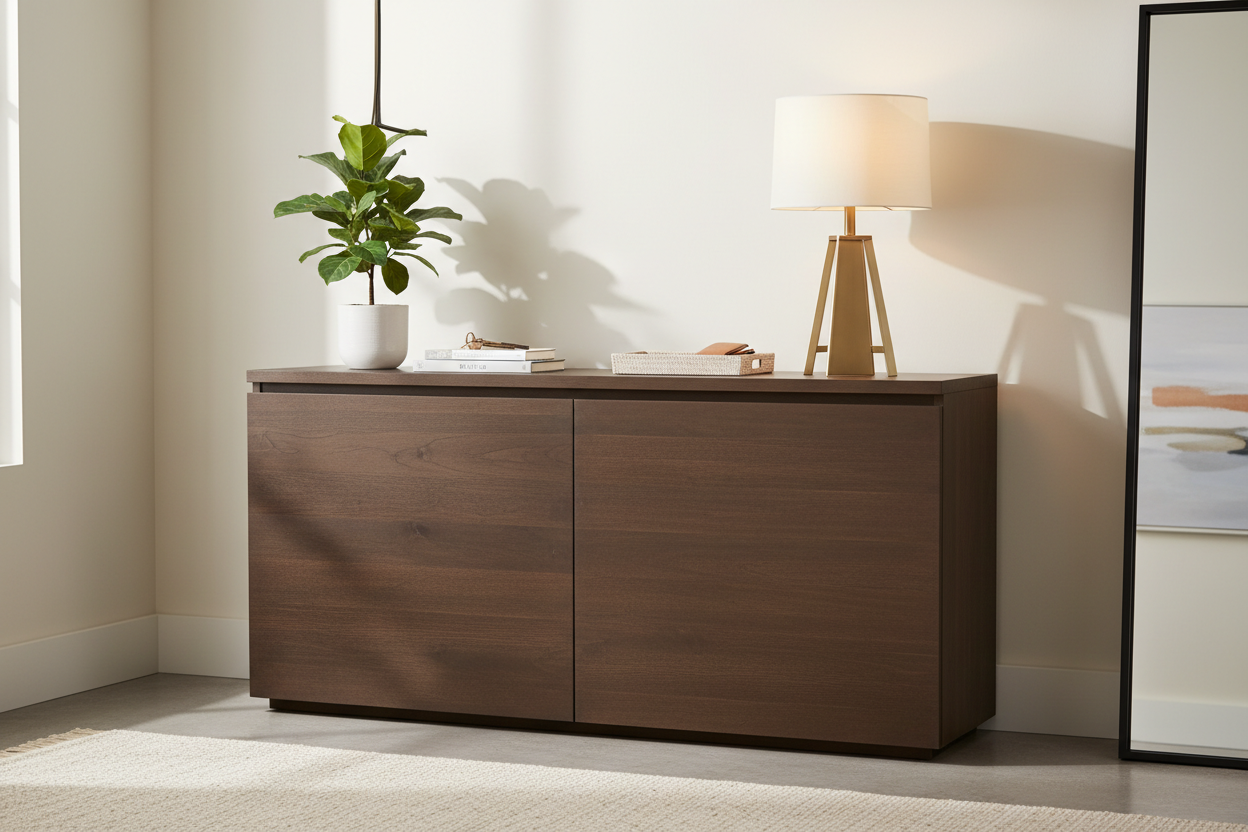
Entryways and hallways are notorious for becoming dumping grounds. Keys, mail, dog leashes, and miscellaneous chargers seem to multiply on any flat surface available. While open shelving looks airy in magazines, reality often demands hidden storage. This is where the console table with doors becomes the unsung hero of home organization. Unlike a standard table that leaves your clutter on display, these pieces offer the visual polish of a sideboard with the slender footprint required for high-traffic areas.
Choosing the right piece isn't just about picking a wood finish that matches your floor. It requires a hard look at your available square footage and an honest assessment of what you need to hide. Whether you are filling a massive wall in a suburban foyer or trying to squeeze storage into a narrow city corridor, the dimensions and door mechanics matter just as much as the aesthetic.
Anchoring the Room with Size
In substantial entryways or open-plan living spaces, diminutive furniture often looks out of place. It creates a visual imbalance, making the walls feel empty and the furniture look temporary. This is the ideal scenario for a large console table with doors. These pieces bring weight and intentionality to a room. Beyond just filling space, the internal volume of a large unit offers genuine utility. You aren't limited to storing small knick-knacks; these cabinets can house seasonal decor, overflow serving platters from the dining room, or bulky board games.
There is a subtle but distinct difference when you start looking at a long console table with doors compared to a simply "large" one. Length is particularly useful for zoning open concepts. Placing a long, low console behind a floating sofa creates a definitive border between the living area and the dining space. It grounds the sofa and prevents the back of the couch from looking like a floating island. When selecting a long unit, ensure the frame is reinforced. Over a span of sixty inches or more, cheap composite wood can bow in the center if it isn't supported by a central leg or a solid hardwood frame.
The Narrow Hallway Dilemma
The most common frustration homeowners face is finding storage that doesn't block the walking path. Standard console tables usually sit between 14 and 18 inches deep. In a tight hallway, those four inches can make the difference between a comfortable walkway and a bruised hip. You need to hunt specifically for a thin console table with doors, typically measuring 10 to 12 inches in depth.
I learned this lesson the hard way during a renovation project a few years ago. We fell in love with a gorgeous, vintage mid-century cabinet for a client's upstairs landing. It was 16 inches deep. On paper, it fit. In practice, once we opened the cabinet doors, the hallway was completely impassable. We had to swap it out for a custom 11-inch depth unit. The swap taught me that in narrow spaces, door clearance is critical. If you are going thin, look for sliding doors rather than swinging ones. Sliding mechanisms allow you to access your items without stepping back or blocking the flow of traffic, preserving the utility of the hallway even when the cabinet is open.
Material Choices and Visual Weight
Because console tables are often positioned against flat walls, they can feel heavy or boxy if the materials aren't chosen carefully. A solid oak cabinet with solid wood doors is beautiful, but it reads as a heavy block. If your room already feels small or dark, consider doors with cane webbing, glass inserts, or decorative fretwork. These materials break up the visual solidity of the piece, making a large console table with doors feel less imposing while still obscuring the contents inside.
Glass doors offer a compromise. They require you to keep the interior somewhat tidy, but fluted or frosted glass can blur the shapes of the items inside, giving you a bit of leeway while keeping the look light. For high-traffic areas where bags and shoes might bump the furniture, solid wood or metal construction will always outlast veneer or particle board. Metal consoles, in particular, can be constructed with thinner walls than wood, maximizing the internal storage space in a thin console table with doors.
Functionality Beyond the Entryway
While we usually associate these tables with the front door, their utility extends throughout the home. A long console table with doors serves as an excellent media center in a living room where you want to mount the TV on the wall but need a place to hide the cable box and gaming consoles. The height of a console—usually 30 to 32 inches—is often more comfortable for viewing than low-slung media stands, and the doors hide the tangle of wires that usually accompanies technology.
In a dining room, these tables function as modern buffets. The narrow depth is often preferable to traditional sideboards in smaller dining areas, allowing for ample chair clearance around the table. If you plan to use it for dining storage, check the internal shelf height to ensure it can accommodate wine bottles or tall pitchers.
Style and Decor
Once the practical needs are met, styling the top surface is where the personality comes in. Since the storage is hidden behind doors, the top should remain relatively clear to maintain that sense of organization. A large mirror hung above the console is a classic move for a reason: it reflects light and widens the perception of the space. Flank the mirror with sconces or a pair of tall lamps to add height.
Avoid lining up small items in a row, which can look like a soldier formation. Instead, group objects in clusters of three at varying heights. A stack of books, a sculptural bowl for keys, and a vase with greenery creates a balanced vignette. If you have a long console table with doors, you have the luxury of creating two distinct zones on the surface—perhaps a lighting zone on one end and a decorative art display on the other.
Finding the balance between storage capacity and floor space requires a tape measure and a bit of foresight. Whether you need the massive storage potential of a large unit or the surgical precision of a thin model, the goal is the same: to stop the clutter at the door and look good doing it.
Frequently Asked Questions
How much clearance space do I need in front of a console table?
You should aim for at least 36 inches of clearance for a comfortable walkway. If the console table has swinging doors, ensure you have enough room to fully open the door and still stand in front of it, which usually requires an additional 18 to 24 inches of space depending on door width.
Can I use a console table as a TV stand?
Yes, console tables work well as TV stands, provided they are sturdy enough to support the weight of the television. You will likely need to drill holes in the back panel for cord management if the unit doesn't come pre-drilled, and ensure the depth is sufficient for the TV's legs or base.
What is the difference between a sideboard and a console table with doors?
The main difference is usually height and depth. Sideboards (or buffets) are typically deeper and lower, designed for dining rooms, while console tables are generally taller and shallower to fit in hallways. However, the lines between these categories have blurred, and the terms are often used interchangeably in modern furniture design.

Dejar un comentario
Este sitio está protegido por hCaptcha y se aplican la Política de privacidad de hCaptcha y los Términos del servicio.