










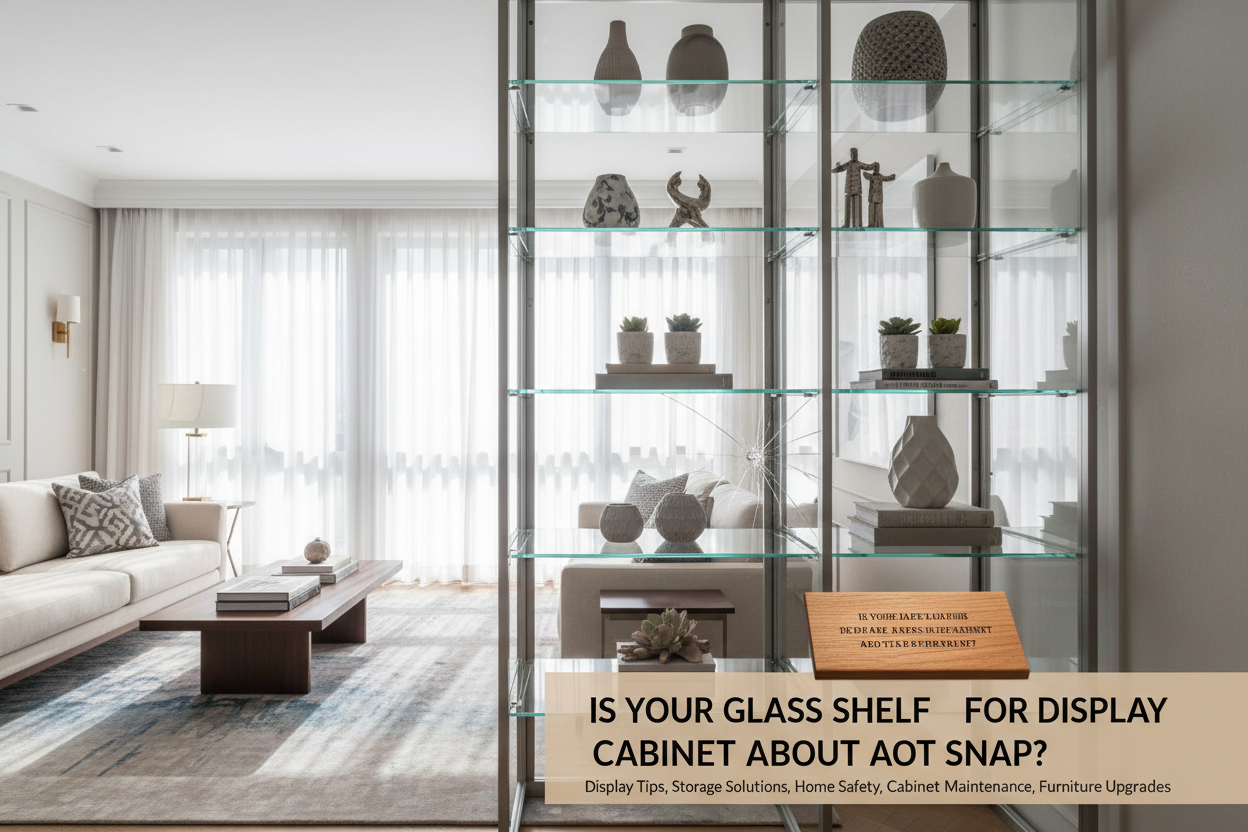
I still remember the sound. It was 2 AM, and a sharp, crystalline 'crack' echoed through my living room. I found my vintage mid-century barware sitting on a glass shelf for display cabinet that had decided to transform into a U-shape. It didn't shatter that night, but it was a warning shot I’ll never forget.
Most of us treat glass like it’s a permanent, indestructible surface until the day it isn't. We keep adding 'just one more' heavy crystal decanter or a heavy marble bust, assuming the factory-standard inserts can handle the load. They usually can't. If you've noticed even a millimeter of a curve, you’re playing a dangerous game of gravity chicken.
- A visible bow means the glass has reached its 'creep' limit and is structurally compromised.
- Tempered glass is non-negotiable for any collection weighing more than a few pounds.
- Factory plastic clips are the most common point of failure—swap them for metal.
- Custom-cut glass is surprisingly affordable and significantly safer than generic replacements.
The Terrifying 'Bow' (And How to Spot It)
Glass is technically a supercooled liquid, but for our purposes, think of it as a rigid sheet that hates to bend. When a glass shelf for display cabinet starts to dip in the center, it’s not just 'settling.' It’s failing. This happens most often with long spans—anything over 24 inches—where the weight of your collection is concentrated right in the middle.
If you suspect a shelf is struggling, don't trust your eyes. Our brains are remarkably good at ignoring subtle curves in things we see every day. Take a metal straight edge or a long carpenter’s level and hold it against the underside of the shelf. If you can see light between the level and the glass in the center, that shelf is a ticking time bomb. It’s no longer a flat surface; it’s a tensioned spring waiting for one more vibration to explode.
Collectors are the worst offenders here. We always think we have more room than we actually do. If you’re wondering Is A 4 Shelf Glass Display Case Enough Space For A Serious Collection, the answer usually depends on the thickness of that glass. Most 'out of the box' cabinets use 3/16-inch glass, which is fine for a few trophies but disastrous for a full set of heavy stoneware. If you see that bow, clear the shelf immediately. Don't wait for the weekend.
Tempered vs. Annealed: What is Actually Holding Your Stuff?
Not all glass is created equal, and this is where most furniture manufacturers save their pennies. 'Annealed' glass is standard window glass. It’s cheap, easy to cut, and absolutely terrifying when it breaks. If an annealed shelf fails, it shatters into long, razor-sharp shards that can slice through anything (or anyone) below it. It has no internal strength to resist impact or heavy weight over time.
Tempered glass, on the other hand, is the gold standard for glass shelves for display cabinets. It’s been heat-treated to create internal compression, making it four to five times stronger than the cheap stuff. When it does break—and it takes a lot to make it happen—it disintegrates into thousands of small, relatively harmless cubes. It’s the difference between a mess and a trip to the ER.
How do you tell what you have? Look at the corners. High-quality tempered glass will usually have a tiny, sandblasted 'bug' or logo in one corner indicating it meets safety standards. If your shelves are perfectly clear with no markings and the edges feel a bit sharp or uneven, you’re likely dealing with annealed glass. If that’s the case, and you’re displaying anything heavier than a feather, an upgrade isn't just a good idea—it’s a necessity.
How to Upgrade Your Glass Shelves for Display Cabinets
The secret that furniture stores don't want you to know is that you don't have to live with the flimsy inserts they gave you. Upgrading your glass shelves for display cabinets is one of the most satisfying DIY projects you can do. It’s the easiest way to turn a budget-friendly cabinet into something that feels like a museum-grade vault.
I learned this the hard way after a 'bargain' cabinet I bought started groaning under my collection of heavy art books. I realized that The Art Of Display Choosing The Perfect Glass Door Cabinet For Your Home isn't just about the aesthetics; it’s about structural integrity. I ditched the stock 4mm glass and went to a local glass shop for 3/8-inch tempered replacements with polished edges. The difference was night and day. The cabinet stopped rattling, and I stopped worrying.
When you go to a local glass shop, ask for 'tempered glass with flat polished edges.' Specify the thickness you want. For serious weight, 1/4-inch is the minimum, but 3/8-inch feels truly high-end. It’s heavier, sure, but it provides a level of stability that makes your display look expensive. Plus, custom glass shops can often give you 'low-iron' glass, which removes that swampy green tint you see on the edges of cheap shelves.
Getting the Measurements Exactly Right
Don't just measure your old shelf. It might have been too small to begin with, leading to those annoying rattles every time you walk past. Measure the actual interior width of the cabinet from wall to wall. Then, subtract exactly 1/8 of an inch. This gives you 1/16th of an inch of clearance on either side, which is the 'sweet spot' for a snug fit that won't jam if the house shifts or the wood expands with humidity.
Check the depth, too. You want the glass to sit back far enough that it doesn't touch the door hinges or the glass front. If your cabinet has a groove for the glass to slide into, measure the depth of that groove and add it to your total. Bring a tape measure with 1/32-inch increments; precision here prevents a lot of headaches later.
Choosing the Right Hardware and Clips
You can buy the strongest glass in the world, but if it’s sitting on four tiny plastic pegs, you’ve accomplished nothing. Those plastic clips become brittle over time and will eventually shear off under pressure. Always replace them with heavy-duty metal shelf supports. Look for the 'spoon' style or the 'locking' style that actually grips the glass.
My personal favorite is the metal peg with a rubber or silicone sleeve. The rubber prevents the glass from sliding and acts as a shock absorber. If you live near a busy street or have kids running around, that tiny bit of vibration dampening can prevent micro-cracks from forming where the glass meets the metal. It’s a five-dollar upgrade that saves a five-hundred-dollar collection.
When to Just Buy a Better Enclosure Entirely
Sometimes, the cabinet itself is the problem. If you’re looking at a piece made of thin MDF that wobbles when you poke it, adding heavy, custom-tempered glass might actually make it more dangerous. The weight of the glass could cause the sides to bow outward, causing the shelves to slip off their supports entirely. In those cases, you’re throwing good money after bad.
If your current setup feels like a house of cards, it might be time to invest in a Large Display Cabinet Storage Shelf. These units are designed with the weight of the glass in mind, using reinforced frames that won't splay out under a load. They come with hardware that’s actually rated for the job, so you aren't doing guesswork with plastic pegs from a hardware store bin.
If you want something that makes a statement while staying structurally sound, look for a black cabinet with glass doors. Modern units often use thicker glass as a design feature, not just a functional one. A dark frame provides a high-contrast 'picture frame' effect for your items while offering the rigid support that vintage or budget pieces lack. If the frame is solid, your glass stays safe. It’s that simple.
FAQ
How much weight can a standard glass shelf hold?
A typical 3/16-inch shelf with a 24-inch span can safely hold about 15-20 pounds if the weight is distributed. If you're putting all that weight in the center, cut that number in half. Always check the manufacturer's rating, but if you're in doubt, upgrade to 1/4-inch tempered glass.
Can I cut a glass shelf myself to make it fit?
If it's tempered glass, absolutely not. The moment a glass cutter or saw touches tempered glass, it will explode into a million pieces. If it’s annealed glass, you can cut it, but you’ll have raw, dangerous edges that need professional polishing. Save your fingers and just order the size you need from a pro.
Why does my glass shelf rattle when I walk by?
It’s usually because the shelf is slightly too small for the opening or the support pegs are hard plastic. Swap the pegs for ones with rubber grommets, or place small clear 'bumper' dots on the corners of the shelf. This kills the vibration and makes the whole cabinet feel more substantial.



Dejar un comentario
Este sitio está protegido por hCaptcha y se aplican la Política de privacidad de hCaptcha y los Términos del servicio.