










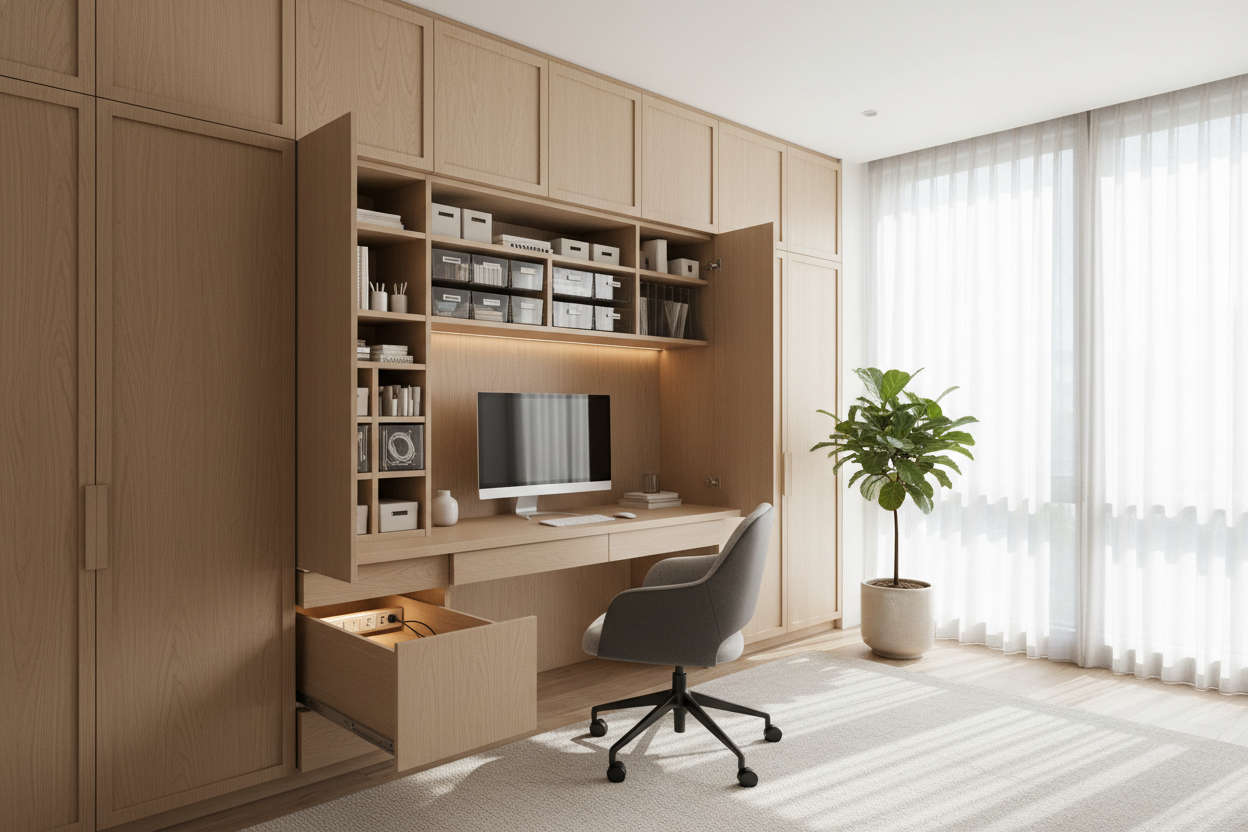
There is a specific kind of fatigue that sets in when your workspace fights against you. You reach for a file, but it’s buried under a stack of unorganized papers. You look for a charger, but it’s tangled in a drawer that won't quite close. As a designer, I see this constantly: clients invest heavily in ergonomic chairs and high-end desks, yet treat storage as an afterthought. The right home office cabinet is not merely a box for your things; it is the architectural backbone of a productive environment.
This guide moves beyond basic utility to explore how joinery, material selection, and spatial planning come together to create a workspace that feels curated, not just assembled.
Key Features to Look For
Before committing to a purchase, review these core elements to ensure your selection meets professional standards for longevity and function:
- Internal Depth vs. External Depth: Always verify that the interior clearance can accommodate standard binders (usually 11-12 inches) or printer footprints, not just the exterior dimensions.
- Joinery Quality: Look for dovetail or mortise-and-tenon joints in drawers rather than staples or glue, especially for home office storage units holding heavy files.
- Cable Management: Premium office room cabinets should feature pre-drilled grommets or ventilated back panels to manage heat and cords from electronics.
- Hardware Durability: Soft-close hinges and full-extension drawer slides are non-negotiable for daily use comfort.
Choosing the Right Material: Aesthetics Meets Durability
When selecting cabinets for home office environments, the finish dictates both the vibe and the maintenance level. While solid wood offers a timeless, heirloom quality, it is susceptible to humidity changes. For a modern, sleek look, high-pressure laminate or lacquered MDF offers resilience against coffee rings and scratches, though it lacks the warmth of natural grain.
If you are aiming for a transitional style, a bureau cabinet in walnut or oak veneer provides a sophisticated silhouette that bridges the gap between professional functionality and residential comfort. Remember, the texture of your cabinetry contributes to the room's acoustics; softer, textured woods can help dampen sound in a hollow room.
Space Planning: The Art of Placement
Integrating Office Desk Cabinets
One of the most efficient layouts involves utilizing office desk cabinets. These low-profile units slip beneath the work surface, keeping essentials within arm's reach without consuming floor space. However, be wary of knee clearance. A common error is placing a cabinet that forces you to sit off-center, compromising your ergonomic posture.
Verticality with Shelves and Cabinets
If your footprint is limited, look upward. Home office shelves and cabinets combined in a floor-to-ceiling unit draw the eye up, making the room feel taller while maximizing storage volume. Open shelving allows for the display of books and art to break up the visual heaviness, while closed lower cabinetry hides the visual noise of paperwork and tech gear.
Functionality: Beyond the Box
Modern office shelves and cabinets must accommodate a hybrid workflow. We are seeing a move away from standard filing drawers toward flexible home office desk cabinets designed for tech storage—think designated charging drawers and adjustable shelving for routers or hard drives. An office table cabinet that serves as a return (an L-shape extension) can double your surface area while providing deep storage for oversized items like blueprints or sample boxes.
Lessons from My Own Projects
I want to share a specific mistake from a project I managed in a pre-war apartment, which changed how I specify home office cabinets and shelves forever. We ordered a stunning, custom-built wall unit that looked incredible on the floor plan.
However, I failed to account for the specific hinge swing radius relative to the plush rug we installed. When the client tried to open the bottom doors of the cabinet home office unit, the bottom edge dragged against the thick wool pile of the rug. It was a friction nightmare. We had to shave a quarter-inch off the bottom of the doors on-site—a dusty, stressful fix that ruined the factory finish on the bottom edge.
Now, I always advise clients: if you are placing cabinetry on a rug, ensure the unit has a plinth base or legs that elevate the door swing at least two inches off the floor. It’s a small detail that saves massive headaches.
Conclusion
Investing in high-quality storage home office furniture is an investment in your mental clarity. Whether you opt for a vintage bureau cabinet or modular home office storage units, prioritize pieces that offer structural integrity and logical organization. A well-designed cabinet doesn't just store your work; it respects your workflow.
Frequently Asked Questions
What is the ideal depth for a home office cabinet?
For lower cabinets intended to hold printers or large files, a depth of 18 to 24 inches is standard. Upper cabinets or shelves should be shallower, typically 12 to 14 inches, to prevent the room from feeling closed in and to avoid head bumps when standing at a desk.
How do I style open office shelves without them looking messy?
The trick is the "60/40 rule." Fill 60% of the shelf space with functional items (books, boxes) and leave 40% as negative space or for decorative objects. Use matching document boxes to conceal loose papers, creating a unified, architectural look.
Can I use kitchen cabinetry in a home office?
Absolutely. Semi-custom kitchen cabinets are often more durable and modular than standard office furniture. Using a "base cabinet" with a custom countertop is a designer hack to create a built-in desk look for a fraction of the cost of custom millwork.

Dejar un comentario
Este sitio está protegido por hCaptcha y se aplican la Política de privacidad de hCaptcha y los Términos del servicio.