










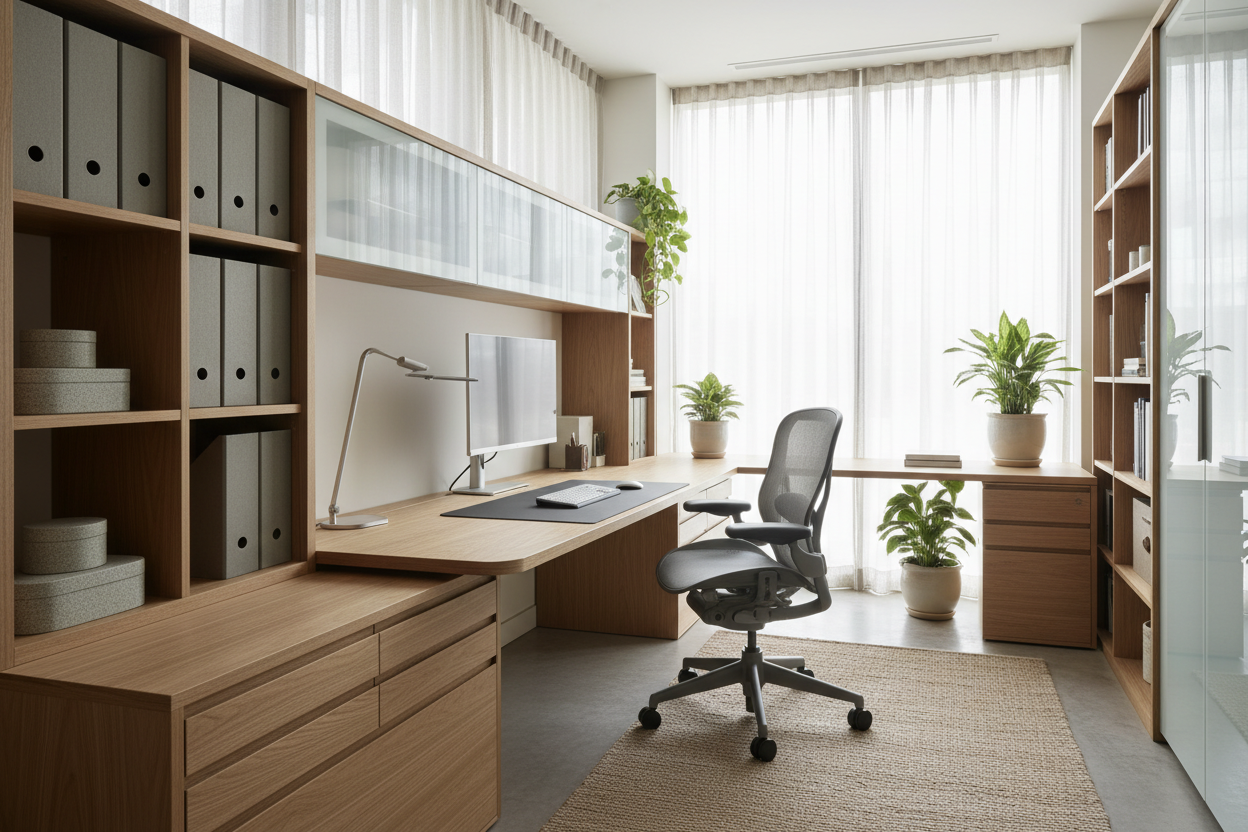
One of the most frequent dilemmas I encounter when consulting on home offices isn't finding a beautiful desk—it is managing the inevitable 'visual noise' of a working life. Papers, tech peripherals, and reference materials accumulate quickly, breaking the serenity of a well-designed room. The solution is rarely just a bigger table; it is a thoughtful desk and storage combination. By merging the work surface with cabinetry, we create a unified architectural element that anchors the room rather than cluttering it. Below, I’ll walk you through how to select a piece that balances high-end aesthetics with rigorous functionality.
Quick Decision Guide: What Matters Most
- Footprint vs. Volume: Ensure the unit maximizes vertical storage (height) rather than just eating up floor space (width/depth).
- Material Continuity: Look for consistent grain matching between the desktop and the storage unit to ensure it looks like furniture, not office equipment.
- Structural Integration: Check if the desk relies on the storage unit for support (integrated leg) or simply slides over it. Integrated options are more stable but less flexible.
- Cable Routing: A true combination unit must have internal channels between the desk and the storage to hide wires completely.
Assessing Material Integrity and Finish
When selecting a desk storage combination, the finish dictates both the longevity and the 'hand' of the piece. In luxury interiors, we often lean towards architectural-grade veneers or solid hardwoods like white oak or walnut. However, be wary of 'paper' veneers often found in big-box retail; they will peel at the edges where your wrists rest.
For high-traffic workspaces, I often recommend High-Pressure Laminate (HPL) with a soft-touch matte finish. It mimics the warmth of wood or the sleekness of lacquer but offers superior resistance to micro-scratches and heat rings from coffee mugs. If you choose a wood finish, ensure the storage component uses a UV-cured lacquer to prevent fading if the unit sits near a window.
The Ergonomics of Integrated Layouts
The biggest failure point in a desk and storage combination is legroom. Unlike a standalone desk, an integrated unit often places a cabinet or drawer bank right where your knees want to be. When planning the layout, I insist on a minimum 'knee well' width of 30 inches. If the storage is an L-return (forming an L-shape), ensure the return is lower than the main desk surface or recessed far enough back that you don't bang your chair armrests against it every time you swivel.
Visual Weight and Balance
A heavy, closed-door storage unit attached to a light, airy desk can make the room feel lopsided. To achieve a sophisticated silhouette, aim for asymmetry that feels intentional. If you have a heavy bank of drawers on the left, balance it with open shelving or a floating hutch on the right. This mix of 'negative space' (open areas) and 'positive space' (solid storage) keeps the furniture from dominating the room.
Lessons from My Own Projects
My Personal Take on the Desk and Storage Combination
I learned a hard lesson about these units during a project for a client in a pre-war apartment. We ordered a stunning, Italian-made integrated desk unit that mounted directly to the wall—a 'floating' look. It was visually weightless and gorgeous.
However, once we loaded the storage drawers with files and a printer, the unit began to sag imperceptibly—just enough that the drawers started binding and wouldn't close flush. The issue wasn't the wall anchors; it was the torque created by the cantilevered desk weight combined with the storage load. We had to retrofit a discrete steel support leg underneath, which ruined the floating aesthetic slightly. Now, whenever I specify a floating combination, I check the 'deflection rating' of the material and usually insist on at least one contact point with the floor for the storage component. It’s a detail you don't think about until you can't close your file drawer.
Conclusion
Investing in the right desk and storage combination is about more than organization; it is about curating a workflow that feels seamless. When your tools are hidden yet accessible, and your workspace feels like a cohesive part of your home’s design language, your productivity naturally follows suit. Measure twice, prioritize legroom, and choose materials that age gracefully.
Frequently Asked Questions
What is the ideal depth for the storage component?
While desks should be 24 to 30 inches deep, the attached storage (credenza or return) works best at 18 to 20 inches deep. This step-down in depth creates a visual hierarchy and ensures the storage doesn't protrude too far into the room.
Can I separate a combination unit later?
It depends on the construction. Modular systems allow you to detach the desk from the storage. However, many 'integrated' architectural units share a structural leg or panel. Always check if the unit is 'fully finished' on all sides if you plan to reconfigure the room later.
How do I handle lighting with a hutch combination?
If your storage includes a vertical hutch, under-cabinet lighting is non-negotiable. It reduces eye strain and eliminates shadows cast by the shelves. Look for units with routed channels for LED strips to keep the look clean.

Dejar un comentario
Este sitio está protegido por hCaptcha y se aplican la Política de privacidad de hCaptcha y los Términos del servicio.