










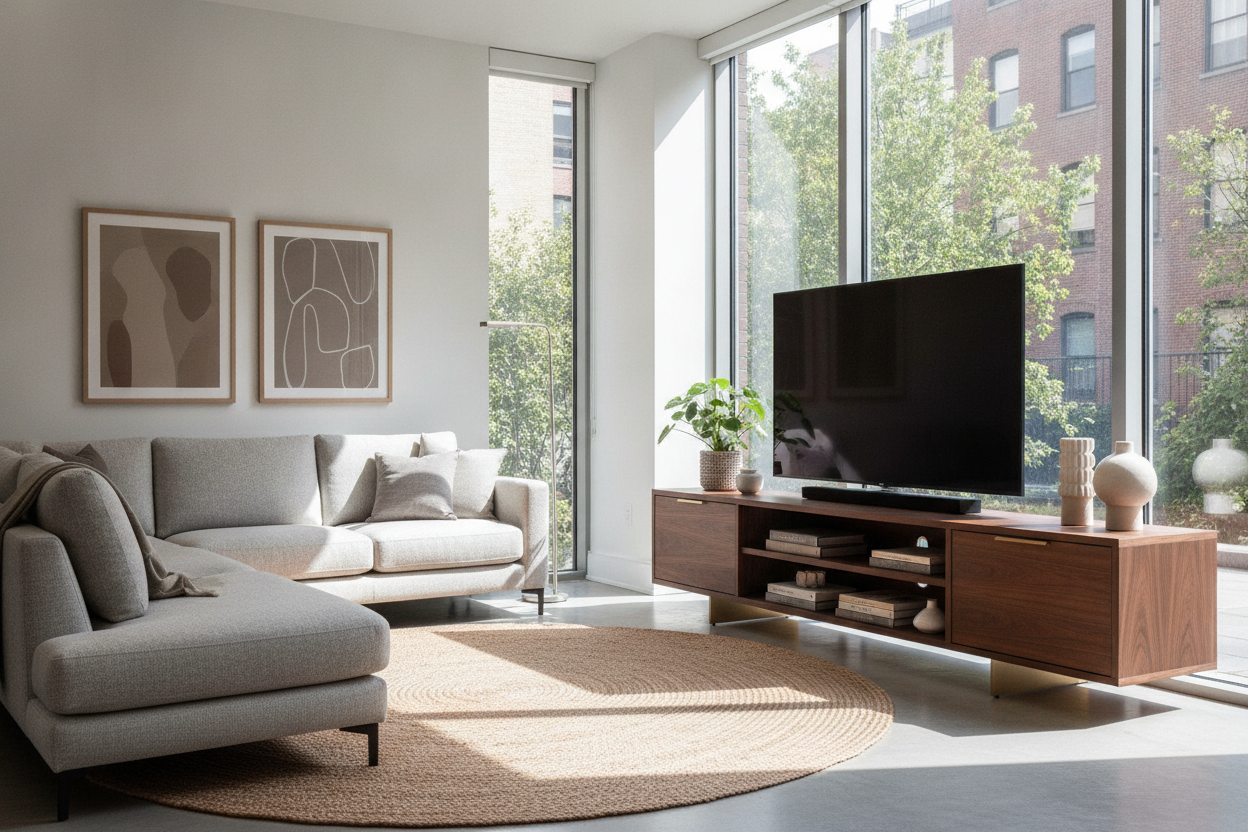
I fell for the classic Black Friday trap. There I was, staring at a 65-inch OLED that cost less than my monthly rent, thinking I’d finally made it. I hauled that beast home, cleared off my trusty mid-century modern console, and set it down. It looked glorious for exactly forty-eight hours.
By day three, I noticed it. A slight, almost imperceptible curve in the top shelf of my media unit. By day ten, the cabinet doors wouldn't close properly because the frame was bowing under the 60-pound weight of the screen. Finding television stands for 65 inch tv setups isn't just about style; it's about structural integrity before your living room centerpiece snaps in half.
- A fifth center leg is non-negotiable for anything over 55 inches.
- Measure the 'footprint' of the TV legs, not just the screen width.
- Particle board is the enemy; look for solid wood or heavy-duty MDF.
- Cable management becomes a nightmare with larger screens—plan for it.
The Day My Old Console Started to Sag
My old console was a $150 flat-pack special that had served me well through three apartments and a 42-inch plasma. I assumed wood was wood. I was wrong. Most budget furniture uses hollow-core panels or thin particle board that can handle 30 pounds, but a modern 65-inch display is a different beast entirely.
The 'dip' started right in the middle. It’s a slow-motion heartbreak watching your expensive tech slowly sink into a valley of cheap laminate. I had to move the TV to the floor for a week while I hunted for a replacement. Lesson learned: if the top panel isn't at least an inch thick, keep walking.
The Golden 'Center Leg' Rule
When you're shopping for an entertainment stand for 65 inch tv units, you have to look underneath. Most four-legged furniture is designed to distribute weight to the corners. But these huge screens put the majority of their pressure right in the dead center of the span.
I always tell people to browse dedicated TV stands that specifically feature a fifth support leg in the center. Without that middle pillar, gravity will eventually win. It doesn't matter how 'industrial' the metal frame looks—if there's a 60-inch gap between the left and right legs, that center is going to sag. I now refuse to buy anything that doesn't have that extra bit of insurance.
Why Depth Actually Matters More Than Width
Everyone talks about width, but depth is the silent killer. Modern TV manufacturers love those wide, V-shaped 'chicken legs' that sit at the very edges of the screen. I bought a sleek, narrow console once, only to realize the TV legs were literally hanging off the front and back edges by half an inch.
A 12-inch deep shelf might work for a 32-inch screen, but for a 65-inch monster, you need real real estate. An adjustable TV stand for living room setups can sometimes save you here, giving you the surface area needed to keep those wide-set legs from sliding off. I look for at least 16 to 18 inches of depth now. Anything less feels like a tipping hazard waiting to happen.
The Renters Dilemma: Should You Just Get a Mount?
If you're renting, you probably can't bolt a heavy-duty bracket into the studs without losing your security deposit. I've spent hours patching drywall after a 'simple' mount job went sideways. This is where the hybrid units come in—the ones with a built-in metal spine that holds the TV up while the furniture sits below it.
But be careful with the cheap ones. You have to ask: is that specific stand with mount actually sturdy enough for a screen this size? I've seen the 'spine' type mounts tilt forward over time because the base wasn't heavy enough to counterbalance the screen. If you go this route, make sure the base of the furniture is weighted like a tank.
Can I use a stand meant for a 55-inch TV?
Only if you like living on the edge. Usually, the weight limit is the real issue, not just the width. Check the manual—if your TV is 55 lbs and the stand is rated for 50, you're asking for a collapse.
What is the best height for a 65-inch TV stand?
Your eyes should be level with the middle of the screen when you're sitting on your sofa. For most 65-inch screens, that means a console that is roughly 22 to 26 inches tall. Anything higher and you'll be visiting a chiropractor for neck strain.
Does solid wood really matter?
Yes. Solid wood or high-grade plywood holds screws better and resists warping. If you buy the cheap stuff, the cam-locks will eventually wiggle loose under the vibration of your soundbar's bass.

Dejar un comentario
Este sitio está protegido por hCaptcha y se aplican la Política de privacidad de hCaptcha y los Términos del servicio.