










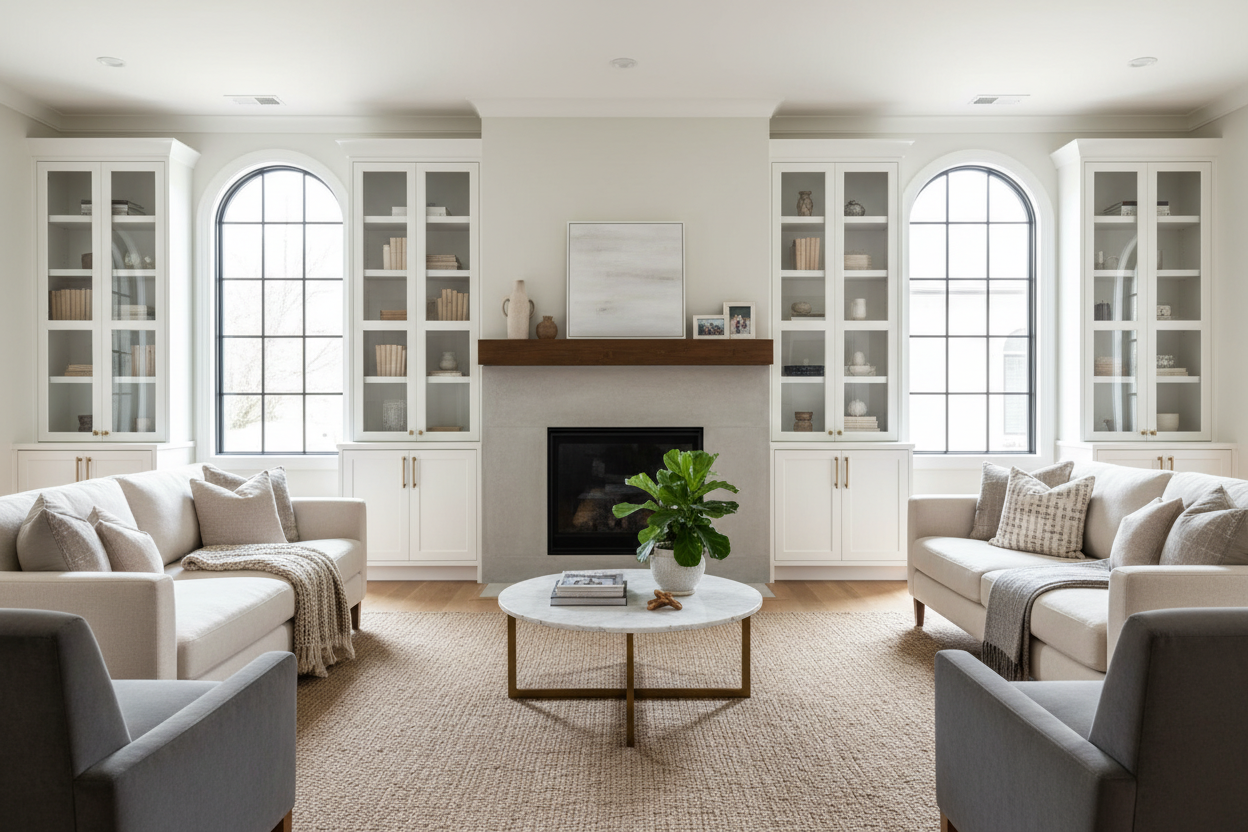
I spent three years staring at the two-foot gaps of dead air flanking my fireplace. Every time I sat on the sofa, those awkward alcoves mocked me. I tried filling them with a pair of matching armchairs (too cramped), then oversized fiddle-leaf figs (which promptly died from lack of light), and finally a couple of cheap ladder shelves that wobbled every time the dog ran past. It looked like I was living in a half-furnished rental, not a home I actually owned.
The truth is, most modern living rooms are designed with a focal point—the fireplace—but the builder usually stops there, leaving you with two useless strips of drywall that serve no purpose other than collecting dust. Adding custom built-in cabinets isn't just about finding a place for your books; it is about giving your room the architectural 'bones' it was supposed to have in the first place.
Quick Takeaways
- Custom millwork eliminates the 'dust moats' created by freestanding furniture.
- Lower cabinets with solid doors are the ultimate hiding spot for messy tech and toys.
- Built-ins should be at least 12 inches deep to accommodate standard books and decor.
- Matching the cabinet color to your wall creates a seamless, high-end look.
The 'Naked Fireplace' Problem
When a fireplace sits alone on a flat wall, it often feels ungrounded. It’s like wearing a tuxedo jacket with gym shorts—the top half looks intentional, but the bottom half is a mess. In many suburban floor plans, these alcoves are roughly 24 to 48 inches wide. Leaving them empty makes the fireplace look like an afterthought rather than a feature. It creates a visual 'stutter' where the eye doesn't know where to land.
By installing custom built-in living room cabinets, you’re essentially extending the footprint of your fireplace to the entire wall. This creates a sense of permanence. Suddenly, the room feels anchored. You’re not just looking at a fireplace; you’re looking at a curated library or a sophisticated media center. It’s the difference between a house that was thrown together and one that was designed.
Why Store-Bought Consoles Always Look Awkward Here
I’ve seen plenty of people try to 'hack' this look with store-bought furniture. I’ve done it myself. I once bought a freestanding display cabinet with glass doors that I thought would look perfect in my 38-inch nook. The cabinet was 32 inches wide. That left three inches of dead space on either side. It looked like a mistake. Those gaps are too small to clean easily but big enough to see every piece of cat hair and stray Cheeto that migrates back there.
Walls are rarely perfectly square. In an old house, they’re definitely not. A store-bought unit will show every tilt and lean of your drywall. Custom built cabinets, however, use scribing—a technique where the carpenter trims the wood to match the specific curves and wonkiness of your actual walls. You get a flush, seamless fit that makes the cabinets look like they grew out of the architecture. No gaps, no dust moats, no awkward 'almost-fits.'
Designing the Lower Half for Real Life (Read: Clutter)
If you’re designing a custom built in cabinet, the bottom half is your best friend. Most people make the mistake of doing all-open shelving. Don't do that. Unless you live in a museum, you have stuff you don't want people to see. I’m talking about the Wi-Fi router with its chaotic nest of black wires, the PlayStation, the half-chewed dog toys, and the board games with missing lids.
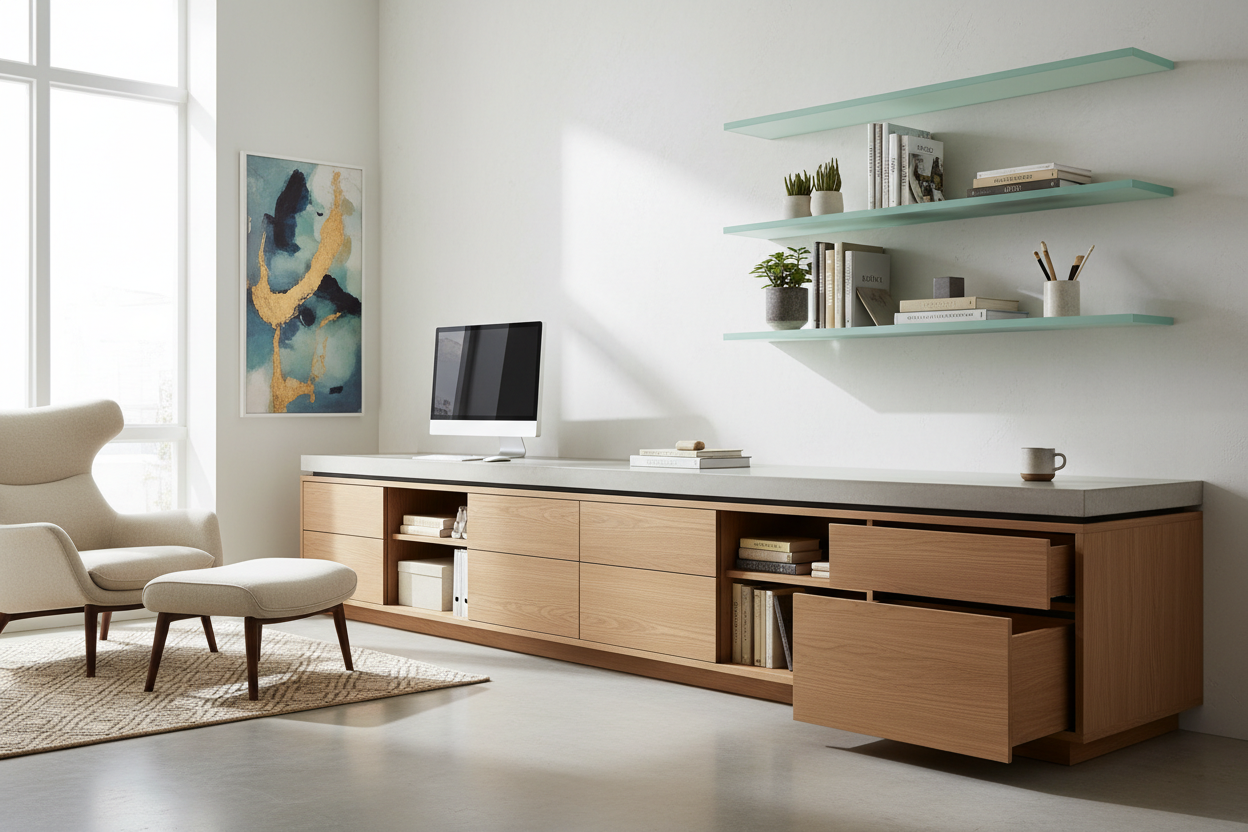
Use solid shaker or flat-panel doors for the bottom 30 to 36 inches. This keeps the visual weight at the bottom and allows the top shelves to stay airy and decorative. If you're tight on home office space, you can even design one side to be a cabinet desk combo for a custom built-in look. You get a functional workspace that disappears the moment you close the door, keeping your living room a place for relaxation rather than a reminder of your inbox.
To Paint or Not to Paint? Choosing Your Finish
This is where people get paralyzed. Should you go with natural wood or paint? If your room feels cold and sterile, a warm white oak or walnut stain on a custom builtin can add much-needed soul. It brings in texture that paint just can't replicate. However, if you want the room to feel larger, paint the cabinets the exact same color as your walls. It makes the shelves recede, making the room feel expansive rather than cluttered.
If you're feeling bold, go dark. A moody charcoal or navy can make the wall pop. In fact, choosing a deep tone for your built-ins gives you the same striking, high-contrast look as a standalone black cabinet with glass doors, but with ten times the storage capacity. Just make sure you use a high-quality trim paint like Benjamin Moore Advance or Sherwin Williams Emerald Urethane; regular wall paint will stay 'tacky' and your books will literally stick to the shelves.
Taking the Built-In Magic Beyond the Living Room
Once you see what tailored millwork does for your living room, you’ll start seeing 'naked walls' everywhere. That weird transition space between the kitchen and the dining room? That’s a prime candidate. A blank wall in a formal dining area is the perfect spot for a custom built in china cabinet. It’s more than just storage; it’s a way to define the room’s purpose.
Custom work isn't cheap—expect to pay anywhere from $2,000 to $6,000 depending on the linear footage and material—but the ROI is real. It’s one of the few interior upgrades that actually adds value to your home appraisal. Unlike a trendy sofa that will be 'out' in five years, well-executed millwork is timeless. It’s an investment in the structure of the house itself.
My Personal Experience: The 'Measure Twice' Disaster
A few years ago, I tried to save money by ordering semi-custom boxes and installing the trim myself. I measured the width of the alcove at the floor, but I didn't measure it at the top. Turns out, my walls leaned inward by nearly an inch over the six-foot span. When I tried to slide the cabinets in, they got stuck halfway up, gouging a massive hole in the drywall. I ended up having to hire a professional finisher to bail me out, which cost more than if I’d just hired him from the start. If you’re doing custom built-in cabinet work, hire a pro who understands scribing. Your sanity is worth the extra few hundred dollars.
Frequently Asked Questions
How deep should custom built-in cabinets be?
Standard depth is 12 inches for the upper shelves (perfect for books) and 18 to 24 inches for the lower cabinets. If you go deeper than 12 inches on top, the shelves can start to look heavy and dark.
Do built-ins add value to a home?
Yes. Appraisers and buyers see custom millwork as a permanent upgrade. It suggests a higher level of craftsmanship throughout the home and provides 'hidden' storage that everyone wants but nobody wants to build themselves.
Should I use MDF or real wood?
For painted cabinets, MDF is actually superior because it doesn't expand and contract with temperature changes, meaning your paint won't crack at the joints. If you want a stained wood look, go with furniture-grade plywood with solid wood face frames.

Dejar un comentario
Este sitio está protegido por hCaptcha y se aplican la Política de privacidad de hCaptcha y los Términos del servicio.