










I spent three hours last Saturday staring at the space behind my media console. It looked like a nest of black snakes had decided to move in behind my 65-inch OLED. No matter how many velcro ties I used or how many plastic clips I stuck to the back of the wood, the HDMI 'waterfall' was still visible from the side of the sofa. It’s the ultimate interior design buzzkill: a beautiful room ruined by a 4-inch gap of visible chaos.
If you're a renter, or just someone who doesn't want to perform surgery on your drywall to hide cables, you've probably looked at wood tv stands with mount and wondered if they’re just for dorm rooms. I’m here to tell you they aren't. They are the secret weapon for anyone who wants that sleek, wall-mounted look without the commitment of a power drill and a stud finder.
Quick Takeaways
- Integrated mounts hide wires inside a hollow metal spine, keeping them out of sight.
- They provide a 'floating' screen look without drilling into your walls.
- A heavy, solid wood base is non-negotiable for stability with larger screens.
- The raised screen frees up the entire top surface of the console for decor.
- They are a lifesaver for renters who want a custom theater feel.
The Dangling Wire Disaster (We Need to Talk About It)
We’ve all seen it. You buy a gorgeous, low-profile mid-century console. You set your TV on top. Suddenly, you have a thick braid of power cables, ethernet cords, and HDMI lines spilling out from the back like an oil leak. Standard consoles are designed for the technology of 1998, back when we just had one coax cable and a prayer. They don't account for the sheer volume of connectivity we deal with now.
The problem is that even if you're a master of cable management, the gap between the TV and the surface of the stand is a magnet for visual clutter. You can't hide the cords that have to reach the ports. This mess doesn't just look bad; it’s a dust magnet. I’ve spent way too much time with a microfiber cloth trying to navigate around a web of wires that shouldn't be there in the first place. It ruins the clean lines of your furniture and makes your living room feel like a back-alley server room.
The Mechanics: How Wood TV Stands With Mount Fake the Floating Look
The genius of these units lies in the integrated metal spine. Instead of your TV sitting on its own flimsy plastic feet, it bolts directly onto a VESA-compliant bracket attached to a vertical pillar. This pillar is usually hollow or has built-in channels. You run your wires through the top, down the center of the spine, and out the bottom directly into your power strip hidden inside the cabinet. When you browse modern TV stands, you'll notice the difference immediately: the spine-mount units look like they’re part of a professional gallery installation.
This setup does two things perfectly. First, it elevates the screen to the actual ergonomic height you need (no more neck strain from a console that's too low). Second, it creates a gap of air between the TV and the wood. This 'floating' effect is what makes a room feel expensive. You get the aesthetic of a wall mount, but the furniture is doing all the heavy lifting. Plus, if you decide to rearrange your room next month, you just move the stand. No holes to patch, no paint to touch up.
Are They Actually Sturdy Enough for a Giant Screen?
This was my biggest fear. I’ve seen the cheap, all-metal stands at big-box retailers that look like they’d tip over if a cat sneezed nearby. The physics are real: you’re hanging a heavy piece of glass and electronics off a vertical pole. This is why the material of the console itself is the most important factor. You need heavy solid wood construction to act as a counterweight. A dense oak or walnut base provides the ballast needed to keep that center of gravity low and stable.
I once tested a version made of thin particle board. Every time I walked past it, the TV would wobble like a bobblehead. It was terrifying. If you're mounting anything over 55 inches, don't skimp. Look for a unit with a wide footprint and a substantial weight. A solid wood base doesn't just look better; it’s the only thing standing between your expensive TV and a very loud crash on the floor.
Wood Finishes That Camouflage the Metal Spine
The trick to making these stands look like high-end furniture rather than office equipment is all about the finish. You want the metal spine to disappear or blend in. A natural wood and black finish handles this perfectly. The black metal of the mount mimics the black bezel of your TV, while the natural wood adds the warmth needed to make the room feel like a home, not a Best Buy showroom.
If your room feels a bit cold or clinical, I'm partial to warmer mango wood tones. Mango wood has this incredible varied grain that draws the eye away from the structural components. The contrast between the industrial metal spine and the organic, swirling patterns of the wood creates a balanced look. It makes the tech feel integrated rather than just 'placed' there. Avoid high-gloss finishes if you can—they reflect the light from the screen and make the whole setup look like a plastic toy.
You Now Have an Empty Top Shelf (Don't Ruin It)
Once the TV is hovering six inches above the console, you suddenly have a vast expanse of horizontal real estate. This is a blessing and a curse. Most people make the mistake of filling it with more tech—soundbars, gaming consoles, and cable boxes. Don't do that. You just went to all this trouble to hide the wires; don't clutter the surface with more plastic boxes.
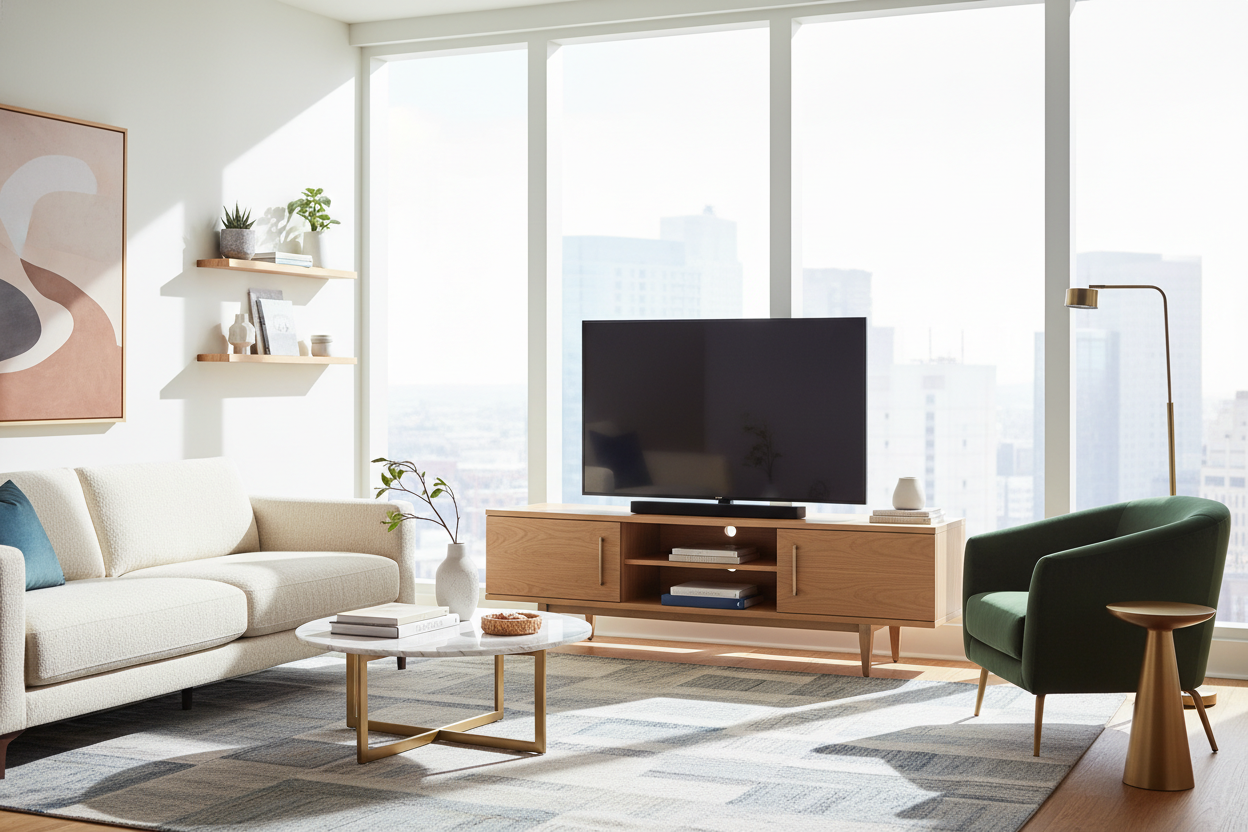
Keep it simple. A stack of two or three large art books, maybe a low-profile ceramic tray for your remotes, and one (just one!) small plant or object of interest. Because the TV is raised, you can actually put things under it without blocking the bottom of the screen. I use this space for a vintage brass bowl that holds my keys. It looks intentional. The goal is to make it look like the TV is an afterthought to the decor, even though we all know it’s the main event.
My Personal Experience with the 'Lean'
I learned the hard way that not all mounts are created equal. I bought a cheap unit for my first apartment because I was obsessed with the 'floating' look. After three months, the metal spine started to slightly bow forward. My TV wasn't just mounted; it was looming over me like a threat. I ended up having to wedge shim pieces under the front of the wood base just to keep it level. It looked ridiculous. Since then, I only buy units where the mount is bolted through the actual frame of the furniture, not just screwed into the top panel. The difference in stability is night and day.
FAQ
Will these stands hold an 85-inch TV?
Most are rated for weight, not just size. However, for an 85-inch, the sheer width can make the setup look top-heavy. Always check the weight capacity of the mount and ensure the wood base is wider than the TV itself to maintain visual and physical balance.
Can I hide a large power strip inside the spine?
Usually, no. The spine is for the cables themselves. You’ll want to mount the power strip to the back of the wooden console or hide it inside one of the cabinets. The spine is just the highway that gets the cables down there invisibly.
Is assembly a nightmare?
It’s about a 45-minute job. You’ll need a second person to help you actually lift the TV onto the bracket. Don't try to be a hero and do it alone; that’s how screens get cracked and friendships get tested.


Dejar un comentario
Este sitio está protegido por hCaptcha y se aplican la Política de privacidad de hCaptcha y los Términos del servicio.