










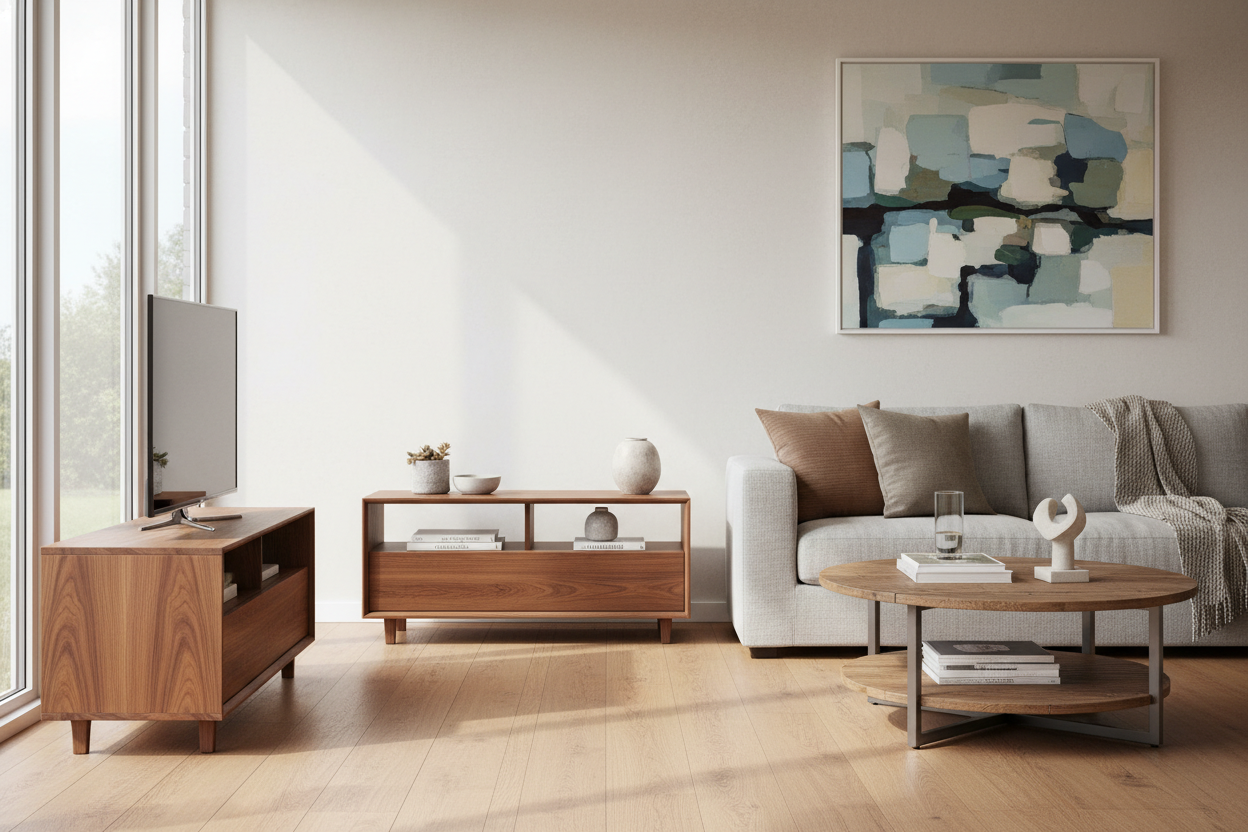
I spent three hours last night scrolling through furniture listings, looking at consoles that cost less than my weekly grocery bill. It is tempting. But then I looked at my current setup—a particle board unit that is currently doing a sad, slow-motion impression of a U-turn under the weight of a 55-inch screen. If you are tired of furniture that feels like it is made of compressed crackers, it is time to talk about wood tv cabinets.
The truth is, most of what we buy online is 'disposable' furniture. It looks great in a staged photo, but the moment you actually put a heavy television and a soundbar on it, the physics of cheap materials start to take over. I have learned the hard way that saving $200 now usually means spending $500 again in two years.
- Solid wood handles weight without 'smiling' (bowing) in the middle.
- Real timber can be sanded and refinished; MDF goes in the landfill if it gets a deep scratch.
- Authentic wood joints (like dovetails) stay tight, while cam-locks in particle board wiggle loose over time.
- Resale value for solid wood remains high, whereas used laminate furniture is often given away for free.
The 'Sagging Shelf' Epidemic in Modern Living Rooms
We have all seen it. You buy a cheap wood tv stand that claims to support up to 75 pounds. You set it up, it looks crisp, and you feel like a budgeting genius. Fast forward twelve months, and there is a visible dip in the center. That is the 'smile'—the structural failure of glue and sawdust under constant pressure.
MDF and particle board simply do not have the internal fiber strength to resist gravity long-term. When you invest in wooden tv stands for flat screens made from actual lumber—think oak, walnut, or mango wood—you are buying a piece that treats gravity as a suggestion rather than a death sentence. If you are ready to stop the cycle of replacing your media center every time you move house, you should browse our collection of TV stands to find something that actually lasts.
Real Timber vs. Veneer: What Are You Actually Paying For?
There is a massive difference between a wooden tv unit and a unit that just looks like wood. A veneer is a paper-thin slice of wood glued over a core of compressed scraps. It looks fine until you bump it with a vacuum cleaner or spill a drink. Once moisture hits that core, the 'wood' swells and the veneer peels off like a bad sunburn.
With a genuine tv shelf wood setup, the material is the same all the way through. If you scratch a solid oak console, you can buff it out with some wax or a bit of sandpaper. If you scratch a laminate stand, you are staring at gray industrial pulp forever. You are paying for the ability to keep the piece for a decade rather than a season.
Matching the Wood to the Room (Without Looking Retro)
People often worry that solid wood feels too 'heavy' or looks like something from their parents' basement in 1994. That is a myth. Modern design has embraced cleaner lines and thinner profiles that make wood tv cabinets feel airy and sophisticated. It is all about the finish.
A wood flat screen tv stand doesn't have to be honey oak. You can opt for a black wood TV stand for a sleek look that disappears into a moody, minimalist room. Darker stains or painted finishes allow the organic texture of the grain to show through without making the room feel like a rustic cabin.
Finding the Right Size for Your Floor Plan
Size matters more than style when it comes to visual balance. A common mistake is buying a tv stand table wood console that is the exact same width as the TV. This makes the whole setup look top-heavy and precarious. You want at least 3 to 6 inches of breathing room on either side of your screen to keep the room feeling grounded.
When Less is More: The Small Profile Console
If you are in a tight apartment, a small wood tv stand is your best friend. Look for pieces with tapered legs—often called 'Scandi' or 'Mid-Century' style. These allow you to see the floor underneath the unit, which tricks the eye into thinking the room is larger than it actually is. It provides the warmth of timber without the visual bulk.
Commanding the Room: The Full Entertainment Wall
In a large open-concept living room, a tiny stand looks like a postage stamp on a billboard. This is where a large wood tv stand or a full wood tv entertainment unit comes into play. It anchors the wall and provides a focal point that isn't just a black glass rectangle. A great example of this scale is a natural wood and black finish entertainment center, which uses height and width to balance out a massive 75-inch screen.
A Personal Lesson in 'Fake' Wood
I once bought a 'walnut-finish' console for my first apartment. It was $120 and looked decent in the box. During assembly, one of the cam-lock screws ripped right through the particle board because I tightened it a quarter-turn too much. I had to use wood glue and a prayer to keep the left leg on. Two years later, the 'walnut' sticker started peeling at the corners where my feet rested. It looked cheap because it was cheap. My current solid mango wood stand has survived three moves, a spilled bottle of wine, and a very heavy cat. It still looks brand new.
A Few Quick Rules for Styling Your Wood Console
Solid wood can look a bit 'serious,' so you need to soften it up. I like to use the 'Rule of Three' on the surface: one stack of books, one organic element (like a plant), and one metallic or glass object to catch the light. If your piece has a lot of texture, like a styling a carved wood TV stand, keep the decor simple so the craftsmanship of the wood remains the star of the show.
FAQ
How much weight can a solid wood TV stand hold?
Most solid wood consoles can easily handle 100 to 150 pounds without breaking a sweat. Always check the manufacturer's specs, but generally, if it is solid timber, the wood will hold more than the TV actually weighs.
Will a wood TV stand scratch my floors?
Any furniture can scratch floors if you drag it. Always use felt pads on the bottom of the legs. Because solid wood is heavy, it stays put better than lightweight plastic or MDF units, which actually reduces the risk of 'scootch' marks.
How do I clean real wood furniture?
Skip the harsh chemical sprays. A slightly damp microfiber cloth followed by a dry one is usually all you need. Once or twice a year, use a high-quality furniture wax to keep the wood from drying out, especially if you live in a climate with harsh winters and indoor heating.

Leave a comment
This site is protected by hCaptcha and the hCaptcha Privacy Policy and Terms of Service apply.