










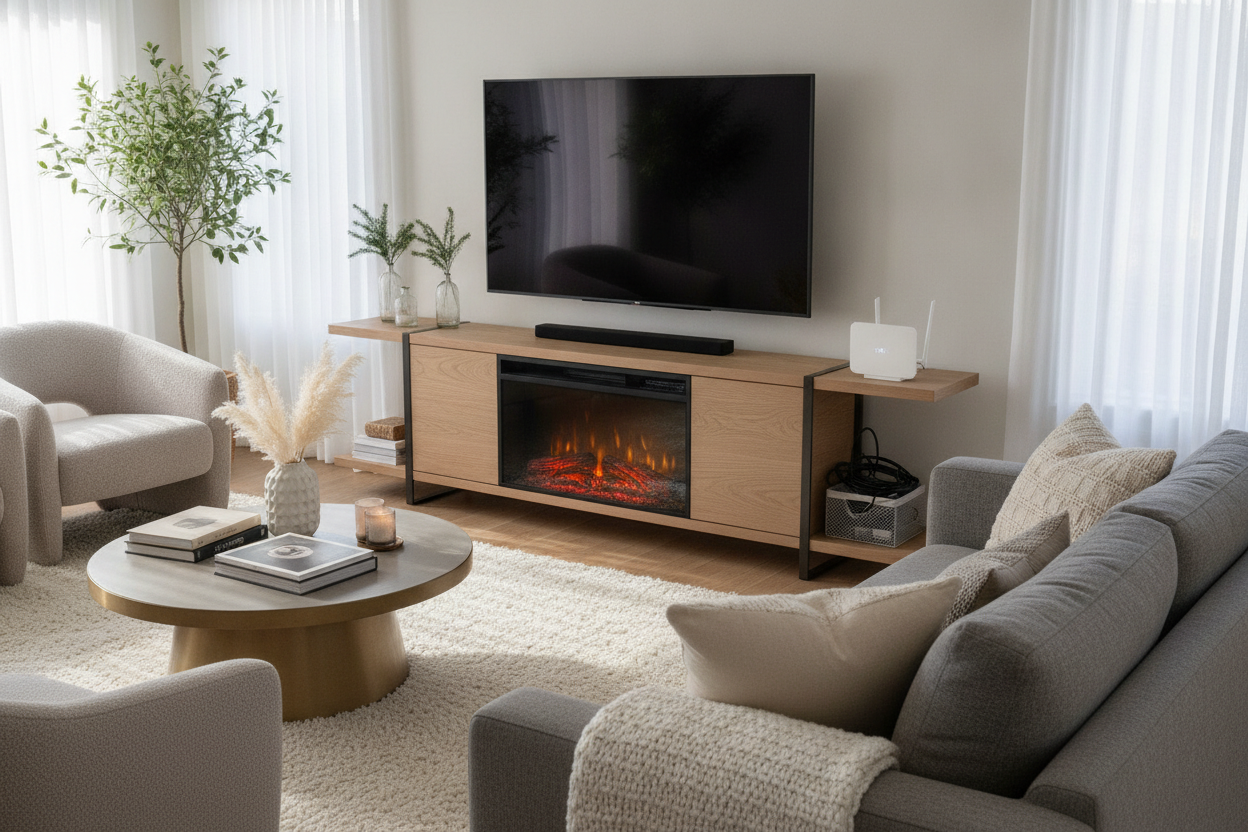
I spent three weeks staring at a drafty corner of my living room and a $500 router that I treated like a newborn baby. The idea of putting a heating element anywhere near my tech felt like asking for a molten plastic disaster. But when the temperature dropped to 40 degrees inside my apartment, my survival instinct finally beat out my tech-paranoia and I started researching tv stands for fireplace setups.
I was convinced I’d be writing a homeowner's insurance claim by February. Instead, I found out that modern media consoles are actually smarter than I gave them credit for. If you are worried about your gaming console or your mesh router turning into a puddle, you are not alone—but you might be worrying for nothing.
Quick Takeaways
- Front-venting fans push heat away from the cabinet, keeping electronics cool.
- Always leave at least 2 inches of clearance behind the unit for cable management and airflow.
- A skinny fireplace tv stand is better for supplemental heat than a primary heat source.
- Check the BTU rating; most units handle about 400 square feet comfortably.
Confession: I Thought Heater TV Stands Were a Massive Fire Hazard
For the longest time, I lumped heater tv stands into the same category as those sketchy plug-in space heaters from the 90s—the ones that smelled like burning dust and made the lights flicker. I had this vision of my expensive OLED screen warping under the heat or my router’s internal chips frying because they were sitting directly on top of a literal furnace.
The reality hit me during a particularly brutal January. My central heating is a joke, and I was tired of wearing three layers of wool just to watch Netflix. I started looking into how these things are built. It turns out, the 'fire' is just LEDs and mirrors, and the 'heat' is a controlled fan-forced system. I finally realized that if I could trust a toaster in my kitchen, I could probably trust a fireplace tv unit in my living room.
How TV Stand Fireplaces Actually Work (Without Frying Your Tech)
The secret is in the venting. Unlike a real wood-burning hearth that radiates heat in every direction, a tv stand with fireplace in it uses a front-facing blower. The heating element is tucked behind a shroud, and a fan pushes the warm air straight out into the room. The actual wooden (or MDF) cabinet stays remarkably cool.
When you browse standard TV stands, you’re usually looking for weight capacity and cable holes. With tv stand fireplaces, you’re looking at the 'zero-clearance' rating of the insert. This means the box is insulated so well that you can press it right against the furniture walls without a problem. My router sits about six inches above the heater vent, and even after four hours of use, the bottom of the router is barely lukewarm.
Finding Your Fit: From Skinny Profiles to Heavy-Duty Storage
Size matters here, and not just for the 'vibe.' If you’re in a tight studio, a skinny fireplace tv stand is a lifesaver. These usually have a depth of about 12 to 15 inches, which is just enough to hold a modern TV without eating up your entire walkway. They don't offer much storage, but they kill that 'cold apartment' feeling instantly.
If you have the floor space, I always lean toward tv stands with fireplace and storage. You want those side cabinets to hide the absolute mess of wires that comes with a home theater setup. It’s a lot easier to choose the perfect TV stand with fireplace when you know exactly how many controllers, HDMI switches, and physical games you need to shove out of sight.
The Mounting Dilemma: Should You Put the Screen Directly on Top?
This is where people get divided. Some people love the look of a tv stand mount with fireplace where the screen is physically attached to a bracket on the back of the unit. It’s sturdy and keeps the TV at a fixed height. Personally? I prefer the floating look of tv stands over fireplace inserts where the TV is wall-mounted about 6 inches above the console.
Wall-mounting gives your tech an extra layer of protection from the heat, even if it is just psychological. It also frees up the entire top surface of the stand for a soundbar or some decor. If you do put the TV directly on the stand, just make sure the feet of the TV aren't hanging off the edge—fireplace units can sometimes be narrower than you expect.
3 Rules for Styling a Fireplace TV Unit So It Doesn't Look Cheesy
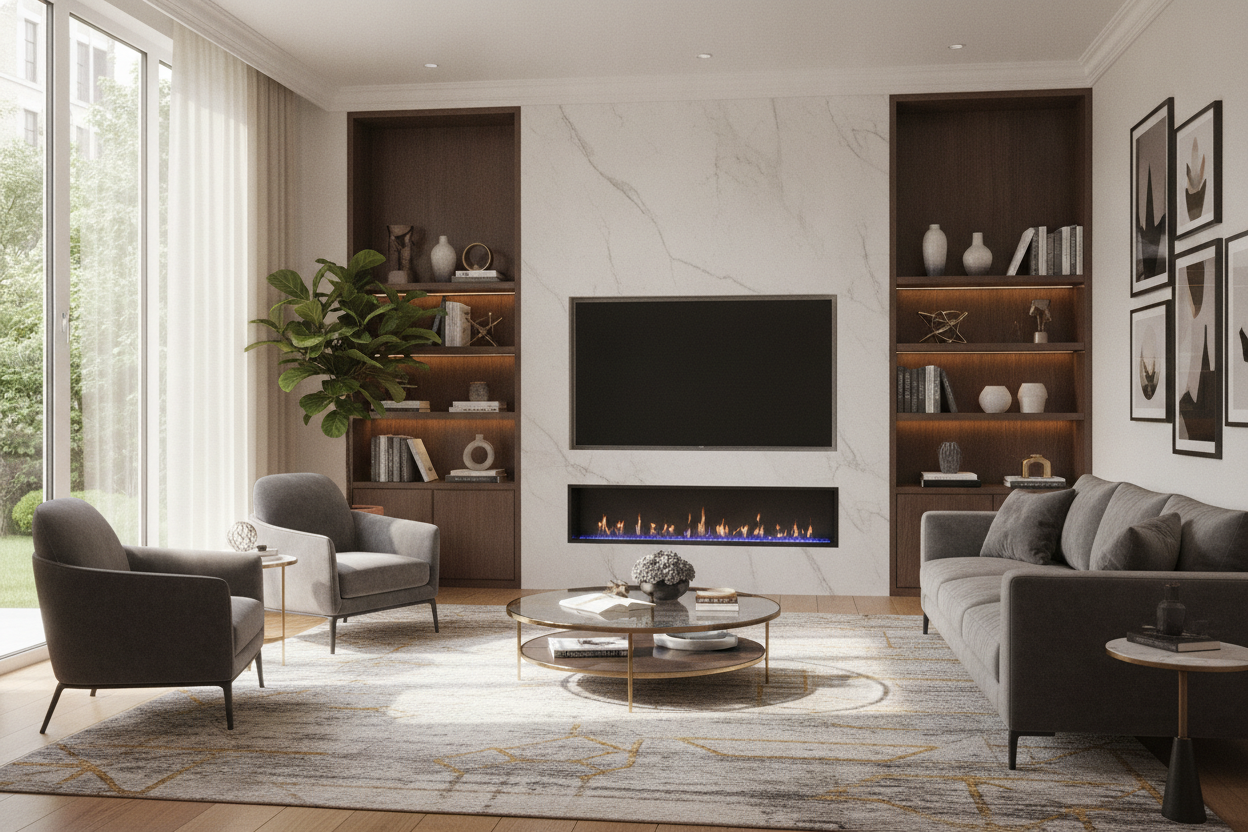
Let’s be honest: some tv stand with fireplaces look like they belong in a budget motel. To avoid that, you have to layer in organic textures. First, ditch the plastic 'logs' if you can and go for a unit with glass crystals or faux stones—it feels more modern and less 'pioneer cabin.'
Second, balance the 'black hole' of the screen and the fireplace with some light. A white fireplace heater TV stand works wonders in a small room because it doesn't feel like a giant dark monolith against the wall. Third, use baskets. I put a chunky wicker basket next to mine to hold blankets. It softens the hard edges of the electronics and makes the whole setup feel intentional rather than just a place to put the TV.
FAQ
Will the heat damage my TV screen?
No, as long as the vent is front-facing and not top-venting. Most electric fireplaces blow air horizontally into the room, so the heat never actually rises directly into the bottom of the TV.
Do these units use a lot of electricity?
On the 'flame only' setting, they use about as much as a lightbulb. When the heater is on, they usually pull about 1500 watts, which is the same as a standard hair dryer or portable space heater.
Can I plug it into a power strip?
Absolutely not. These should always be plugged directly into a wall outlet. Power strips aren't usually rated for the continuous high draw of a heater and can become a fire hazard themselves.

Leave a comment
This site is protected by hCaptcha and the hCaptcha Privacy Policy and Terms of Service apply.