










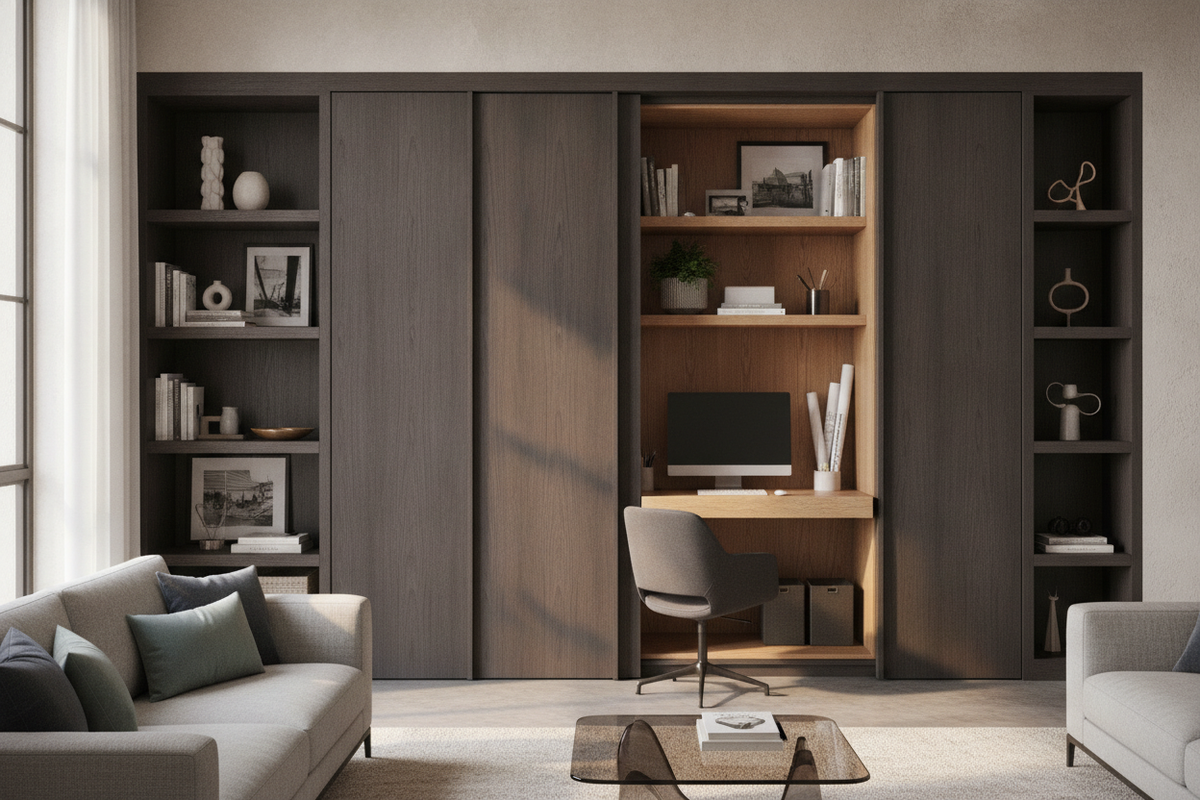
The Hidden Workstation Concept: Why Integrate a Desk Inside a Cabinet?
Modern residential design increasingly prioritizes multi-use versatility. As hybrid work schedules blend domestic and professional environments, keeping dedicated computer equipment, papers, and office accessories on constant display can disrupt the visual calm of living rooms, bedrooms, or shared family zones. Choosing a cabinet with a desk inside addresses this balance by offering a functional work surface that conceals entirely behind closed doors during off-hours.
Integrating a workstation into a cabinet enclosure establishes a psychological boundary between workday productivity and domestic relaxation. Rather than letting computer monitors and peripherals dominate a room's aesthetic, a concealable cabinet allows homeowners to hide your office in plain sight while preserving precious floor space for daily living.
Structural Archetypes of Cabinets with Desks Inside
Concealed desk cabinets come in distinct structural forms, each offering specific spatial footprints and operational styles depending on room size and workflow requirements.
Drop-Down Secretary and Bureau Enclosures
The drop-down secretary desk remains a classic compact choice. In this configuration, the front panel of the upper or middle cabinet section hinges downward along a horizontal axis to form a flush work surface. Heavy-duty support stays, hinges, or slide rails hold the flap steady under normal working loads. When folded up, the unit resembles a traditional sideboard or vertical cabinet, making it suitable for compact apartments, guest rooms, and hallway alcoves.
Full-Height Armoire Workstations with Concealed Pedestals
Full-height armoire desks offer a comprehensive workspace solution inside a tall, wardrobe-style structure. These units typically feature bi-fold doors, pocket doors, or standard swinging doors that open wide to reveal a stationary, deep desktop surface, upper shelving for monitors and paper trays, and lower compartments designed for computer towers or document storage. Pocket doors that slide back into the side recesses of the cabinet frame are especially beneficial for maintaining clear walkways in tighter rooms.
Horizontal Credenzas with Pull-Out or Slide-Under Desks
For spaces with lower horizontal profiles or open wall areas beneath windows, credenza-style desk cabinets provide an elongated layout. These configurations often pair built-in storage bays with an extending desktop surface that slides out on heavy-duty drawer glides or swings open on pivoting casters. Combining lower file storage with flexible surface expansion, a wooden reception desk with filing cabinet layout offers a horizontal format that anchors transitional spaces without dominating vertical sightlines.
Internal Clearance and Ergonomic Dimensional Frameworks
A successful concealed workstation must balance exterior proportions with internal ergonomic clearances. When closed, the cabinet must maintain a streamlined profile; when open, it must accommodate natural seating posture, legroom, and screen viewing angles.
- Desktop Depth and Width: An internal work surface must provide sufficient depth for a laptop or keyboard alongside basic desktop essentials without forcing cramped wrist positions.
- Knee-Well Clearance: Ensuring unobstructed vertical clearance underneath the extended work ledge allows standard office seating or folding desk chairs to pull up closely and comfortably.
- Monitor and Shelf Elevation: Upper internal shelving should leave adequate vertical space for laptop displays or dedicated desktop monitors, avoiding awkward downward neck angles.
- Seating Integration: Planning how the chair will be stowed is essential. Many setups pair the cabinet with a low-profile task chair, an accent chair that complements the surrounding decor, or an internal bay designed specifically for stool storage.
Using a structured cabinet organizer office setup inside the enclosure helps prevent loose stationery and peripherals from crowding the active working envelope.
Power, Cable Routing, and Thermal Ventilation inside Cabinet Workspaces
Operating electronic devices inside a cabinet requires careful attention to wiring, power supply access, and heat dissipation.
To prevent messy wiring from tangling around door hinges or obstructing the closure of fold-down panels, look for cabinet designs with pre-drilled cable pass-through grommets between internal shelves and the rear panel. Installing an internal surge-protected power strip allows laptops, monitors, task lamps, and charging docks to remain plugged in internally, requiring only a single power cord to exit the back or base of the cabinet toward the nearest wall outlet.
Thermal management is equally important. Laptops and computer power supplies generate ambient heat during extended operation. Open back cutouts, ventilated rear panels, or maintaining small gaps between interior shelves and the backboard facilitate natural air circulation, preventing heat buildup within the enclosed enclosure during long work sessions.
Storage Configurations: Balancing Upper Shelves, Compartments, and Filing Drawers
The interior architecture of a desk cabinet determines how effectively it keeps clutter contained. A well-organized cabinet balances active desktop surface area with vertical utility.
Upper compartments function best for vertical dividers, reference materials, small document bins, and task lighting. Mid-level open ledges provide convenient landing spots for active notebooks and desktop accessories. Below the work surface, integrated file drawers and utility pedestals offer enclosed storage for hanging folders, extra office supplies, and bulkier peripherals such as printers or external storage drives.
Units like a 4-drawer multi-door office storage cabinet with desk illustrate how dividing interior space into dedicated pull-out drawers and closed shelving keeps every tool accessible without requiring permanent desktop clutter.
Room Placement and Aesthetic Integration Across Home Layouts
Because a cabinet with a desk inside looks like a standard storage piece when closed, it can blend effortlessly into diverse residential spaces:
- Living Rooms: Position the unit along a feature wall or beside an entertainment center, selecting an exterior finish that matches media consoles, bookcases, or coffee tables.
- Guest Bedrooms: Place the cabinet against a side wall to serve as a writing desk for visitors while providing general storage for linens or spare essentials.
- Dining Areas and Open Concepts: An elegant cabinet with classic paneling or glass-accented upper compartments functions as a buffet or display unit when closed, transforming into an efficient workspace during daytime hours. Browsing designs like a black cabinet with glass doors collection illustrates how dark wood tones and framed glass panels elevate formal living or dining environments.
- Hallway Alcoves: Shallow drop-down secretary cabinets make productive use of wide corridors, entryways, or unused structural recesses without encroaching on main traffic paths.
Material Craft, Hinge Mechanisms, and Long-Term Stability
The operational durability of a concealed desk cabinet relies heavily on its hardware and material construction. Fold-out writing panels and pull-out trays experience continuous daily motion and downward pressure, requiring robust hardware engineering.
Drop-down work flaps benefit from continuous piano hinges or reinforced heavy-duty drop-front stays that distribute weight evenly across the seam. Doors should feature adjustable, soft-close hinges or smooth sliding tracks to ensure clean alignment over time. For tall armoires and high-profile bureau units, anchoring the cabinet securely to wall studs using anti-tip mounting hardware is an essential step to ensure complete structural stability when doors and heavy internal components are fully extended.
Selection Checklist: Choosing Your Ideal Concealed Desk Cabinet
Before selecting a cabinet with a desk inside, review this practical decision checklist to ensure the piece matches your spatial and functional requirements:
- Measure Door Swing Paths: Confirm that swinging, bi-fold, or fold-down doors have full clearance without hitting nearby sofas, beds, or walkways.
- Verify Hardware and Screen Heights: Check that your primary laptop or desktop monitor fits comfortably inside the designated shelf opening when the cabinet doors are latched shut.
- Assess Internal Cable Routing: Ensure the unit has adequate cable grommets or removable back panels for clean power management.
- Evaluate Weight and Support Needs: Choose drop-down or slide-out surfaces supported by heavy-gauge steel hinges or sturdy support brackets suited for your daily typing and writing needs.
- Harmonize Exterior Styling: Select door profiles, hardware finishes, and wood grains that align naturally with existing furniture in the room.

Leave a comment
This site is protected by hCaptcha and the hCaptcha Privacy Policy and Terms of Service apply.