










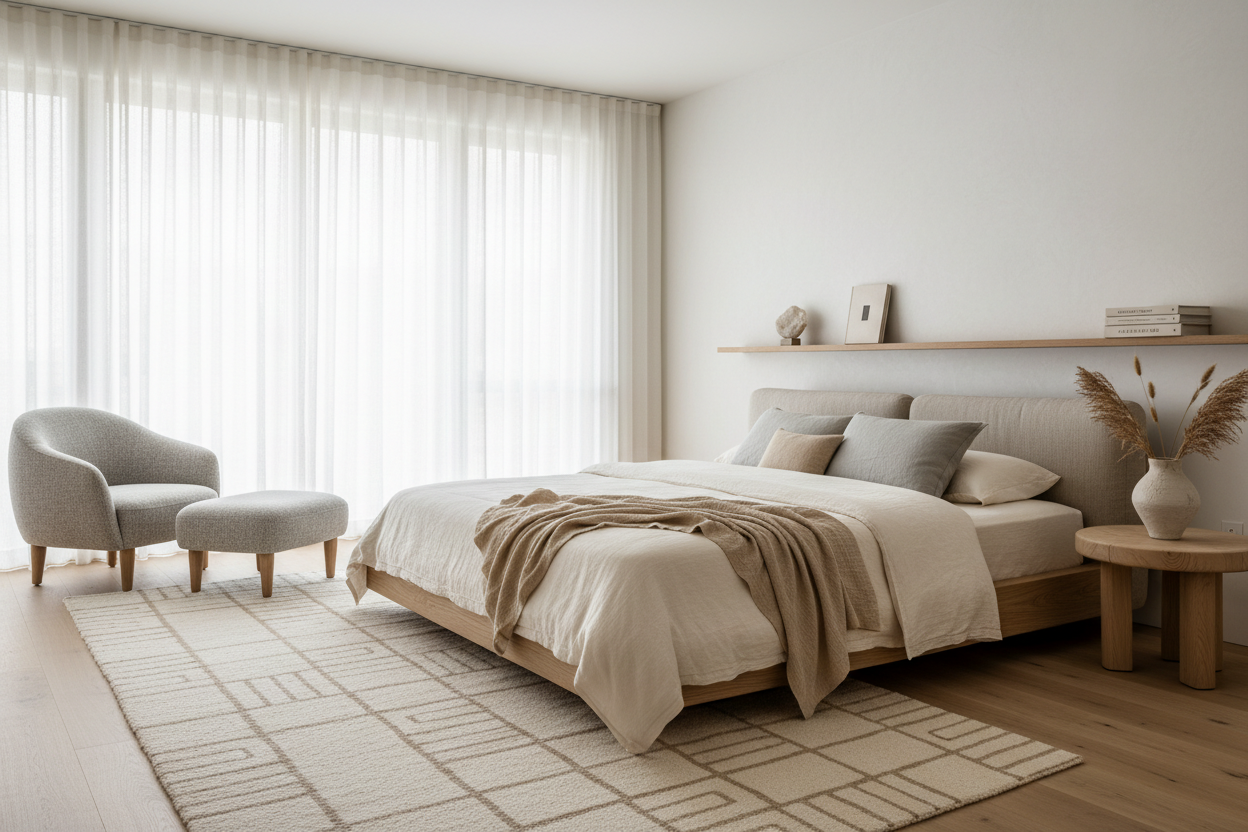
It's not minimalism. It's not maximalism. It's the space in between — where every choice is intentional, every surface has texture, and every room feels like exhaling.
If you've spent any time browsing design media this year, you've likely noticed a phrase recurring with unusual frequency: curated calm. It appeared in Dezeen's influential January 2026 roundup, where Hong Kong designer Andre Fu described the emerging aesthetic as "quiet authenticity and personal narrative — curated calm over superficial opulence." Within weeks, the term was everywhere — in design studio manifestos, magazine trend reports, and client briefs.
But curated calm isn't a trend in the conventional sense. It doesn't come with a specific color palette, a signature material, or a look you can copy from a Pinterest board. It's a philosophy — a way of making decisions about your home that prioritizes atmosphere over appearance, feeling over fashion, and presence over performance.
Understanding what it means, and what it doesn't, is the key to designing a space that will feel right not just in 2026, but for years to come.
Where It Came From
Curated calm didn't appear out of nowhere. It's the natural resolution of two competing forces that have dominated interior design for the past decade.
On one side: the minimalist impulse. The 2010s were defined by a widespread pursuit of visual simplicity — all-white rooms, clean lines, open floor plans, and a deliberate absence of ornamentation. At its best, this approach was calming and democratic. At its worst, it was sterile, impersonal, and emotionally hollow. By 2024, designers were openly describing "minimalist fatigue" among their clients.
On the other side: the maximalist reaction. As minimalism exhausted itself, a counter-movement emerged — rooms packed with pattern, color, collected objects, and deliberate excess. Maximalism was energizing and personal, but it also risked visual chaos. Not every homeowner wanted to live inside a gallery of competing statements.
Curated calm occupies the ground between these two extremes. It takes the restraint of minimalism and the warmth of maximalism, discards the weaknesses of each, and arrives at something that feels genuinely new: spaces that are quiet but not empty, layered but not cluttered, personal but not chaotic.
As Tokyo architect Keiji Ashizawa observed in early 2026, the most memorable interiors are not those with the strongest visual statements, but the ones where people naturally want to stay longer. That desire — to create rooms worth lingering in — is the heartbeat of curated calm.
What Curated Calm Is
Intentional, Not Minimal
The defining characteristic of curated calm is intentionality. Every element in the room has been considered — not just for how it looks, but for how it functions, how it feels under your hand, and what it means to the person who chose it.
This is fundamentally different from minimalism, which often defines itself by what's been removed. A minimalist room may contain very few objects, but those objects aren't necessarily meaningful — they're simply what survived the editing process. A curated calm room may contain more things, but each one earns its place through purpose, beauty, or personal significance.
The distinction matters in practice. A minimalist bedroom might have a platform bed, a single side table, and nothing else. A curated calm bedroom might have that same bed, but dressed in a handwoven linen duvet. A ceramic lamp made by a local potter on the side table. A single piece of art on the wall — not because the wall needed "something," but because that particular piece changes how you feel when you wake up in the morning.
It's the difference between a room that has been emptied and a room that has been considered.
Atmospheric, Not Decorative
Curated calm prioritizes atmosphere — the total sensory experience of being in a space — over decoration, which is primarily visual. This means thinking about light, texture, scent, acoustics, and temperature as design elements, not afterthoughts.
In a curated calm living room, for instance, the lighting isn't just functional. It's layered: a combination of natural light, a floor lamp casting a warm pool in the reading corner, and maybe a candle or two in the evening that shifts the room's character entirely. The walls might be finished in limewash or plaster rather than flat paint, creating surfaces that change subtly throughout the day as light moves across them.
Several designers have noted that texture is becoming the new status symbol in 2026 interiors — more important than brand names, more expressive than bold color. A hand-plastered wall, a stone countertop with visible veining, a wool rug with natural variations in the weave — these surfaces don't just look good. They engage multiple senses. They reward attention. They make a room feel alive.
Warm, Not Neutral
One of the most common misunderstandings of curated calm is that it means beige. It doesn't.
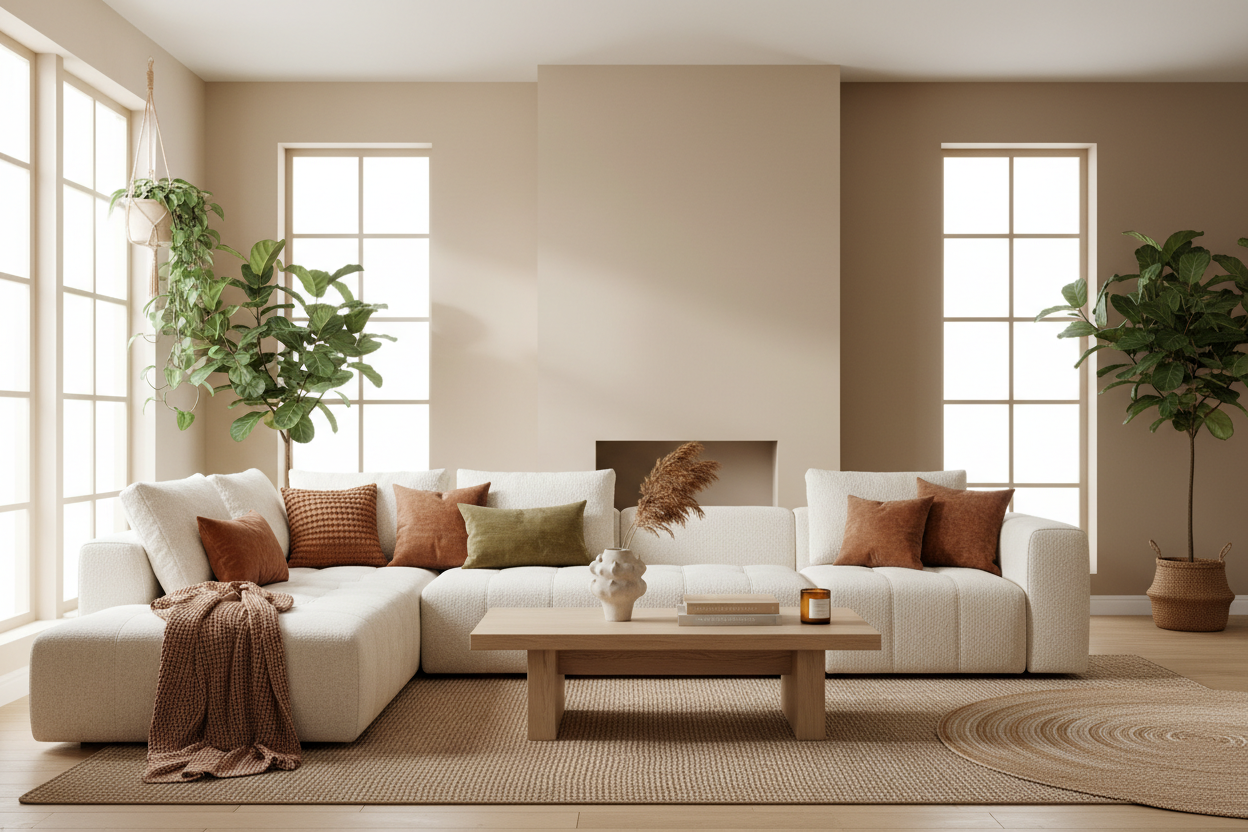
The palette of curated calm tends toward warmth — earth tones, clay, terracotta, deep olive, umber, soft walnut, warm stone — but it's not limited to neutrals. Deep teals, muted blues, rich burgundies, and forest greens all have a place, provided they're applied with restraint and intention. The key is that colors are chosen for how they make a room feel, not for how they photograph.
Color in curated calm interiors is often used immersively rather than as an accent. A technique gaining popularity in 2026 involves painting walls, trim, ceiling, and sometimes even cabinetry in the same enveloping hue — creating a unified atmosphere rather than a series of visual contrasts. When done well, the effect is remarkably soothing. The room becomes a single continuous environment rather than a collection of surfaces competing for attention.
Personal, Not Styled
Perhaps the most radical aspect of curated calm is its insistence on personal narrative over aesthetic consistency. The rooms that best embody this philosophy don't look like they were designed by a professional in one session. They look like they were assembled over time by someone with a specific life, specific memories, and specific tastes.
This means inherited furniture is welcome. So are travel souvenirs, vintage finds, handmade objects from local artisans, and pieces that don't match anything else in the room but carry emotional weight. The goal isn't visual coherence for its own sake — it's a room that tells a true story about the person living in it.
London designer Benni Allan described 2026 interiors as "quietly expressive — spaces that feel calm, tactile and deeply personal." That word "personal" is doing the heavy lifting. A curated calm space isn't just nice to look at. It's recognizably, unmistakably someone's.
What Curated Calm Is Not
Understanding the boundaries of this philosophy is just as important as understanding its principles. Curated calm is not:
Stark minimalism. Empty rooms with bare walls and nothing on the surfaces. Curated calm rejects the idea that "less is more" as a universal truth. Sometimes less is just... less. The goal is not reduction for its own sake, but the presence of just the right things.
Instagram maximalism. Rooms designed primarily for visual impact — gallery walls covering every inch, pattern stacked on pattern, objects crammed onto every shelf. Curated calm has layers, but they breathe. There's space between things. The eye has somewhere to rest.
Showroom perfection. Spaces that look untouched, unlived-in, and interchangeable. If a room could belong to anyone, it belongs to no one. Curated calm demands specificity — the marks of a real life being lived.
Trend-chasing. Curated calm is fundamentally allergic to following fashion for fashion's sake. If something is in your home only because a magazine told you it should be, it doesn't belong in a curated calm space. If it's there because it makes your mornings better, it stays — regardless of whether it's "in" or "out."
The Five Principles in Practice
How do you actually achieve curated calm in a real home? Here are five guiding principles that designers working in this mode consistently apply.
1. Edit by Feel, Not by Count
The minimalist approach to editing is quantitative: fewer things equals better. The curated calm approach is qualitative: does this object contribute to how the room feels? If a room has twelve objects and each one enhances the atmosphere, that's not too many. If it has three objects and one of them creates visual noise, that's too many.
Walk through each room and ask, about every piece: Does this make the room feel better? Not "does this look good in a photo," but does its presence make the room more pleasant to be in? Remove what doesn't pass the test. Keep what does, regardless of how many items remain.
2. Layer Texture, Not Pattern
Pattern can be energizing, but it demands visual attention. Texture provides richness without that demand. In a curated calm space, variety comes through surface rather than print: the roughness of a linen curtain against the smoothness of a plaster wall, the grain of a solid wood table against the softness of a wool seat cushion, the cool weight of a stone bowl against the warmth of a ceramic mug.
This approach creates rooms that feel rich and interesting when you're in them, but calm and restful when you glance around. The complexity reveals itself gradually, through touch and proximity, rather than shouting from across the room.
3. Use Light as Material
In curated calm interiors, natural light is treated with the same seriousness as paint or furniture. The way light enters a room, moves across its surfaces throughout the day, and changes character from morning to evening is central to the atmosphere.
This means being thoughtful about window treatments — choosing materials that filter light softly rather than blocking it entirely or letting it flood in uncontrolled. It means selecting wall finishes (limewash, plaster, matte paint) that respond to light rather than reflecting it uniformly. And it means layering artificial light at multiple heights and temperatures, so that the room can shift from energizing to restful as the day progresses.
4. Choose Materials That Age
One of the clearest distinctions between curated calm and its predecessors is the relationship to time. Minimalism and the popular "Apple Store Aesthetic" of the 2010s favored materials that looked identical on day one and day one thousand — engineered surfaces, synthetic fabrics, laminated finishes. They resisted time.
Curated calm embraces it. The materials favored in this philosophy are those that develop character as they age: solid wood that darkens and develops patina, natural stone that acquires subtle marks, leather that softens, brass that oxidizes, linen that grows more supple with every wash. These materials don't deteriorate — they mature. And a room filled with them feels more alive and more beautiful with each passing year.
5. Let One Thing Be Imperfect
This might be the most counterintuitive principle, but it's also the most important. A room that is too perfect — too coordinated, too polished, too considered — loses the quality that makes curated calm feel human. Something needs to be slightly off. A handmade vase with a slight wobble. A vintage chair with visible wear. A shelf arranged with a casualness that could never have been art-directed.
This intentional imperfection is related to the Japanese concept of wabi-sabi, which finds beauty in transience and irregularity. In the context of curated calm, it serves a practical purpose: it signals that this is a real home, occupied by a real person, and not a stage set waiting for its close-up.
Why Now?
The emergence of curated calm in 2026 isn't random. It's a response to specific conditions in the world beyond design.
Post-pandemic domesticity. After years of spending unprecedented time at home, people have developed a deeper relationship with their living spaces. The gap between "looks good" and "feels good" has become impossible to ignore, and the demand has shifted decisively toward the latter.
Digital overload. In a world saturated by screens, notifications, and algorithmic content, the home is increasingly being conceived as a counterspace — a refuge from stimulation rather than another source of it. Curated calm offers visual and emotional rest.
The AI question. As artificial intelligence reshapes workplaces and creative industries, there's a growing cultural desire for things that feel authentically human. Handmade objects, natural materials, spaces shaped by personal choice rather than algorithmic recommendation — these carry a significance in 2026 that they didn't a decade ago.
Economic pragmatism. Buying fewer, better things isn't just a philosophy — it's a financial strategy. In an era of rising costs, investing in durable materials and meaningful objects that don't need replacing every few years makes practical sense. Curated calm aligns personal values with economic reality.
Smita Thomas, founder of Bengaluru-based Multitude of Sins, captured the broader cultural shift when she described 2026 as the year of "disciplined, intelligent restraint that borrows from maximalism's warmth but strips its excess." That discipline — warm, considered, and deeply personal — is what curated calm is all about.
The Enduring Appeal
Trends, by definition, expire. The all-white kitchen had its moment. Millennial gray had its moment. Boucle furniture had its moment. Each looked fresh for a season and dated the next.
Curated calm is designed to outlast that cycle. Because it's defined not by specific materials, colors, or styles but by a set of principles — intentionality, atmosphere, warmth, personal narrative, and the embrace of time — it remains relevant regardless of what surfaces and palettes happen to be fashionable in any given year.
A room designed around curated calm in 2026 won't need to be "updated" in 2028. The wood will have aged. The textiles will have softened. A few new objects will have joined the collection — a ceramic found on a trip, a painting by a friend, a lamp inherited from a parent. The room will have grown more itself, not less.
And that, perhaps, is the most radical idea in curated calm: a home isn't a project to be completed. It's a story being written, one considered choice at a time.
The quietest rooms often say the most. Not because they're empty — but because everything in them means something.

Leave a comment
This site is protected by hCaptcha and the hCaptcha Privacy Policy and Terms of Service apply.