










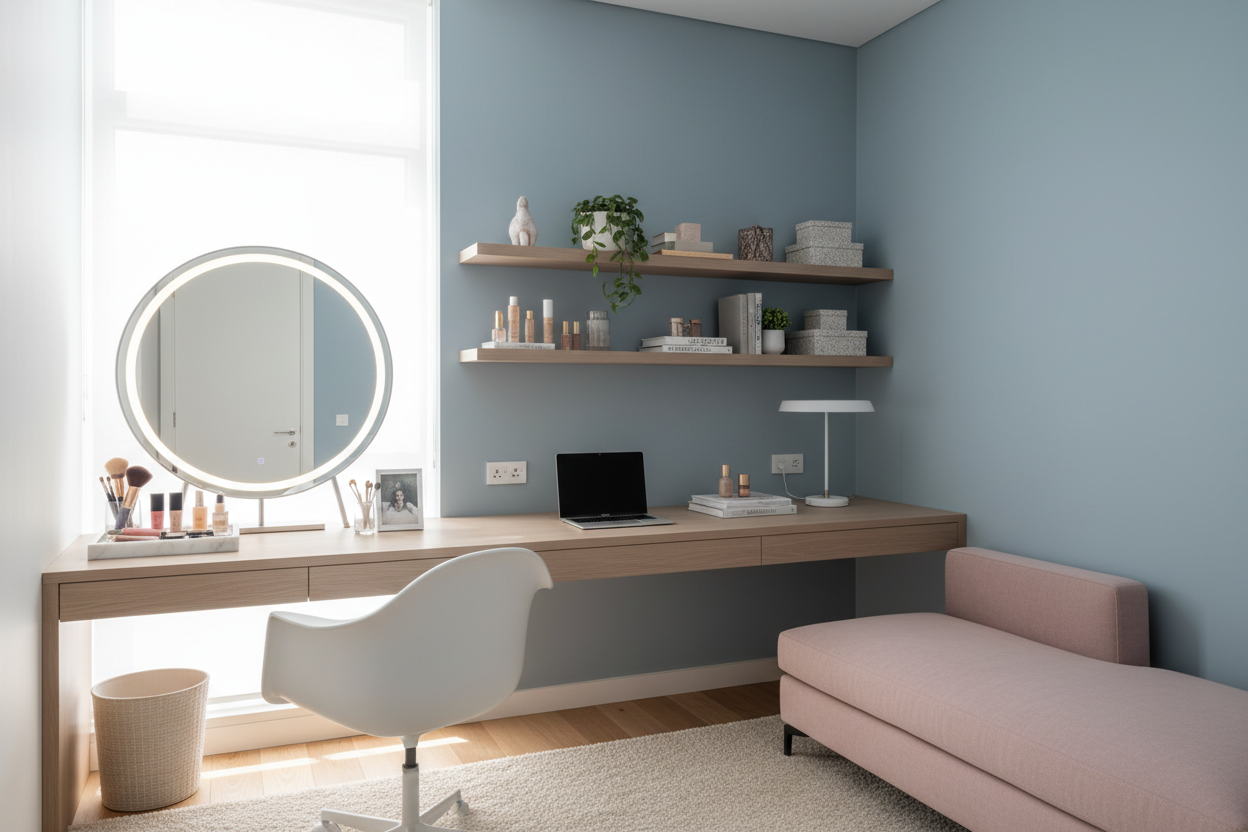
Merging two distinct zones—a productive workspace and a creative beauty station—is a common spatial puzzle for modern interiors. The challenge lies in balancing the utilitarian needs of a 9-to-5 with the soft, glamorous atmosphere required for your morning ritual. You want a space that feels professional on Zoom calls yet indulgent when you are getting ready. This guide explores the architectural and decorative nuances of creating a seamless office and makeup room without sacrificing ergonomics or style.
Quick Decision Guide: Key Features to Look For
- Lighting Temperature: Aim for adjustable Kelvin settings (2700K for ambiance, 4000K-5000K for makeup application and task work).
- Surface Durability: Choose non-porous materials like quartz or tempered glass over unsealed wood to prevent makeup staining.
- Ergonomics: Prioritize a chair with lumbar support that fits under the vanity; avoid low-profile lounge chairs for desk work.
- Storage Zoning: distinct storage systems are vital—acrylic dividers for beauty products and opaque filing cabinets for documents.
Zoning and Layout Strategy
The most successful office makeup room designs rely on distinct zoning. In a small home office and makeup room, you might not have the square footage for two separate desks. Here, the layout must be linear or L-shaped.
The L-Shaped Configuration
If space permits, an L-shaped desk is the gold standard. Dedicate the longer side to your computer setup (monitors, keyboard) and the shorter return to your vanity mirror. This allows you to swivel between tasks without physically moving equipment, maintaining a mental separation between work and self-care.
The Linear "Double-Duty" Console
For tighter footprints, a long floating console works best. Visual separation is key here. Use a drawer stack or a small mobile pedestal to act as a physical border between the "tech zone" and the "beauty zone." This prevents your laptop from encroaching on your palette layout.
Choosing the Right Materials
When curating office beauty room ideas, material selection is more than just aesthetics; it is about longevity. Makeup pigments are notorious for staining porous surfaces.
Solid Wood vs. Engineered Stone: While a solid walnut desk adds warmth and gravitas to a home office and makeup room, it is vulnerable to acetone and oils. If you prefer the wood look, ensure it has a high-grade polyurethane seal. However, for the vanity section, I always recommend a glass top overlay or a stone surface (like quartz or sintered stone) which is impervious to spills and easy to sanitize.
Lighting: The Critical Intersection
Lighting is where most office and beauty room ideas fail. Office lighting needs to be diffuse to reduce screen glare, while makeup lighting must be directional and high CRI (Color Rendering Index).
Avoid relying solely on overhead downlights, which cast unflattering shadows under the eyes. Instead, layer your lighting. Install sconces at face level for the vanity area. For the office side, an architectural task lamp with a dimmer allows you to control the mood. If you are video conferencing, the vanity lights can double as excellent ring-lighting to brighten your face on camera.
Seating: The Form vs. Function Debate
In an office beauty room, the chair is the anchor. The temptation is to buy a tufted velvet ottoman or a low-back accent chair for the aesthetic appeal. However, if you are working eight hours a day, this is a recipe for back pain.
Opt for a high-quality task chair upholstered in a fabric that bridges the gap, such as a performance velvet or a high-grade leather in a soft neutral tone like taupe or blush. Ensure the chair has seat-height adjustment; the ideal typing height is often different from the ideal mirror-viewing height.
Lessons from My Own Projects
I recently designed a dual-purpose room for a client who insisted on a gorgeous, rough-hewn reclaimed wood desk to serve as both her workstation and vanity. It looked incredible in the photos, but three months later, she called me in frustration.
The issue wasn't the look—it was the texture. She found that loose powder and foundation were getting trapped in the grain of the wood, making it impossible to keep clean. Furthermore, the "vibey" warm lighting we installed for the room's evening ambiance was terrible for applying eyeliner; she was constantly walking to the bathroom to check her work. We ended up retrofitting a tempered glass sheet over the wood to create a smooth, wipeable surface and swapping the bulbs for tunable LEDs. It taught me that in a hybrid space, practical maintenance must always precede texture.
Conclusion
Creating a cohesive space requires a thoughtful approach to layout and lighting. By selecting durable materials and prioritizing ergonomic furniture, you can design a room that supports your career ambitions while providing a sanctuary for your personal style. It is not about compromising one for the other; it is about smart integration.
Frequently Asked Questions
What is the best desk depth for a dual-purpose room?
Aim for a depth of at least 24 inches (60 cm). This provides enough distance for a computer monitor while leaving ample foreground space for a mirror and makeup products when you switch modes.
How do I hide clutter in a small office/makeup room?
Vertical storage is your ally. Use wall-mounted shelving for books and decor, and dedicate drawer organizers strictly for small items. A rolling cart can also be tucked away when not in use to keep the vanity surface clear.
Can I use a regular mirror for my office vanity setup?
Yes, but ensure it is positioned correctly. Avoid placing a mirror directly behind your computer monitor, as it can reflect room movement and distract you during work. A tri-fold mirror that can be closed or a dedicated wall-mounted mirror off to the side is preferable.

Leave a comment
This site is protected by hCaptcha and the hCaptcha Privacy Policy and Terms of Service apply.