










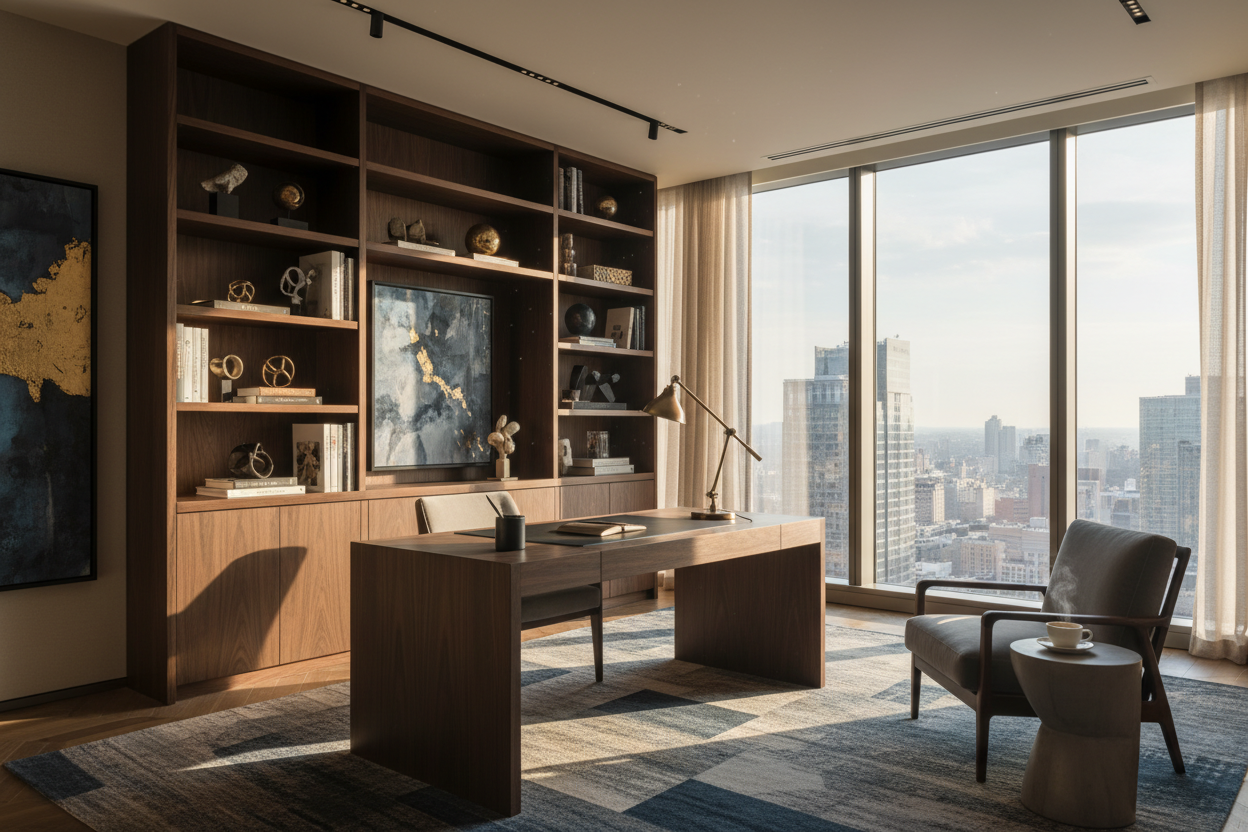
There is a distinct difference between a standard workspace and a sanctuary designed for focus, strategy, and contemplation. Many homeowners make the mistake of prioritizing pure utility over atmosphere, resulting in a room that feels sterile rather than inspiring. A true gentleman's office is not just a place to answer emails; it is a physical manifestation of character, blending rich textures with architectural weight.
Key Design Elements for the Modern Gentleman
- Material Palette: Prioritize natural materials like full-grain leather, solid walnut or mahogany, and antiqued brass.
- Lighting Layers: Move beyond overhead lights; utilize task lamps and accent lighting to create a moody, focused ambiance.
- The Anchor Piece: The desk should face the room (floating layout), not the wall, to establish authority.
- Textural Balance: Soften hard wood surfaces with heavy drapery or a high-pile rug to improve acoustics and comfort.
Defining the Aesthetic: Modern vs. Traditional
The first step in curating a gentleman's home office is determining where you fall on the spectrum of design. The traditional route leans heavily on English library aesthetics—think tufted leather, dark wainscoting, and intricate millwork. However, the modern gentleman's office is increasingly popular for its cleaner lines.
In a modern interpretation, we swap the heavy ornamentation for sleek silhouettes. We might replace a bulky Victorian desk with a live-edge slab on iron legs. The goal is to maintain the masculine color palette—charcoals, navies, and forest greens—while eliminating visual clutter.
The Anchor: Selecting the Right Desk
Solid Wood vs. Veneer
When selecting your focal point, the material quality is paramount. For a piece that ages beautifully, solid wood is the superior choice. It develops a patina over time that tells a story. Veneers can look sharp initially but chip easily, revealing the particle board beneath—a detail that instantly cheapens the room's feel.
Placement and Flow
Never push your desk against a wall if space allows. Floating the desk in the center of the room, or at least facing the door, changes the psychology of the space. It places you in a command position, allowing you to see who enters and giving the room a sense of breathability.
Lighting: The Mood Maker
Lighting is often the most undervalued aspect of a gentleman's study. Harsh 4000K (cool white) bulbs have no place here. Aim for 2700K to 3000K warm bulbs. Layering is critical: start with a statement chandelier or pendant, add a dedicated brass task lamp for your work surface, and consider picture lights to highlight artwork or shelving. This creates pockets of shadow and light that add drama and depth to the interior.
My Personal Take on Gentleman's Office Design
I learned a hard lesson about the "Chesterfield Trap" early in my career while designing a study for a client in Chicago. We were both obsessed with the aesthetic of a vintage, tufted leather Chesterfield chair behind the desk. It looked incredible—pure, old-world sophistication.
However, three weeks after installation, the client called me. The lack of lumbar support and the fixed height meant his back was killing him after two hours of work. We had to swap it out. Now, I always advise clients: keep the Chesterfield as a guest chair or a reading nook piece. For your actual desk chair, invest in a high-end ergonomic hybrid wrapped in cognac leather. It preserves the look without sacrificing your spine. Also, a small unpolished detail: if you choose a glass-top desk for a modern look, be prepared for the acoustic "slap" of putting a coffee cup down. I always insist on a high-quality leather desk blotter to dampen that sound and warm up the surface.
Conclusion
Curating a gentleman's office is about balancing the visual weight of masculine design with the practical necessities of modern work. By investing in quality materials that patina with age and prioritizing a layout that commands the room, you create a space that respects your time and your ambition. It is an investment in your state of mind.
Frequently Asked Questions
How do I design a gentleman's office in a small room?
Focus on verticality. Use floor-to-ceiling shelving to draw the eye up and create storage without using floor space. Choose a desk with legs rather than a solid block base to keep the room feeling open, and use a dark paint color on the walls to blur the corners, making the room feel infinite rather than cramped.
What makes a home office a "gentleman's" office?
It comes down to the material palette and the mood. Standard offices often use whites and bright colors for high energy. A gentleman's office utilizes darker, richer tones (navy, oxblood, charcoal), substantial materials (wood, leather, metal), and warm lighting to create a subdued, sophisticated atmosphere.
Is a rug necessary for this aesthetic?
Absolutely. A rug anchors the furniture so the desk doesn't feel like it's floating in an abyss. Furthermore, offices with hard floors and heavy furniture can have terrible echoes. A dense wool or vintage Persian rug dampens sound, making phone calls clearer and the room feel more intimate.


Leave a comment
This site is protected by hCaptcha and the hCaptcha Privacy Policy and Terms of Service apply.