










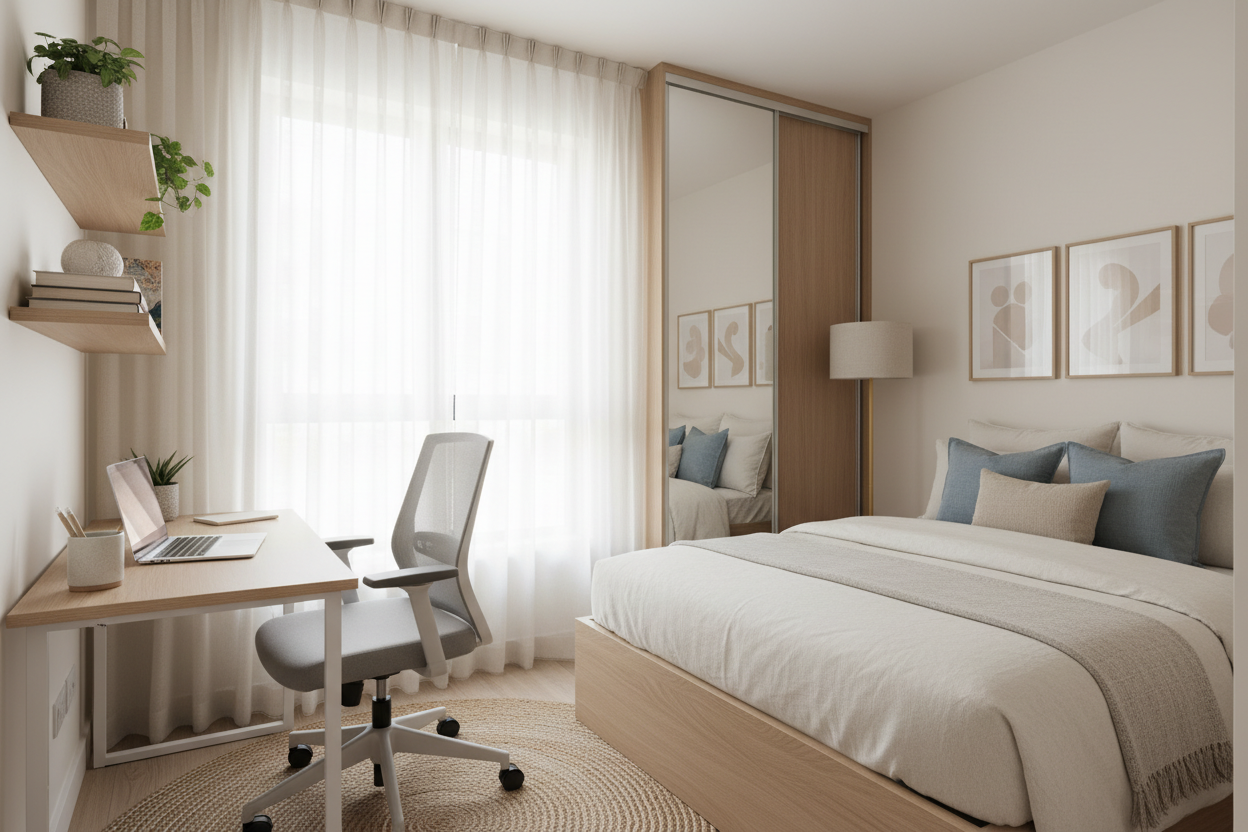
The blurred line between rest and productivity is perhaps the most significant design challenge in modern urban living. When square footage is at a premium, creating a dedicated workspace that does not encroach on your sanctuary requires strategic spatial planning, not just purchasing a desk. We must move beyond simple furniture placement and look at how volume, light, and material choices impact the psychology of the room. Here, we explore professional home office ideas small bedroom layouts that balance rigorous function with necessary tranquility.
Key Considerations for Compact Workspaces
- Scale and Proportion: Avoid standard office desks (30-inch depth); opt for console depths (18-22 inches) to maintain traffic flow.
- Visual Weight: Select materials like glass, acrylic, or slender metal frames to keep the room feeling open.
- Vertical Utilization: maximize storage upwards with wall-mounted shelving rather than floor-bound cabinets.
- Dual-Functionality: Prioritize furniture that serves two purposes, such as a nightstand-desk hybrid.
Strategic Zoning and Layouts
In a small office area in bedroom scenarios, the layout dictates your mental state. The goal is to position the desk so that you are not staring at your pillows while working, nor staring at your computer while trying to sleep. If architecture allows, the "floating" layout—placing the desk at the foot of the bed facing away from it—creates a distinct zone. Alternatively, utilizing a "cloffice" (closet-office) allows you to physically close the door on your workday, which is vital for mental separation in a tiny bedroom office.
Materiality: Solid Wood vs. Veneer
As a furniture specialist, I often guide clients through the material debate. In a tight sleeping quarter, the finish of your furniture impacts the ambient noise and visual clutter.
The Case for Veneer and Laminates
High-quality veneers often offer a smoother, more uniform appearance which can feel less chaotic in a small space. They are also generally lighter, making them easier to move if you need to reconfigure your small office setup in bedroom layouts. However, cheap laminates can peel at the edges, which looks unkempt quickly.
The Case for Solid Wood
Solid wood brings warmth and texture, acting as a grounding element. However, in a small home office ideas in bedroom context, be wary of heavy, dark woods like mahogany or walnut which can absorb light and make the room feel smaller. Light oak or ash are superior choices here; they offer the durability of hardwood without the visual heaviness.
Ergonomics and Visual Balance
Implementing small office space bedroom ideas does not mean sacrificing your spine. The challenge is that ergonomic chairs are often bulky. Look for "active sitting" stools or mid-century modern task chairs that have a lower profile. Avoid high-back executive chairs; they dominate the vertical space and ruin the serenity of a bedroom. If a standard office chair is non-negotiable, choose one in a light fabric (grey or beige) rather than stark black leather to blend it into the bedroom's color palette.
My Personal Take on Home Office Ideas Small Bedroom
I learned a hard lesson early in my career while designing a studio apartment in Manhattan. I specified a beautiful, standard-depth (24-inch) writing desk for a client's bedside alcove. On paper, it fit. In reality, once the chair was pulled out, the walkway was completely blocked. I had failed to account for the "active zone"—the space a human occupies while actually working.
Since then, I almost exclusively use console tables (approx. 16-18 inches deep) for bedroom workspaces. The difference of six inches sounds negligible, but in a small room, it is monumental. Also, a specific detail regarding finishes: I now avoid glass tops for bedroom desks. While they look airy, the sound of a pen or cup clinking on glass is sharp and jarring in a room meant for softness. A matte lacquer or wood surface absorbs sound better, keeping the room's acoustic profile softer.
Conclusion
Integrating a workspace into your sleeping quarters is an exercise in restraint and precision. By choosing furniture with the right visual weight and adhering to strict scale limitations, you can create a spot that invites productivity without ruining your rest. It is about making the furniture work for the room, not just forcing it in.
Frequently Asked Questions
What is the minimum depth for a bedroom desk?
For a laptop setup, you can work comfortably on a surface as shallow as 15 to 18 inches. If you use an external monitor, aim for at least 20 to 22 inches to maintain proper focal distance.
How do I hide cables in a bedroom office?
Visual clutter ruins relaxation. Use cable management sleeves that match your wall color, or mount a power strip to the underside of the desk. Wireless peripherals are also a worthwhile investment for this specific application.
Can I use a dining chair as a desk chair to save space?
You can, provided you add a lumbar pillow. However, for full-time work, look for a "conference" style chair. They often have the aesthetic of a dining chair but include hidden ergonomic features like tilt and swivel.

Leave a comment
This site is protected by hCaptcha and the hCaptcha Privacy Policy and Terms of Service apply.