










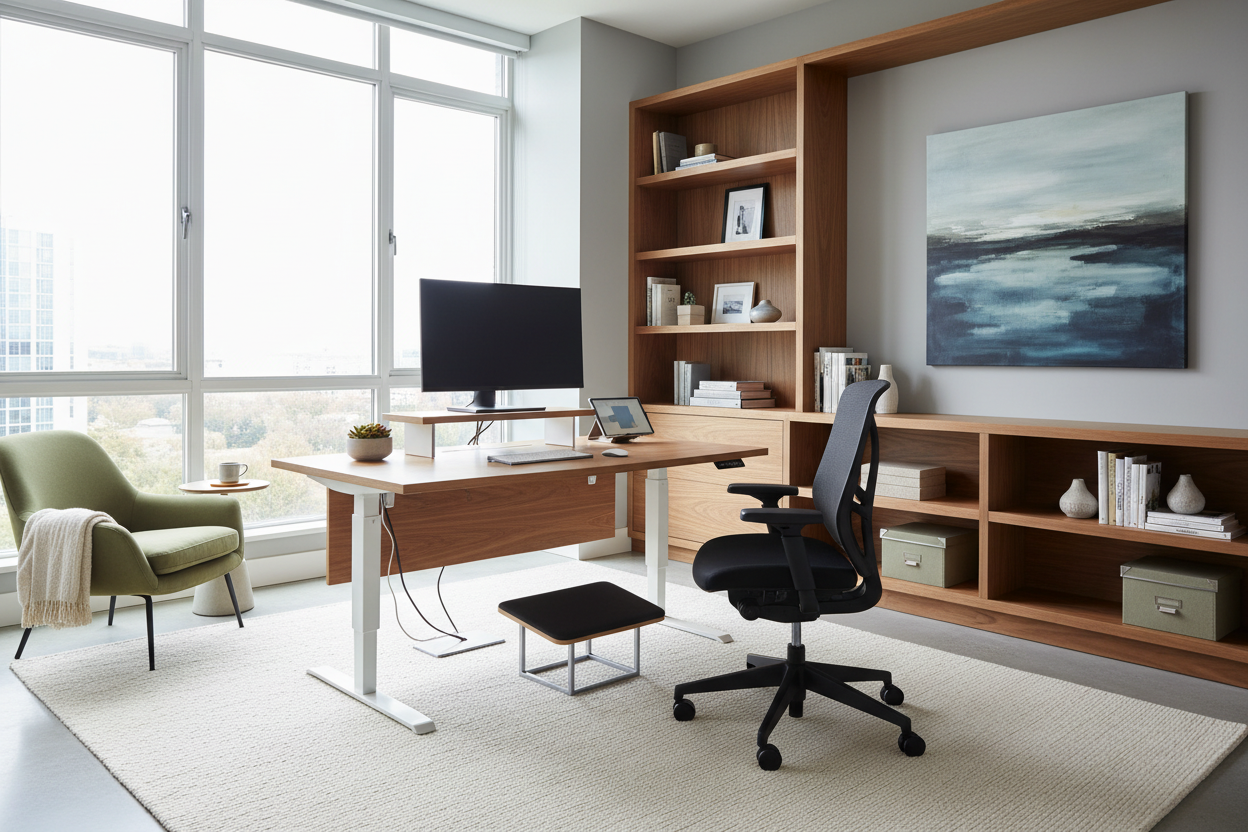
For many homeowners, the transition to remote employment brings a unique challenge: integrating a professional environment into a personal sanctuary. When we discuss the home-based job meaning from an interior design perspective, we aren't just talking about employment contracts; we are defining a spatial commitment. It is the deliberate act of carving out a zone that fosters productivity without disrupting the aesthetic flow of your living space. The dilemma often lies in treating the workspace as an afterthought—a laptop on a dining table—rather than a curated element of the home's architecture.
Key Design Pillars for Home Workspaces
- Spatial Zoning: Clearly defining where the "home-based work definition" begins and ends using rugs, lighting, or partitions.
- Ergonomics First: Prioritizing lumbar support and desk height over purely decorative silhouettes.
- Material Durability: Selecting surfaces (like high-pressure laminate or sealed hardwood) that withstand daily wear better than soft veneers.
- Lighting Layers: Combining ambient overheads with focused task lighting to reduce eye strain.
- Acoustic Control: Utilizing soft furnishings and textiles to dampen echo for calls.
Translating the Home-Based Work Definition into Layout
To truly understand what a home-based worker needs, we must look at the floor plan. A functional workspace requires a psychological boundary. In open-concept homes, this is often achieved through "floating" furniture arrangements. Placing a desk perpendicular to a wall, rather than flush against it, creates a command position that defines the area as a place of business.
The Role of Ergonomics and Silhouette
The home job meaning is often lost when physical discomfort sets in. As a designer, I urge you to look past the velvet trend for your primary seating. While visually stunning, high-pile fabrics can retain heat and compress unevenly over an eight-hour day. Instead, look for performance meshes or top-grain leathers that offer breathability. The silhouette of your chair should mimic the natural S-curve of your spine; a beautiful mid-century modern bucket chair may look sculptural, but it rarely offers the requisite support for full-time work.
Materiality: Where Aesthetics Meet Function
Home-based work has specific demands on furniture surfaces. Unlike a dining table used for an hour a day, a desk sees constant friction from wrists, mice, and devices.
- Solid Wood: Offers warmth and can be refinished, but requires coasters and humidity control.
- Tempered Glass: Creates a feeling of openness in small rooms but can feel cold and amplifies sound.
- Matte Laminates: Excellent for resisting fingerprints and optical mouse tracking issues.
Lighting: The Invisible Design Element
Proper illumination is critical to the home-based workers definition of a healthy environment. Reliance on a single overhead fixture creates harsh shadows. I recommend a layered approach: maximize natural light by positioning the desk near (but not directly facing) a window to manage glare. Supplement this with a task lamp featuring an adjustable arm and a warm color temperature (2700K-3000K) to maintain a cozy, residential feel while providing professional clarity.
My Personal Take on Home-Based Job Meaning
In my years of designing executive home offices, I’ve learned that the theoretical home-based job meaning often clashes with reality. I remember a specific project where I specified a stunning, unsealed raw oak desk for a client. It was visually breathtaking—a true statement piece. However, within three months, the client called me. The oils from their wrists had darkened the edge of the desk, and a spilled coffee had left a permanent ring that sanding couldn't fully remove.
That experience shifted how I approach these spaces. Now, I prioritize "forgiving" finishes. I realized that a home office isn't a museum; it's a machine for working. If a material requires you to be precious with it, it hinders your workflow. The true meaning of a home workspace is one that serves you, not one you have to serve.
Conclusion
Ultimately, the home-based job meaning is about balance. It is the intersection where high-performance utility meets your personal style narrative. By investing in the right materials, respecting ergonomics, and zoning your space effectively, you elevate your daily grind into a sophisticated, comfortable ritual.
Frequently Asked Questions
What is the ideal desk depth for a home-based worker?
For standard computer work, a depth of 24 to 30 inches is ideal. This provides enough distance for your monitor to prevent eye strain while leaving room for a keyboard and notepad.
How does home-based work have an impact on rug selection?
If you use a rolling chair, avoid high-pile or shag rugs. A low-pile or flat-weave rug allows casters to move smoothly and prevents the chair from bunching up the fabric, which can be a tripping hazard.
What is the definition of home-based workers' lighting needs?
Design-wise, it requires a mix of ambient (general room light) and task lighting. Avoid placing a light source directly behind you, as it creates glare on the monitor, which causes visual fatigue.


Leave a comment
This site is protected by hCaptcha and the hCaptcha Privacy Policy and Terms of Service apply.