










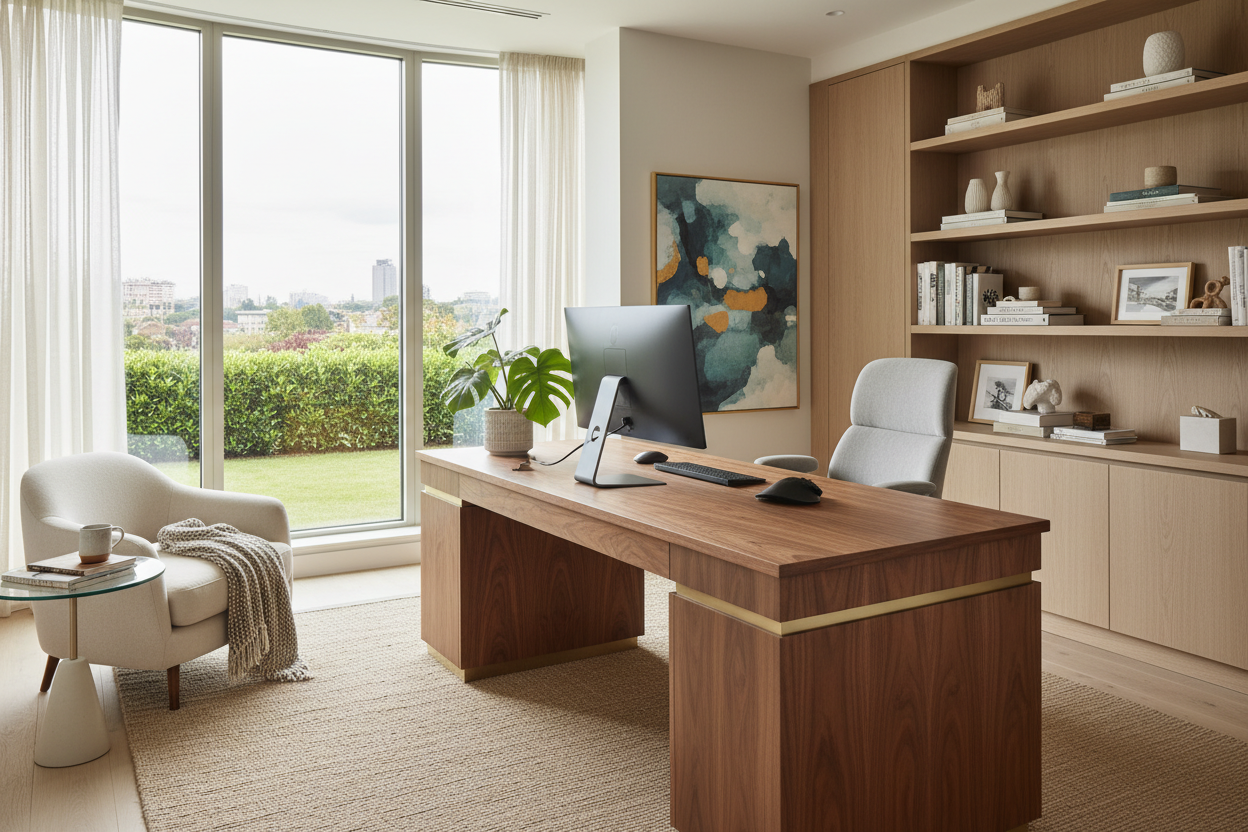
We have all been there: you buy a beautiful desk, drag it into your spare room, and immediately shove it flat against the nearest wall. It feels like the safest choice, but a few weeks later, the room feels cramped, and your productivity is tanking. If you are struggling to make your workspace feel intentional, you need strategic desk layout ideas for office environments that prioritize both flow and focus. By the end of this guide, you will know exactly how to position your furniture to create a room that feels larger, looks professional, and actually supports the way you work.
Quick Decision Guide
- Never place your back to the door; aim for the 'command position' where you have a clear view of the entrance.
- Leave at least 36 inches of clearance behind your chair to allow for easy movement without scuffing the baseboards.
- Position your screen perpendicular to windows to eliminate harsh glare while still benefiting from natural light.
- Use area rugs to anchor a floating desk, giving it visual purpose rather than looking stranded in the middle of the room.
Mastering Space Planning and Flow
Finding the Command Position
In interior design, the command position is a foundational rule borrowed from Feng Shui, but its practical benefits are undeniable. This layout places your desk so you can see the door without being directly in line with it. Sitting with your back to the entrance creates subtle psychological tension—you are constantly anticipating interruptions. By turning the desk to face the room, you instantly establish a sense of authority and calm. If room dimensions force you to face a wall, hang a mirror above the monitor to reflect the doorway behind you.
Navigating Windows and Glare
When brainstorming office desk placement ideas, lighting is usually the deciding factor. It is tempting to push your desk right up against a window for the view. However, the intense contrast between a bright sunny day and a backlit monitor will quickly cause severe eye strain. Instead, set your desk perpendicular to the window. This allows the natural light to wash across your workspace evenly, minimizing harsh shadows during video calls and keeping glare off your screen.
Balancing Visual Weight and Proportion
Floating vs. Anchored Configurations
Floating a desk—placing it in the center of the room rather than against a wall—is a classic designer move that makes an office feel executive and high-end. But this only works if your room has the square footage to support it. A heavy, solid wood executive desk needs breathing room; otherwise, it swallows the negative space and makes the room feel like a storage closet. If you are working with a standard 10x10 foot suburban bedroom, an anchored layout (tucked into a corner or flat against a non-window wall) using a visually light, open-frame metal desk is usually the smarter play.
Lessons from My Own Projects
A few years ago, I designed a stunning home office for a client in a suburban craftsman home. We floated a massive, matte-black oak desk right in the center of the room. Visually, it was a masterpiece. Practically? It was a nightmare.
I learned the hard way that if you do not have floor outlets installed, a floating desk becomes an island surrounded by a trip hazard of extension cords. We ended up having to route power cables under a custom rug, which created an annoying bump my client's rolling chair constantly caught on. The matte finish also showed every single fingerprint. If you want to float your desk, you must plan your power source first—otherwise, anchor it near a wall where outlets are accessible.
Frequently Asked Questions
How much clearance do I need behind my desk?
You should leave an absolute minimum of 36 inches between the edge of your desk and the wall or furniture behind it. If you use a large, high-back ergonomic chair or like to lean back, aim for 42 to 48 inches to prevent damaging your drywall.
Is it bad to face a window while working?
Yes, facing a window directly is a common mistake. The bright outdoor light forces your pupils to constrict, making your monitor look incredibly dim by comparison. This causes rapid eye fatigue. Always try to place your desk at a 90-degree angle to the primary light source.
Can I put my desk in the middle of a small room?
Generally, floating a desk in a room smaller than 12x12 feet disrupts the traffic flow and eliminates usable floor space. In smaller footprints, an L-shaped layout tucked into a corner is much more efficient, leaving the center of the room open to maintain a sense of spaciousness.

Leave a comment
This site is protected by hCaptcha and the hCaptcha Privacy Policy and Terms of Service apply.