










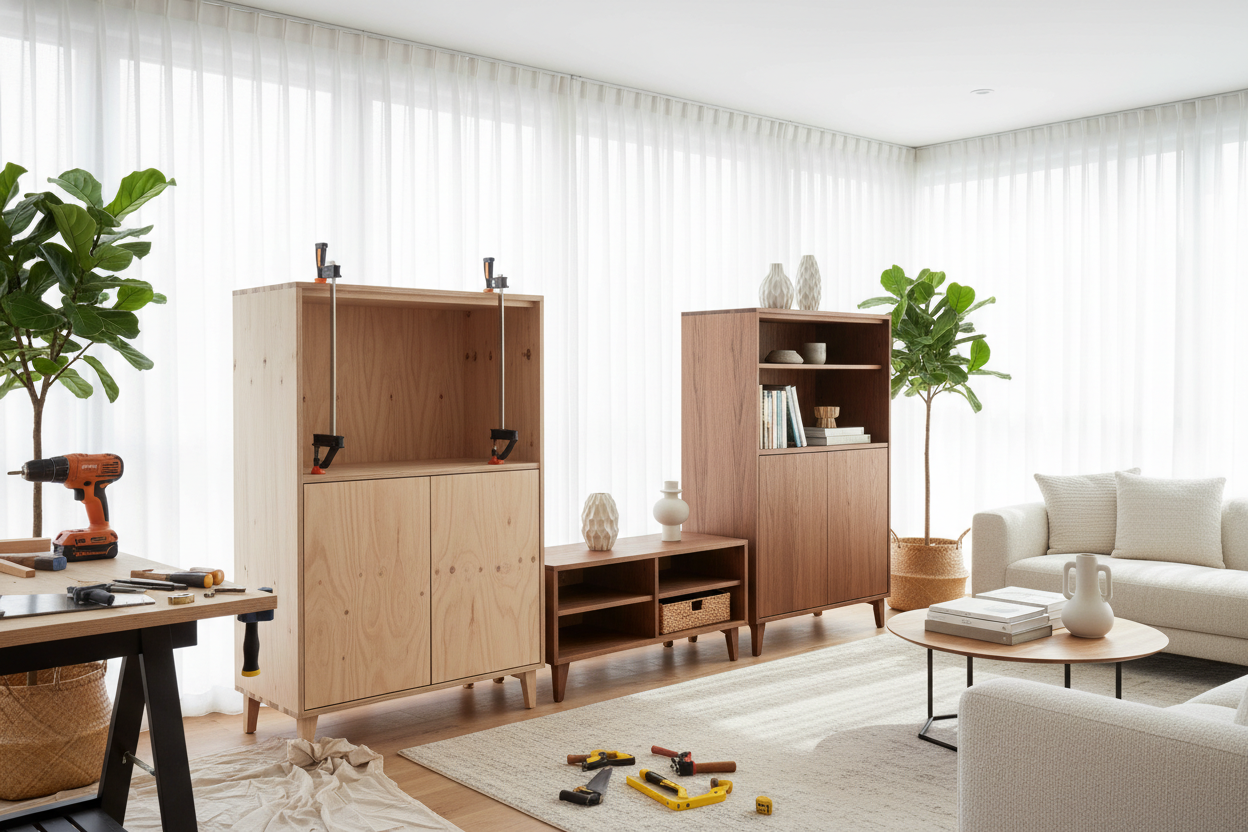
I remember the first time I got a quote for a 'custom' built-in bookshelf for my living room. The contractor wanted $8,500 for what essentially looked like three white boxes. I stared at the invoice, then at my cluttered two-car garage, and decided I’d rather spend that money on tools and probably a lot of wood filler. If you've been doom-scrolling Pinterest and feeling like your home is one storage unit away from sanity, learning how to custom build cabinets is the single most empowering DIY skill you can acquire.
Quick Takeaways
- A cabinet is just a five-sided box with a door on the front; don't overthink the physics.
- You do not need a $3,000 table saw; a track saw is safer and better for small garages.
- Pocket holes are the 'cheat code' of cabinetry—embrace them.
- Always buy your cabinet doors premade if you want to keep your sanity.
Spoiler Alert: A Cabinet Is Literally Just a Wood Box
Stop looking at high-end kitchen catalogs for a second. Strip away the crown molding and the soft-close hinges, and what are you left with? A carcass. In the world of building custom cabinets, the 'carcass' is just four pieces of 3/4-inch plywood joined together with a back panel. It’s a box. That’s it.
When I first started my cabinetry workshop in my garage, I was terrified of 'racking'—that annoying thing where a box becomes a trapezoid. The secret is the back panel. Even a thin 1/4-inch piece of plywood stapled to the back will lock the whole thing into a perfect square. Use pre-finished maple plywood for the insides. It costs a bit more, but it means you don't have to crawl inside a dark box to sand and paint the interior later. Trust me, your lower back will thank you.
The Only 3 Tools You Actually Need for a Custom Cabinet Build
You don't need a massive shop. I build everything on a pair of folding sawhorses. The first essential is a track saw. While most pros use a table saw, a track saw allows you to break down 4x8 sheets of plywood on the floor. It's more accurate for a beginner and won't take off a finger if you sneeze.
Second, get a Kreg pocket hole jig. This is how to make custom cabinets without learning complex mortise and tenon joinery that takes years to master. You drill a hole at an angle, drive a screw, and the joint is rock solid. Third, buy a decent drill and impact driver set. If you're building more than one box, you don't want to be swapping bits every thirty seconds. These three tools are the holy trinity of the garage woodworker.
How to Make Custom Cabinets Look Good (Even With Wonky Walls)
Here is a universal truth: your house is crooked. No wall is perfectly plumb, and no floor is perfectly level. When you plan a custom built-in china cabinet, you have to measure the width of your space at the bottom, middle, and top. Usually, these three numbers are different. Build your cabinet slightly smaller than the smallest measurement—about 1/2 inch of 'scribe' room is standard.
Once the box is in place, you use cedar shims to level it. Don't worry about the gaps between the cabinet and the wall; that’s what 'scribe molding' or 'filler strips' are for. If you encounter a complex corner, sometimes it’s smarter to pivot. For instance, a corner kitchen pantry cabinet set involves 45-degree cuts that can break a beginner's brain. There is no shame in buying a prefab corner unit and building your custom boxes around it to save yourself a week of math-induced headaches.
To Design Your Own Cabinet Doors or Just Buy Them Premade?
Building the boxes is the easy part. Building the doors is where most DIYers lose their minds. To design your own cabinet doors requires a router table, specialized bits, and a level of precision that a dusty garage rarely affords. If you want a specific look, like a black cabinet with glass doors, I highly recommend ordering the doors raw from an online supplier.
You give them the dimensions, they ship you perfectly square, sanded doors, and you just do the painting and hinge boring. It’s the ultimate 'semi-homemade' hack. It makes your work look professional while you spent your weekend actually finishing the project instead of swearing at a router bit that just splintered your last piece of oak.
Faking the Built-In Look If You Change Your Mind
If you get halfway through this and realize you actually hate sawdust, there’s an exit ramp. You can use modular furniture to achieve the same result. You can integrate a cabinet desk combo using stock units and just add a continuous top and baseboard. This 'fakes' the built-in look without you having to cut a single sheet of plywood. It’s the bridge between 'I bought this at a big box store' and 'I am a master carpenter.'
Personal Experience: The Leaning Tower of Pantry
My first custom build was a pantry for my wife. I spent three days obsessing over the cuts. I felt like a pro. Then I put it in the kitchen and realized the floor sloped nearly an inch toward the fridge. Because I hadn't built a 'toe kick' base (a separate platform the cabinet sits on), I had to shove a stack of plywood scraps under one side to keep it from tipping over. It looked terrible until I covered it with trim. Lesson learned: always build a separate base and level that first. It makes the rest of the install a breeze.
FAQ
Is plywood or MDF better for cabinets?
Use 3/4-inch plywood for the boxes—it holds screws better and won't sag. Use MDF only for the door panels if you’re painting them, as it stays perfectly flat and doesn't have a grain that shows through the paint.
How much can I save by building my own cabinets?
Usually, you'll save about 50-70% compared to custom professional work. You’ll spend more on materials than you would for cheap particle-board furniture, but your cabinets will actually last twenty years instead of five.
Do I need a special drill for the hinges?
Yes, buy a Forstner bit or a cheap hinge jig (like the one from Kreg). It lets you drill the large, flat-bottomed holes needed for European-style concealed hinges. Trying to do this freehand is a recipe for a hole through the front of your door.

Leave a comment
This site is protected by hCaptcha and the hCaptcha Privacy Policy and Terms of Service apply.