










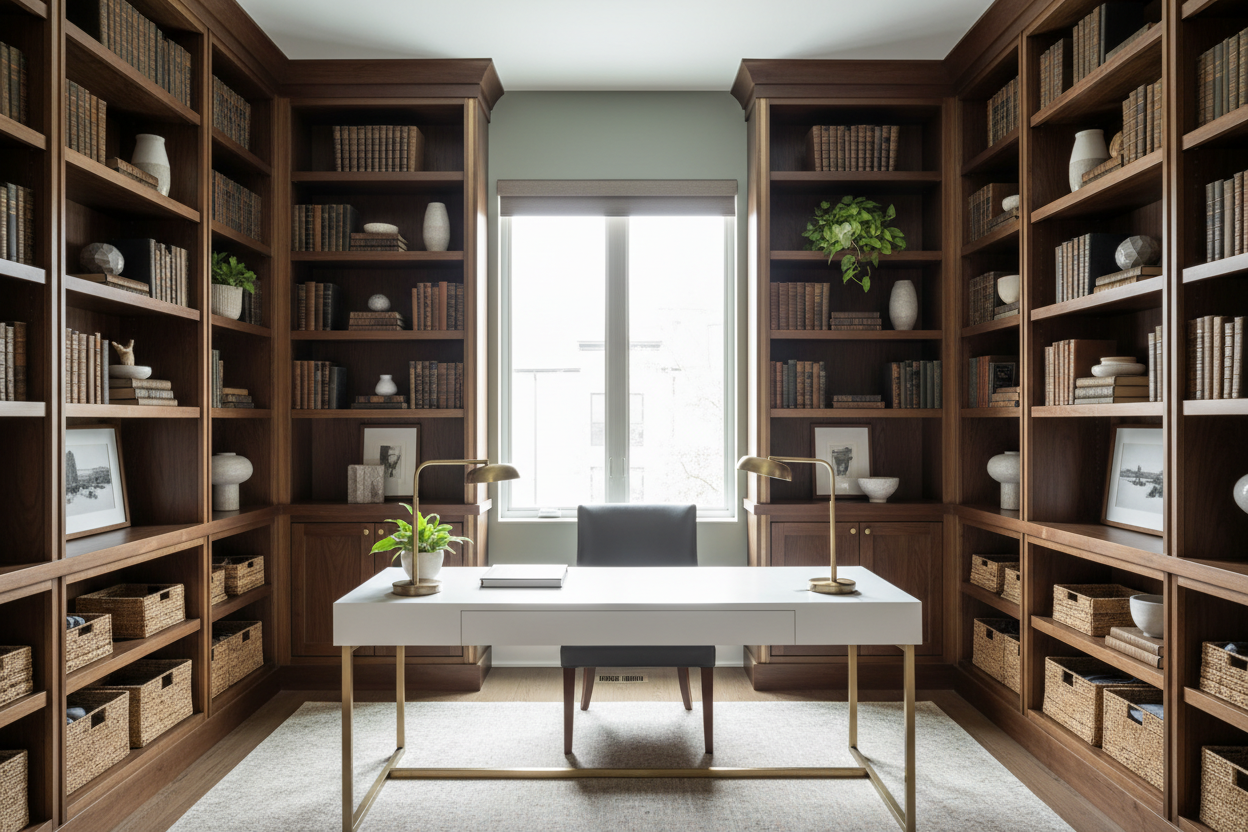
Most workspaces start with good intentions: a sleek desk, an ergonomic chair, and maybe a potted plant. But within a month, paper stacks multiply, reference books pile up, and the room feels chaotic. Adding well-planned home office shelves is the most effective way to reclaim your floor plan and your focus.
Getting your storage right is about more than just buying a basic bookcase. If the proportions are wrong, the room feels cramped. If the materials are cheap, the shelves will bow under the weight of your textbooks. In this guide, I will walk you through exactly how to choose, place, and style your shelving for a custom, professional look that actually works for your daily routine.
Quick Decision Guide
- Mind the depth: Standard books need 10 to 12 inches of depth, while storage bins and oversized binders require 14 to 15 inches.
- Mix open and closed storage: Use cabinets or baskets on the bottom for ugly tech cords and paperwork, reserving upper open shelves for display.
- Watch the weight capacity: Floating shelves look incredibly sleek, but track-and-bracket designs or freestanding units hold significantly more weight.
- Follow the one-third rule: When styling, aim for one-third books, one-third decorative objects, and one-third negative space to prevent visual clutter.
Space Planning & Layout
The biggest mistake I see when clients place shelves in home office layouts is ignoring the room's flow. You need to account for chair clearance and visual weight. If you place a bulky, dark wood bookshelf immediately inside the doorway, the entire room will feel smaller the second you walk in.
Finding the Right Clearances
Always leave at least 36 inches of clearance between the edge of your desk and any freestanding shelving unit. This gives you enough room to push your chair back without dinging the furniture. If your office is notoriously small, wall-mounted home office shelving systems are your best option. By keeping the floor entirely visible, you trick the eye into perceiving more square footage.
Material & Build Quality
Not all shelves are created equal, especially in a working environment. The humidity levels in typical North American homes, combined with the heavy weight of hardback books, will quickly expose cheap materials.
Engineered Wood vs. Solid Wood
Particleboard or low-grade MDF will almost certainly bow over time if a shelf spans more than 30 inches without a center support. If you are on a budget, look for high-grade plywood with a real wood veneer, which offers excellent structural integrity without the premium price tag of solid walnut or white oak. For a modern, industrial look, modular home office shelf systems made of powder-coated steel are practically indestructible and resist scratching from metal bookends or heavy bins.
Style & Coordination
Your background matters, especially if you spend half your week on video calls. The shelving directly behind your desk acts as your professional backdrop, so it needs to reflect a cohesive style.
Mastering Visual Balance
To avoid a messy aesthetic, group your books by size or color, and lay some stacks horizontally to act as bookends for the vertical rows. Introduce organic textures to soften the rigid lines of the shelves—think a trailing pothos plant, a textured ceramic vase, or woven storage baskets. Layering these elements prevents the space from feeling like a sterile corporate cubicle.
Lessons from My Own Projects
Early in my career, I designed a stunning mid-century modern office for a client in Seattle. I specified beautiful, custom-milled floating walnut shelves to go directly above their monitors. They looked incredible on installation day. But I made a rookie mistake: I underestimated the sheer volume of heavy, oversized architecture books the client owned.
Because the floating brackets were only anchored into drywall toggles rather than directly into the wall studs, the bottom shelf developed a terrifying downward tilt within three months. We had to pull everything down, patch the drywall, and reinstall using heavy-duty bracket hardware that hit the studs perfectly. The honest truth? Floating shelves are gorgeous, but if you are storing a heavy library, you need a system with visible, structural brackets or a freestanding unit. Physics always wins.
Frequently Asked Questions
How deep should home office shelves be?
For general reading books and small decor, 10 to 12 inches is standard and prevents the shelf from intruding too far into the room. If you need to store legal binders, printer paper, or large storage boxes, look for shelves that are 14 to 16 inches deep.
How do I style my office shelves without looking cluttered?
Stick to a cohesive color palette and use the one-third rule: one-third books, one-third objects, and one-third empty space. Hide your functional mess (like chargers, pens, and loose paper) inside opaque decorative boxes or woven baskets.
Are modular shelving systems worth the investment?
Yes, especially for renters or growing businesses. Modular systems allow you to adjust shelf heights as your storage needs change, and you can easily disassemble and move them to a new home without damaging the unit.


Leave a comment
This site is protected by hCaptcha and the hCaptcha Privacy Policy and Terms of Service apply.