










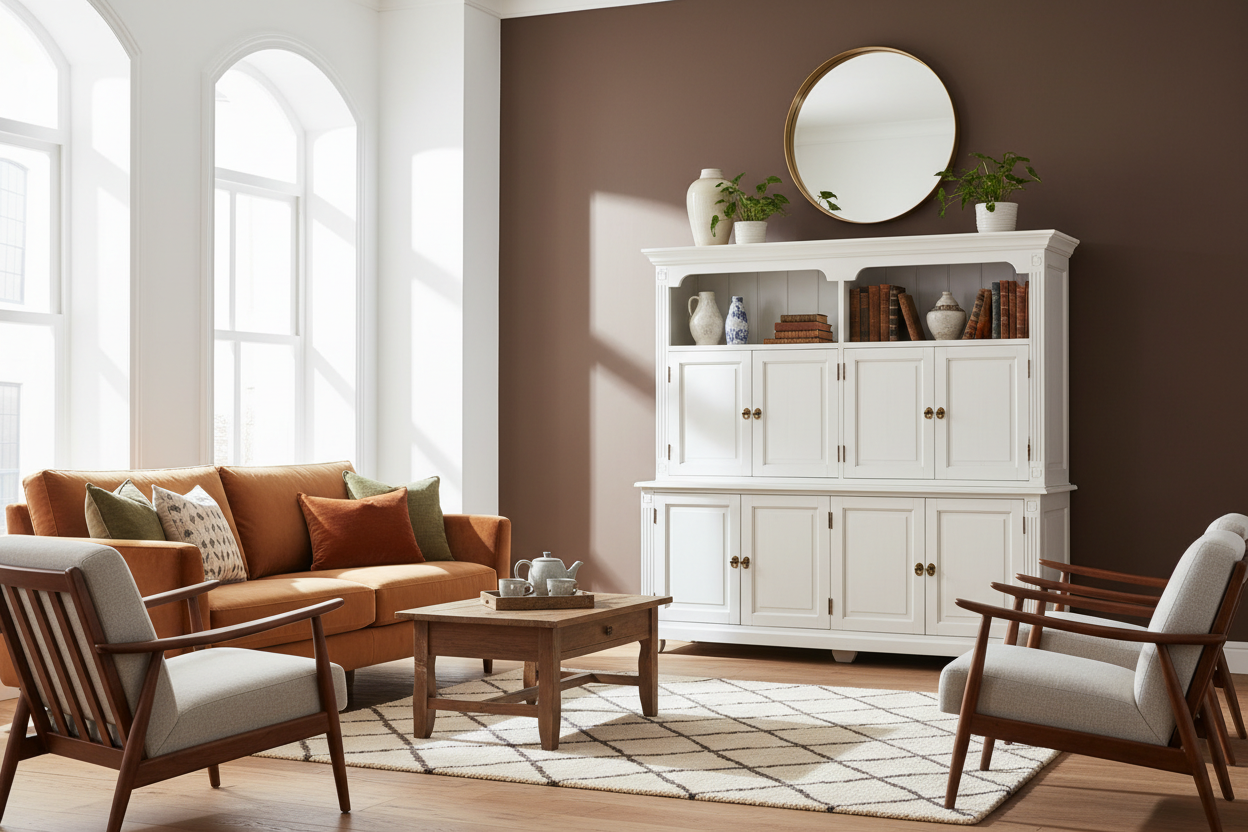
I sat on my velvet sofa last Tuesday and realized I was living in a mahogany tomb. I love vintage furniture—the kind with stories and dovetail joints—but I’d officially hit the 'grandma’s attic' threshold. Every single piece of furniture in my sightline was a shade of espresso, teak, or walnut. The room felt like it was shrinking under the weight of all that dark timber. I needed a white wood cabinet to act as a visual exhale before the walls closed in on me entirely.
- White wood acts as a 'palate cleanser' in rooms with too many dark wood tones.
- Solid doors are better than glass for hiding modern plastic clutter like routers and game consoles.
- Swap out generic chrome hardware for aged brass to make the piece feel intentional.
- Scale matters—a tiny cabinet looks like an afterthought; a large one looks like architecture.
The 'Antique Mall' Effect (And How I Accidentally Got There)
It happens slowly. You find a great mid-century sideboard at a yard sale, then a mahogany desk at an estate auction, and suddenly your living room has the personality of a dusty library. My space was heavy. The teak coffee table fought with the dark walnut bookshelves, and the whole place felt dated rather than curated. I was suffocating in brown. It wasn't just the color; it was the visual density of all those heavy grains and deep stains. I had zero negative space.
Most people have the opposite problem—they’re trying to fix a sterile, 'white box' apartment with a dark wood storage cabinet to add some soul. But when you’ve already got the soul (and the scratches and the 60-year-old patina), you need something crisp to break the tension. I realized that by sticking strictly to the 'all wood everything' rule, I was losing the contrast that makes vintage pieces actually pop. Without a neutral anchor, my expensive antiques just looked like thrift store clutter.
I spent weeks staring at 14-inch deep alcoves, wondering if I should paint an existing piece. But painting a vintage mahogany chest felt like a crime against craftsmanship. Instead, I decided to hunt for a high-quality white wood storage cabinet that could provide that much-needed bright spot without feeling like a flimsy piece of disposable dorm furniture.
Why I Broke the Rules and Bought a White Wood Cabinet
The old-school design rule says you should match your wood tones or at least stay in the same family (warm with warm, cool with cool). I’m here to tell you that rule is boring. A solid white wood storage cabinet acts as a palate cleanser. It’s the white space on a printed page. When I finally dragged a 72-inch tall whitewood storage unit into the corner, the entire room suddenly felt five feet wider. The white surface reflected the light from the window rather than absorbing it like a black hole.
I chose a piece made from kiln-dried solid wood rather than that crumbly MDF stuff. If you’re going to mix modern white pieces with vintage, the quality has to be there. You can tell the difference between a 1.5-inch thick solid shelf and a 0.5-inch particle board shelf from across the room. The weight of the wood gives it a presence that holds its own against a heavy oak dining table. It doesn't look like a temporary fix; it looks like a deliberate design choice.
What surprised me was how the 'newness' of the white finish actually made my old pieces look better. The grain on my vintage teak credenza suddenly looked richer and more intricate because it wasn't competing with three other brown pieces. It’s like wearing a crisp white shirt with a pair of beat-up vintage jeans—the contrast makes the whole outfit look expensive.
The Great Debate: Doors vs. Drawers
When you’re shopping for whitewood storage, you have to be honest about your own messiness. I went back and forth between a white wooden cabinet with doors and a white wood cabinet with drawers. Drawers are fantastic for organization, but they often have a more 'bedroom' vibe. For a living or dining area, a white wooden cabinet with doors offers a cleaner, more architectural look that mimics a built-in cupboard.
I ended up choosing a model that featured both: a white wooden cupboard with drawers at the bottom for napkins and candles, and large doors above for the bulky stuff. If you have a collection of beautiful white ironstone or vintage glassware, you might be tempted by a small wood cabinet with glass doors. But for my 'heavy brown room' fix, I went with solid doors. Why? Because I needed a place to hide the ugly reality of modern life—the mesh router, the tangled charging cables, and the board games with the ripped corners. Solid doors provide a flat, calm surface that hides the chaos, which is essential when the rest of the room is visually busy with wood grains.
How to Style Whitewood Storage Without Looking Sterile
The biggest fear with white furniture is that it will look like a hospital room or a cheap rental. To avoid the 'sterile' trap, you have to bridge the gap between the new white finish and your old-soul furniture. The first thing I did was ditch the shiny chrome knobs that came with the cabinet. I replaced them with heavy, unlacquered brass pulls that will patina over time. That small change made the white wood cabinet with drawers look like it had been in the house for decades.
Next, think about what goes on top. Don't put more white stuff on a white cabinet. I styled mine with a stack of old, leather-bound books and a chunky ceramic lamp in a deep olive green. The goal is to layer textures. If you have a low-profile room, you might even consider a versatile console table for living room use instead of a tall cabinet. It gives you a long horizontal surface to display taller vintage art, which draws the eye up and away from the floor.
I also recommend 'breaking' the white with a bit of greenery. A trailing Pothos or a tall snake plant against a white wood backdrop looks incredibly vibrant. The white surface acts like a gallery wall, making the colors of your plants and books look more saturated than they ever did against the dark brown walls or furniture.
Proving the Skeptics Wrong With Large White Cabinets
If you're worried that a white piece will look 'wimpy' next to your heavy antiques, the secret is scale. Don't buy a tiny accent table; go for large white cabinets. I’m talking about white wood storage cabinets with doors and shelves that stand at least six feet tall. When a piece is that large, it becomes part of the architecture of the room rather than just another stick of furniture. It mimics the look of high-end custom millwork.
My large cabinet now houses my entire 'clutter life' while providing a massive block of bright, neutral color that balances out the dark wood floors and the navy blue rug. It’s the anchor I didn't know I needed. If I had gone with another brown piece, the room would still feel like a cave. Instead, it feels like a curated home. Don't be afraid of the 'pop' of white—it’s often the only thing standing between a beautiful vintage collection and a room that feels like it’s stuck in the past.
FAQ
Will white wood yellow over time?
If it’s cheap laminate, yes. If it’s a high-quality painted wood cabinet with a UV-resistant topcoat, it’ll stay crisp for years. Just keep it out of direct, punishing afternoon sunlight to prevent any finish changes.
How do I clean scuffs off white wood?
Skip the harsh chemicals. A damp microfiber cloth and a tiny drop of Dawn dish soap usually do the trick. For stubborn scuffs from shoes or vacuums, a Mr. Clean Magic Eraser works, but use a very light touch so you don't dull the finish.
Does white wood look 'cheap' next to real mahogany?
Only if the construction is flimsy. Look for details like inset doors, crown molding, and real wood backing. If the cabinet has a cardboard back that nails on, it will look cheap. If it has a solid wood back, it will look like a million bucks.


Leave a comment
This site is protected by hCaptcha and the hCaptcha Privacy Policy and Terms of Service apply.