










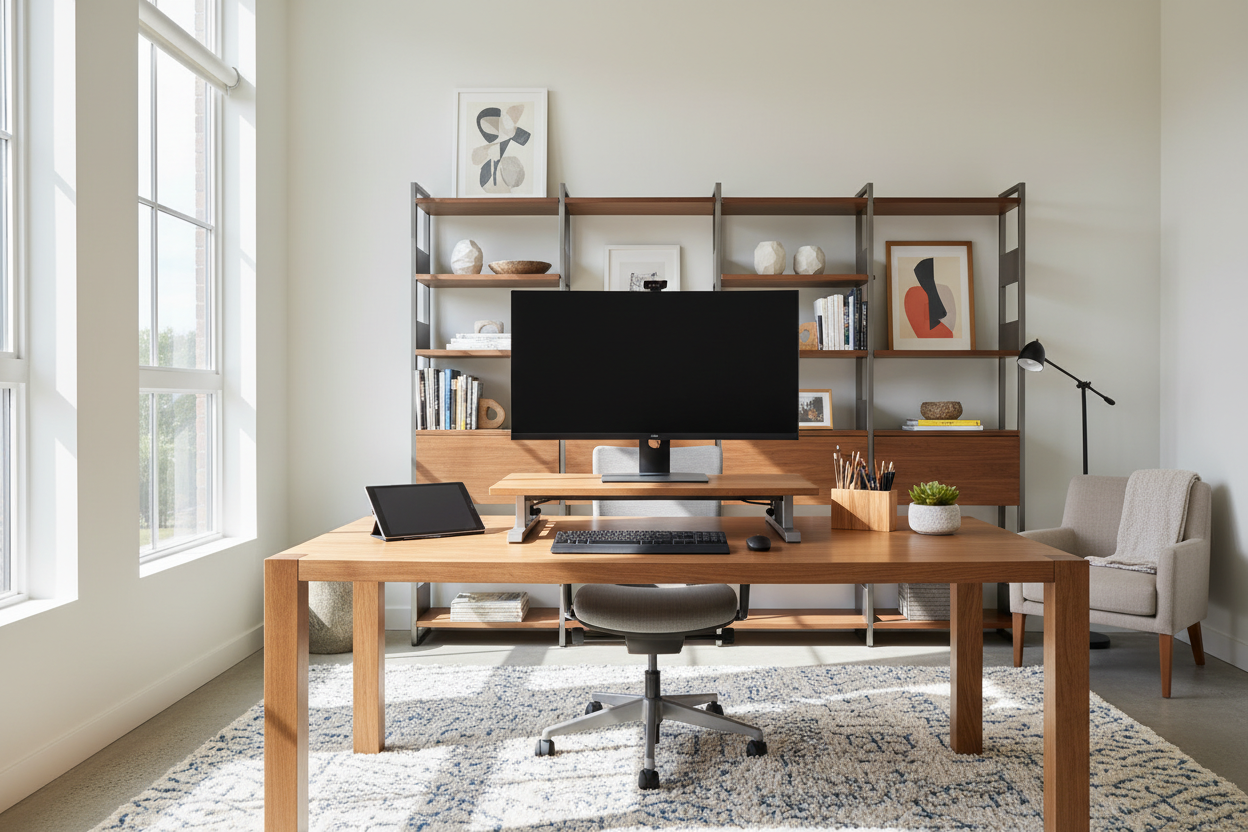
We have all been there: trying to draft a blueprint, sketch a concept, or edit a manuscript while perched on a dining chair that was never designed for more than a sixty-minute meal. The lack of support kills your focus, and the poor lighting strains your eyes. To truly elevate your craft, you need more than just a desk; you need a dedicated workspace for creation that merges ergonomic integrity with aesthetic inspiration.
Quick Decision Guide: Essentials for Your Studio
- Surface Durability: Opt for high-pressure laminate (HPL) or sealed solid wood if your creative process involves heavy tools or pigments.
- Lighting CRI: Ensure your task lighting has a Color Rendering Index (CRI) above 90 to see true colors.
- Ergonomics: Prioritize a chair with adjustable lumbar support and seat depth over purely sculptural designs.
- Acoustics: Incorporate soft textures (rugs, acoustic panels) to dampen echo and improve focus.
Selecting the Right Surface Material
When you set out to create a workspace, the desk surface is your primary instrument. In my showroom consultations, I often steer clients away from softwoods like pine for creative studios. While they offer a rustic charm, they dent far too easily under the pressure of a pen or stylus.
For a sophisticated look that withstands daily abuse, consider a matte-finished walnut veneer or a linoleum-topped desk. Linoleum is a favorite among designers because it offers a slight tactile "give" that feels wonderful under the hand, resists fingerprints, and doesn't reflect overhead glare like glass or polished lacquer.
Zoning and Spatial Flow
If you are planning to create work space in an open-plan home, zoning is non-negotiable. Visually separating the creative zone from the relaxation zone signals your brain that it is time to focus. You do not always need a physical wall; a high-backed shelving unit or a strategic change in floor covering (such as a flat-weave wool rug) can define the perimeter effectively.
When you create a workspace, consider the "triangle of reach." Much like a kitchen work triangle, your primary tools, digital interface, and reference materials should be accessible without standing up. This preserves your flow state and prevents the constant breaking of concentration.
Lighting: The Invisible Design Element
Many homeowners ask how to create a workspace that feels energetic yet cozy. The secret lies in layered lighting. Relying solely on a ceiling can light creates harsh shadows that fatigue the eyes. Instead, aim for a blend of ambient light (diffused general illumination) and directional task lighting.
For a new workspace, position your desk perpendicular to natural light sources to minimize screen glare. Supplement this with an articulated desk lamp featuring a warm-to-neutral temperature (3000K-4000K). This spectrum mimics natural daylight closely enough to keep you alert without the sterile, clinical feel of cool white LEDs.
Lessons from My Own Projects: The "Texture" Trap
I want to share a specific mistake I made early in my career when designing my own home studio. I fell in love with a reclaimed barn-wood table. It had incredible character, deep grain, and a raw, organic silhouette. It looked stunning in photographs.
However, the reality of using it was different. Within a week, I realized that the deep grain texture was a nightmare for sketching—my pencil lines were jagged, and the crevices trapped eraser dust and graphite that was nearly impossible to clean out without a vacuum. I also found that my optical mouse jittered constantly on the uneven surface. I eventually had to cover that beautiful wood with a large leather desk pad. If you are a tactile creator, always test the smoothness of the finish with your specific tools before purchasing. Sometimes, the most beautiful furniture is the least practical for actual creation.
Conclusion
Designing a sanctuary for your work is an investment in your output quality. By balancing durable materials with ergonomic layouts and layered lighting, you build an environment that pulls you in rather than pushes you away. It is time to stop compromising and build the studio your talent deserves.
Frequently Asked Questions
What is the ideal desk depth for a creative setup?
For most creative work involving monitors and sketchpads, a depth of at least 30 inches (76 cm) is recommended. This allows you to maintain a proper viewing distance from screens while leaving ample foreground space for physical tools.
How do I create a workspace in a small apartment?
Focus on verticality. Use wall-mounted floating desks or shelving systems that draw the eye upward. A "ladder desk" silhouette is excellent for small footprints as it provides storage without visual bulk.
Is a standing desk worth the investment for artists?
Yes, specifically for the shift in perspective. Many creatives find that the ability to stand allows for broader arm movements and a literal change in viewpoint, which can be helpful when tackling large-format work or breaking through a creative block.

Leave a comment
This site is protected by hCaptcha and the hCaptcha Privacy Policy and Terms of Service apply.