










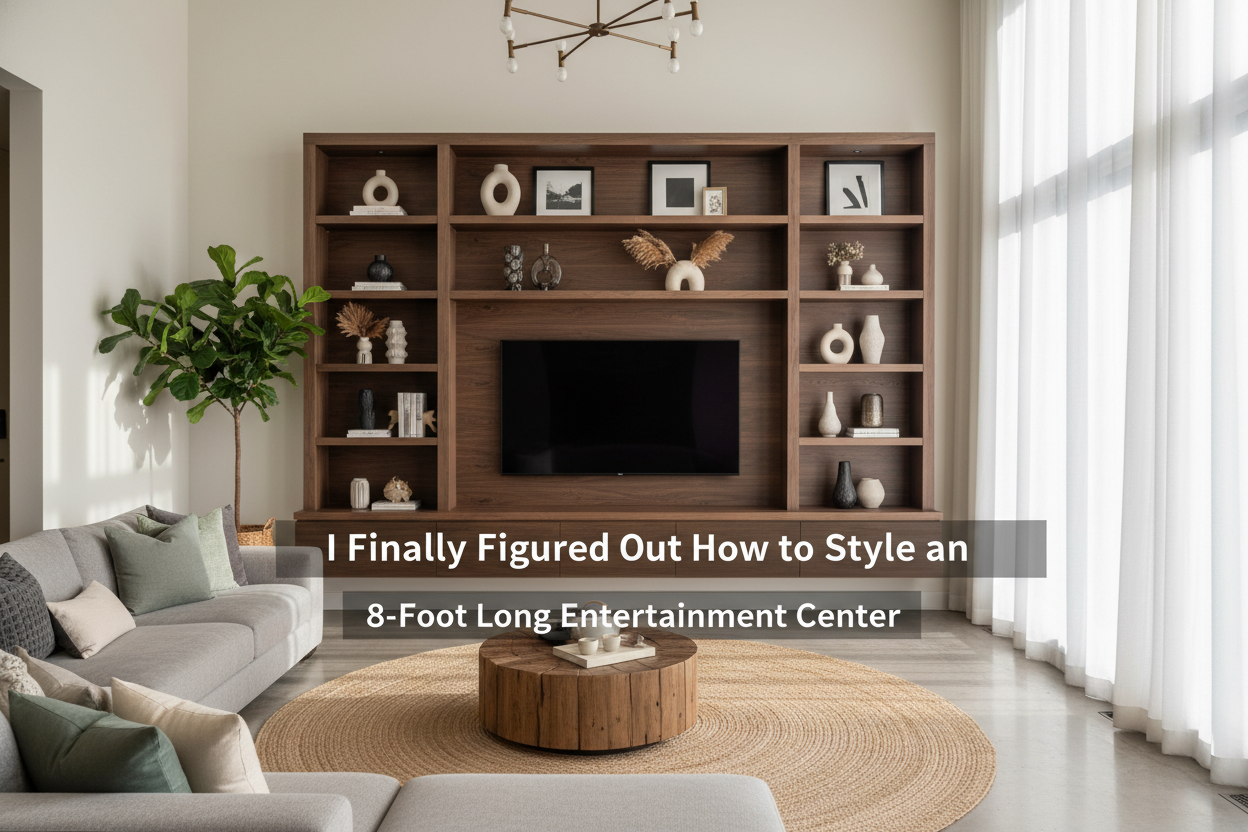
I remember the delivery driver's face when he saw my narrow hallway. The box was the size of a small kayak, and it took two people and a lot of creative swearing to get it inside. Once I finally unboxed my 8 foot long entertainment center, I stared at it for an hour. It wasn't just furniture; it was a barricade. I had spent weeks hunting for a modern entertainment center that could fill my massive living room wall, but standing there in the empty room, I worried I had accidentally bought a giant wood block.
- Asymmetry is your friend—don't center the TV.
- Use vertical decor to balance the long horizontal line.
- Hidden storage is non-negotiable for a clean look.
- Scale matters: small decor items will get lost on a 96-inch surface.
The 'Giant Wood Block' Problem
The mistake most people make—myself included—is thinking that a 96-inch console is just a bigger version of a 60-inch TV stand. It's not. It is an architectural element. When I first pushed it against the wall, the room felt heavy and lopsided. It looked like a piece of commercial office furniture that had lost its way.
I realized that a piece this size requires intent. You can't just throw a TV on it and call it a day. It needs to be styled as a landscape, not a pedestal. I almost sent it back, but I decided to treat the top surface like a mantel instead of a shelf. That shift in perspective changed everything.
Rule 1: Stop Centering Your TV (Seriously)
The instinct is to put the TV right in the dead center. On an 8-foot span, a 65-inch TV centered leaves about 15 inches of awkward space on either side. It looks like a floating island. Instead, I pushed my TV about 20 inches to the left.
This creates a 'heavy' side and a 'light' side. The asymmetry immediately makes the setup look like a custom built-in rather than a box from a warehouse. By shifting the TV, I opened up a large, continuous space on the right side for a substantial table lamp and a ceramic vase. It gives the eye a place to rest that isn't a black screen.
Rule 2: You Need Height to Balance the Width
A long, low piece of furniture can make your ceilings feel 5 feet tall if you aren't careful. While some people opt for an 8 foot tall entertainment center to fill that vertical gap, I prefer the low-and-long look balanced with wall styling. If you're struggling with the scale, check out my tips on how to style an 8 foot tall cabinet without crowding a room for some height-balancing logic.
I used a tall, spindly floor lamp on one side and a leaning floor mirror on the other to draw the eye upward. I also hung a vertical gallery wall above the 'empty' side of the console. This creates a diagonal flow that pulls your gaze from the floor to the ceiling, preventing the furniture from feeling like a heavy anchor dragging the room down.
Rule 3: Hide the Tech, Display the Texture
The beauty of a 95-inch unit is the sheer volume of storage. I chose a wood grain color entertainment center specifically for the pull-down doors. My router, PS5, and a messy tangle of HDMI cables are all living behind those doors. I didn't even have to be neat about it—I just shut the door and the mess disappeared.
On top, keep it minimal. I see people cover these long units in dozens of tiny picture frames and candles. Don't do that. It looks like a garage sale. Stick to three 'zones' of decor. A stack of oversized art books, a single large tray for remotes, and one statement plant. If the item is smaller than a grapefruit, it probably doesn't belong on an 8-foot console.
The Final Look: Was the 96-Inch Monster Worth It?
After living with the 'monster' for six months, I wouldn't go back to a standard size. Small furniture on a big wall looks like it's floating away. This unit finally makes my living room feel grounded and expensive. It’s the difference between a room that looks 'furnished' and a room that looks 'designed.'
If you're still on the fence about going horizontal, you could always go vertical with a massive 8 foot tall cabinet instead. But for me, the long console is the winner. It provides a clean, mid-century vibe that doesn't box in the room, provided you have the guts to style it asymmetrically.
How do I hide cords on such a long unit?
Look for units with built-in cable management ports. If yours doesn't have them, use a 2-inch hole saw bit to create your own behind where the TV will sit. Use adhesive cable clips along the back edge to keep everything off the floor.
Will an 8-foot console make a small room look smaller?
Counter-intuitively, no. One large piece of furniture often makes a room feel bigger than four small pieces. It creates a long, continuous line that tricks the eye into thinking the wall is wider than it actually is.
Should I wall-mount the TV or sit it on the console?
If you have an 8-foot console, wall-mounting is usually better. It allows you to place decor items directly under the TV without them blocking the screen, and it reinforces that 'gallery' look we're going for.


Leave a comment
This site is protected by hCaptcha and the hCaptcha Privacy Policy and Terms of Service apply.