










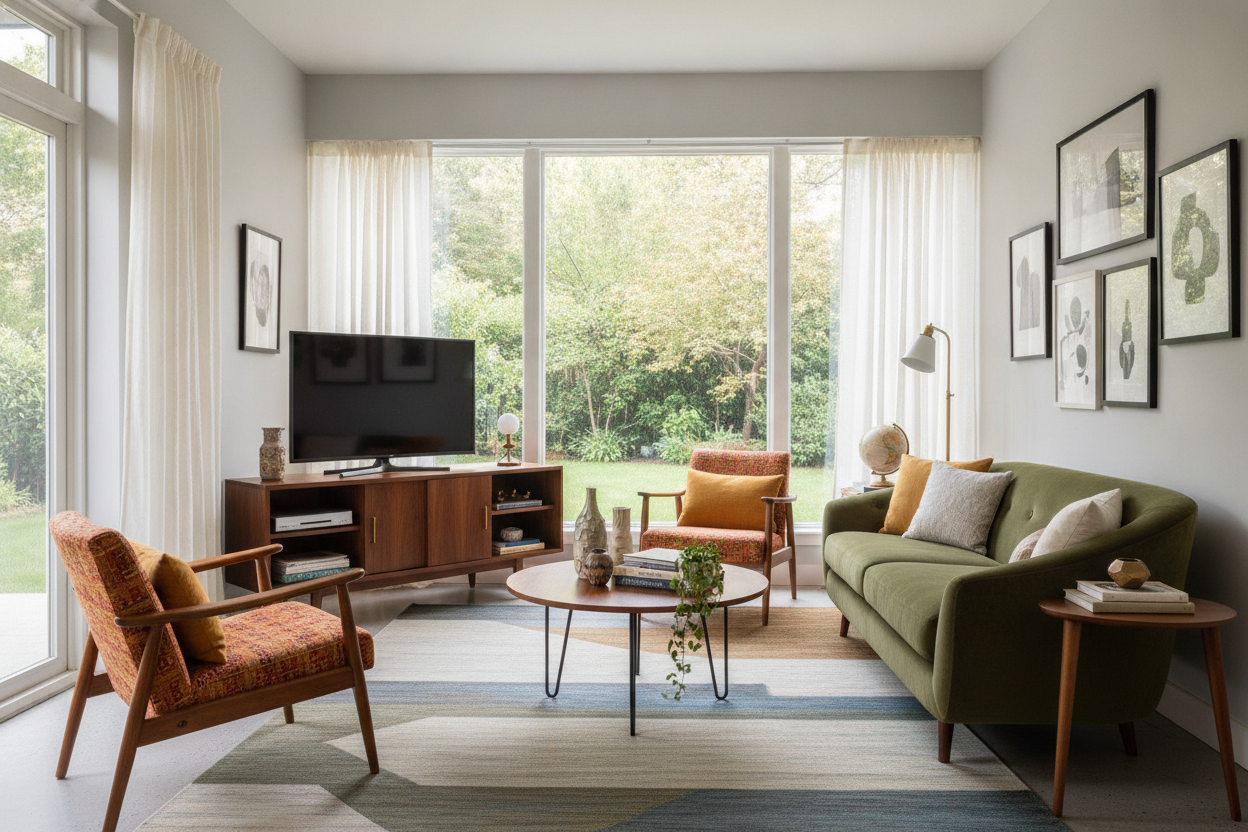
I spent three weeks staring at a 45-degree angle in my living room, nursing a lukewarm coffee and feeling personally insulted by my own floor plan. My 1920s bungalow has charm for days—original crown molding, drafty windows, and a fireplace that doesn't actually work—but it was clearly designed before anyone imagined a 55-inch glowing rectangle would become the focal point of human existence. Every time I tried to place my media console against a flat wall, it blocked a walkway or cut off the flow to the kitchen.
I finally accepted my fate: the TV had to go in the corner. But as a vintage furniture obsessive, I was horrified. Most corner units I found online looked like they were salvaged from a 1998 Circuit City clearance rack. Finding a corner tv stand mid century purists would actually approve of felt like searching for a unicorn in a sea of particleboard. I needed something with those iconic tapered legs and rich wood tones that didn't scream 'I gave up on my aesthetic because of a weird wall.'
- Look for the Legs: Authentic MCM style requires tapered, flared legs (usually 6-8 inches tall) to keep the piece from looking like a heavy block.
- Material Matters: Stick to walnut or acorn finishes; skip the 'black ash' or 'espresso' if you want that true vintage warmth.
- Cable Management: Ensure there are pre-drilled holes or slatted fronts to hide the inevitable 2024 cable mess.
- Measure Twice: A corner stand's width is deceptive—always check the 'depth from corner' to ensure it won't stick out too far into your walking path.
The Awkward Floor Plan That Broke My Living Room
My living room is a series of architectural 'no's.' One wall is dominated by a giant radiator that clanks like a ghost in the winter. Another is mostly a floor-to-ceiling window that provides great light but creates a glare that makes watching anything during the day impossible. That left me with exactly one corner to work with. For months, I tried to ignore it. I put a plant there. I put a floor lamp there. But eventually, the reality of my 12x14 room set in: if I wanted to actually sit on my sofa and see the screen without craning my neck at a 60-degree angle, the TV had to go in that tight, ignored corner.
The problem is that corners are where design goes to die. Most people just shove a square peg into a round hole, leaving a dusty triangle of wasted space behind a flat console. It looks accidental, like you just moved in and haven't decided where things go yet. I wanted a corner tv stand mid century enthusiasts would think was a custom find. I spent hours measuring the distance from the corner to the door frame, realizing I only had about 42 inches of clearance before I started tripping over the furniture. It’s a specialized piece of furniture that requires a specific kind of geometry to look intentional rather than desperate.
Why Do Most Corner Media Consoles Look Like 1998?
If you spend any time trying to find mid century modern corner tv stands, you’ll quickly notice a pattern. Most of them are hideous. For some reason, furniture manufacturers decided in the late 90s that 'corner unit' was synonymous with 'chunky, dark, and cheap.' I saw dozens of options that looked like they belonged in a dial-up internet cafe or a basement dorm room. They are often made of that flimsy, paper-thin laminate that peels if you even think about setting a coaster-less drink on it. It’s frustrating because it’s so much easier to browse standard TV stands and find hundreds of gorgeous, spindly-legged options that look like they were plucked from a Don Draper set.
But the second you add the word 'corner' to your search, the quality drops off a cliff. You get these heavy, windowless boxes that sit flush to the floor, trapping dust and making your room feel ten square feet smaller. A true mid century corner tv cabinet should respect the design ethos of the era: functionality, clean lines, and an 'airy' feel. If it doesn't have legs that lift the body of the cabinet off the floor, it’s not MCM—it’s just a box. I almost gave up and decided to wall-mount the TV, but my plaster walls are about as sturdy as a cracker, so the hunt for a high-quality stand continued.
The 3 Details That Make or Break the Vintage Illusion
When you're trying to fake a vintage look with new furniture, the devil is entirely in the details. First, you have to look at the grain. Cheap mid century modern corner tv stands often use a grain pattern that repeats every six inches, which is a dead giveaway for low-quality laminate. You want a walnut veneer or solid wood that shows some variation. Second, check the hardware. Authentic 1960s pieces didn't have bulky, shiny chrome handles. They had recessed pulls or slim, brass-toned knobs that didn't interrupt the silhouette. I personally prefer the handle-less look where the doors have a beveled edge for your fingers.
Third, and most importantly, is the leg height. If the cabinet sits too low, it loses that iconic 'floating' quality. You want at least six inches of clearance. This isn't just about looks; it’s about the physics of a small room. Being able to see the floor continue under the furniture tricks your brain into thinking the room is larger than it is. It's interesting to read what designers actually think about this; most pros agree that the biggest mistake people make in small spaces is buying 'heavy' furniture that blocks the sightlines of the floor. A corner unit with peg legs solves this perfectly.
Slatted Doors: The Ultimate Trick for Hiding Ugly Tech
We all have the same problem: we want a 1964 aesthetic, but we have a 2024 collection of plastic junk. Between the soundbar, the gaming console, the router, and the tangled nest of power strips, the 'clean' look is hard to maintain. This is where slatted wood fronts become your best friend. They are a classic MCM design element—think of those beautiful tambour-door desks—but they serve a very modern purpose. The gaps between the wood slats allow infrared signals from your remote to pass through, meaning you can keep the doors shut while you're flipping through Netflix.
I finally settled on a stand with slatted doors, and it was a total revelation. Not only does it hide the blinking green lights of my router, but it also provides much-needed airflow. Modern tech runs hot, and trapping a PS5 inside a solid wood box is a recipe for a hardware meltdown. The slats keep everything cool while maintaining that sleek, horizontal line that defines the era. It’s the one feature I tell everyone to prioritize. It turns a piece of furniture into a functional tool rather than just a place to park your screen.
Wait, Will My 65-Inch Screen Actually Fit on This?
Here is the cold, hard math that most people ignore until the delivery truck arrives: a 65-inch TV is roughly 57 inches wide. If you buy a mid century corner tv cabinet that is only 48 inches wide, your TV is going to overhang the sides by nearly five inches on each end. This looks terrible. It makes the whole setup look top-heavy and accidental. When you’re dealing with a corner unit, the 'width' listed on the website is usually the widest point of the front face, but because it tapers toward the back, you lose a lot of surface area for the TV's feet.
Before you buy, measure the distance between the two legs of your TV stand. Many modern TVs have 'v-shaped' feet at the very ends of the screen rather than a center pedestal. If those feet are 50 inches apart, and your corner stand is only 45 inches wide, you’re in trouble. If you realize your screen is simply too massive for a standard corner unit, you might have to get creative. I've seen people use an adjustable length media console to bridge a corner by extending one side along the wall. It’s a great workaround if you refuse to downsize your screen but can't find a corner unit wide enough to support it without looking like a disaster.
FAQ
Can I put a soundbar on a corner TV stand?
Yes, but check the depth. Corner stands narrow at the back, so if your soundbar is long, it might hit the walls before it sits flush. Measure your soundbar and compare it to the width of the stand at least 4 inches from the front edge.
Are these stands sturdy enough for heavy TVs?
Most mid century modern corner tv stands use kiln-dried hardwood or high-quality MDF with veneer. Check the weight capacity—usually around 100-150 lbs. If you have an older, heavier plasma TV, you definitely want solid wood legs, not screw-in plastic ones.
How do I hide the cables coming out of the back?
The best units have a 'clipped' back corner with a dedicated cable management hole. If yours doesn't, use adhesive cable clips along the back of the legs to run the wires down to the floor invisibly. Never let them just dangle in the 'triangle' space behind the unit.

Leave a comment
This site is protected by hCaptcha and the hCaptcha Privacy Policy and Terms of Service apply.