










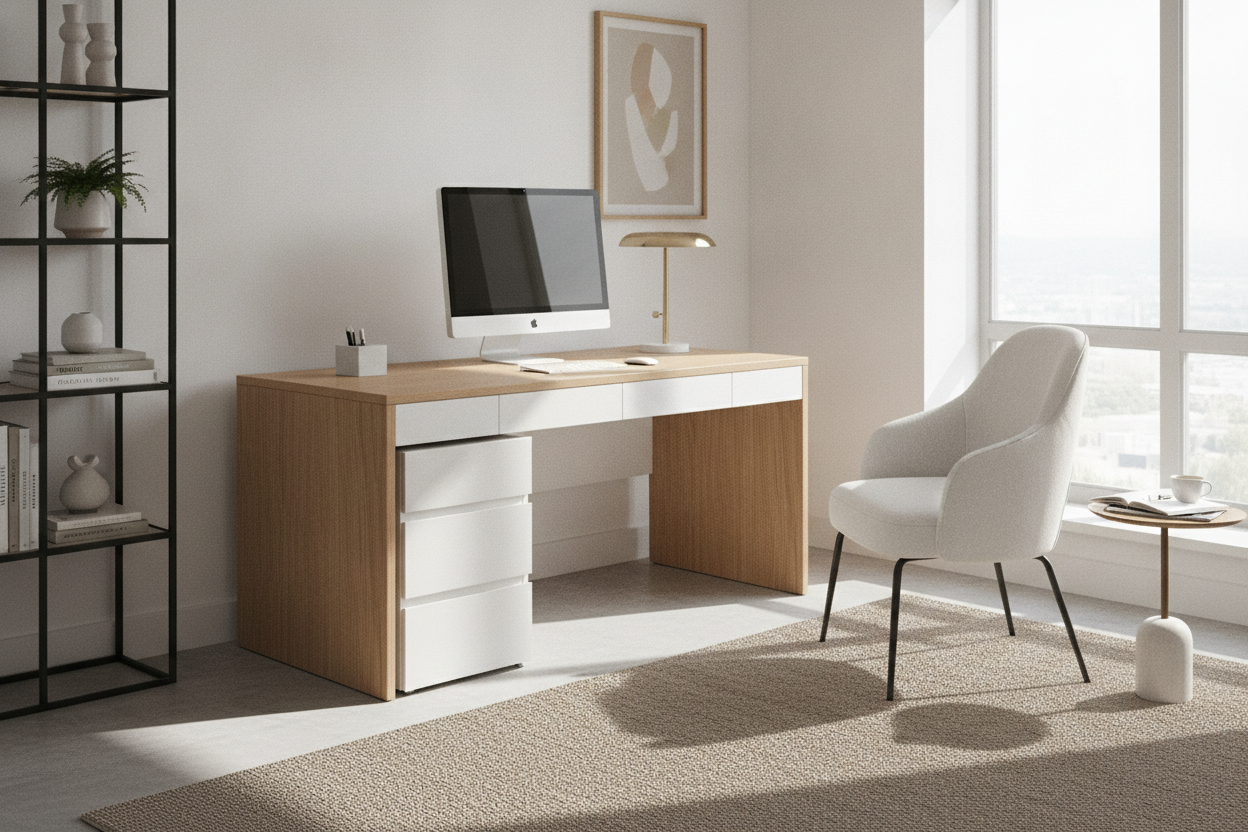
I spent three weeks staring at a beautiful, $800 walnut sit-stand frame only to realize my life was still a mess of loose papers and tax returns stuffed into a plastic milk crate. It is the ultimate design paradox: you buy a sleek, modern desk to 'optimize' your life, but you realize your paper trail didn't disappear just because your desktop moved four feet into the air. Finding a standing desk with file cabinet that doesn't look like it was scavenged from a 1990s DMV office is surprisingly difficult.
- Measure your desk's minimum height before buying any storage; a 27-inch cabinet will collide with a desk that drops to 24 inches.
- Look for a 'fifth wheel' on the bottom drawer to prevent the unit from tipping over when fully loaded.
- Prioritize matte finishes or wood veneers to avoid the sterile HR aesthetic.
- Freestanding cabinets offer more flexibility for cable management than integrated ones.
The Corporate Cubicle Aesthetic Problem
Most office furniture is designed for people who don't have to live with it after 5 PM. When you search for a standing desk with file drawers, you are usually met with two options: a flimsy $60 particle board box that wobbles if you look at it funny, or a heavy, cold, industrial metal cube that screams 'corporate audit.' Neither of those belongs in a room where you also occasionally want to relax or host guests.
The problem is that standing desks are inherently airy. They have those thin, T-style legs and lots of open space underneath. When you shove a mismatched, bulky filing cabinet under there, you immediately kill the visual 'breathability' of the room. It looks like an afterthought. I’ve tried the DIY route—painting an old metal cabinet I found on the curb—but even then, the scale is always off. Real home office furniture should feel like it was built for a person, not a department.
The Physics of Mismatching (How I Almost Burned Out a Motor)
Here is a mistake I made so you don't have to: I bought a high-end standing desk filing cabinet from a different brand than my desk. It looked great. It was 28 inches tall. My desk, at its lowest sitting position, is 27.2 inches. One afternoon, I hit the '1' preset to sit down and heard a sound like a car engine trying to chew through a bag of gravel. The desk frame was literally trying to crush the steel cabinet into the floor.
Before you hit 'buy' on that Amazon special, stop buying a desk with cabinet setups without checking the clearance of your specific motor. Most dual-motor frames have a collision detection sensor, but they aren't always sensitive enough to stop before the frame bends. You need at least an inch of 'air' between the top of your cabinet and the bottom of your desk's lowest point. If you’re short like me and sit with your desk at 25 inches, your search for a standing desk filing cabinet gets much harder, as you’ll need a low-profile unit specifically designed for sit-stand clearance.
What to Look For in a Standing Desk With File Drawers
If you are actually going to use your standing desk with file drawers for, you know, files, you need to look at the hardware. Cheap drawers use plastic rollers that squeak and eventually jump the track. You want full-extension ball-bearing slides. This allows you to actually reach the files at the very back of the drawer without bruising your knuckles. I also look for a counterweight—usually a heavy plate in the bottom or a fifth caster on the drawer itself. Without this, a heavy drawer full of medical records will pull the whole cabinet forward onto your toes the second you open it.
Material-wise, if you can't afford solid hardwood, look for high-pressure laminate (HPL) or real wood veneer over MDF. Avoid the paper-thin 'photo-wood' stickers found on budget furniture; they peel at the corners within six months. Also, consider the knee-room factor. I've seen people jam their storage right where their legs need to go, which is a classic desk with drawer and cabinet layout mistake that will leave you bruised and annoyed. You want a cabinet that is narrow enough (usually 15-16 inches) to sit off to the side while still leaving you 25-30 inches of horizontal space for your chair.
Should Your Standing Desk File Cabinet Be Attached?
You’ll see some models where the standing desk with filing cabinet is actually bolted to the underside of the desktop. This looks incredibly clean because the cabinet moves up and down with the desk. No wires are exposed, and your files are always at arm's reach. However, there is a massive catch: weight capacity. A drawer full of paper can weigh 50 to 80 pounds. If your desk motor is rated for 200 pounds and you've already got two monitors and a heavy desktop, you are pushing that motor to its absolute limit every time you transition from sitting to standing.
I personally prefer the rolling freestanding route. It allows me to move the cabinet out from under the desk when I need to get behind the PC to fix cable tangles. It also means if I ever want to upgrade my desk frame, I don't have to throw away my storage. A standalone standing desk filing cabinet gives you a modular workspace that grows with your gear, rather than locking you into a specific, heavy configuration that is a nightmare to move during a house shift.
Why I Ultimately Chose a Matching Set
After months of trying to mix and match, I gave up and bought a standing desk with matching file cabinet from the same manufacturer. I realized that 'close enough' wasn't good enough for my eyes. The walnut grain on the desk finally matched the grain on the cabinet, and the powder-coated steel legs were the exact same shade of matte charcoal. It sounds trivial, but it changed the room from a 'work station' back into a 'home office.'
The visual clutter disappeared. Because the standing desk file cabinet was designed for the frame, it tucked perfectly into the corner without blocking the motor housing or the power brick. It feels intentional. If you're spending 40 hours a week in a room, those little details—the way the light hits a uniform surface vs. a mismatched one—actually matter for your focus. Don't settle for the HR cubicle look; hold out for the furniture that actually fits your house.
FAQ
Can I put any file cabinet under a standing desk?
Technically yes, as long as it is shorter than the desk's lowest setting. However, standard cabinets are often 28-29 inches, which is too tall for many people's sitting height. Always measure twice.
Do I need locking casters?
Yes. If you don't have locking wheels, the cabinet will scoot backward every time you try to pull open a drawer, especially on hardwood or laminate floors. It’s a small detail that prevents a lot of daily frustration.
Will a heavy file cabinet slow down my desk motor?
If the cabinet is freestanding on the floor, it won't affect the motor at all. If it is an 'under-mount' style that hangs from the desk, it definitely adds strain. Check your desk's lift capacity—usually listed in pounds—before mounting anything heavy.

Leave a comment
This site is protected by hCaptcha and the hCaptcha Privacy Policy and Terms of Service apply.