










My living room was a 10-foot-wide disaster zone. I spent six months trying to convince myself that a massive 75-inch screen on a flat-wall console worked, but every time I walked to the kitchen, I had to shimmy sideways past the coffee table like I was navigating a crowded subway car. It wasn't living; it was an obstacle course. I’d spent way too much money on a kiln-dried hardwood sofa just to have it shoved into a corner where nobody could actually see the TV without a neck cramp.
The breaking point came when I stubbed my toe on the media console for the third time in a week. I realized that a traditional layout just doesn't work for narrow, long rooms. That's when I started looking at a wood corner entertainment center as a legitimate solution instead of a compromise. I needed my floor space back, and I needed a layout that didn't feel like a waiting room at a dentist's office.
- Corner units reclaim roughly 4-6 square feet of 'dead' floor space.
- Solid wood construction prevents the 'cheap college dorm' aesthetic.
- Angling the TV 45 degrees improves viewing for sectional sofas.
- Hidden cable management is significantly easier with a triangular rear profile.
The Awkward 'Hallway Effect' of My Old Living Room
In a narrow room, every inch counts. My old setup featured a standard 60-inch console hugged against the long wall. Because the TV was there, the sofa had to be directly opposite it. This effectively sliced my living room in half, leaving a narrow 24-inch 'hallway' for actual human movement. It felt cramped, looked cluttered, and made the whole house feel smaller than the square footage suggested. Even with a low-profile stand, the depth of the unit plus the TV meant I was losing nearly two feet of clearance right in the main thoroughfare.
I tried every trick in the book. I moved the rug, I bought smaller side tables, and I even considered wall-mounting the TV. But wall-mounting in a narrow room doesn't solve the furniture depth issue—you still need a place for the receiver, the gaming console, and those unsightly wires. The 'hallway effect' is a vibe killer. It makes guests feel like they’re blocking traffic just by sitting down. If you're constantly bumping into your furniture, your layout is failing you. It’s that simple.
Why I Finally Pivoted to a Wood Corner Entertainment Center
The epiphany happened while I was staring at a dusty corner that held nothing but a dying snake plant. Why was I wasting the most structurally sound part of the room? By shopping for tv stands that actually fit the architecture of my home, I realized I could tuck the entire media hub into that useless 90-degree intersection. It felt like finding a hidden room in my own house.
I was picky about materials, though. I've been burned by hollow-core MDF that sags under the weight of a soundbar or a heavy center-channel speaker. If I was going to do this, it had to be solid wood. A wood tv unit corner needs to have some heft to it. I looked for kiln-dried oak or walnut—something that feels permanent and intentional. Cheap laminate peels at the corners within two years, especially if you live in a humid climate or have a robot vacuum that bumps into the baseboards. I wanted something that would age with the house, not something destined for a landfill by next Christmas.
The unexpected warmth of a natural wood corner tv stand
There is a lingering fear that corner furniture looks like something out of a 1980s catalog. I get it. We all remember those bulky, glass-doored monstrosities. But a natural wood corner tv stand avoids that sterile, 'office cubicle' vibe. The organic grain of the wood softens the sharp lines of the corner. It makes the furniture feel like a part of the architecture rather than an awkward plastic protrusion.
Choosing a lighter finish like white oak or maple keeps the corner from feeling like a black hole. I’ve argued before that a dark wood unit won't look like 1999 as long as the silhouette is clean and the hardware is modern. It's about the texture, not just the shape. When the light hits a natural grain, it adds a layer of depth that painted MDF just can't mimic. It turned my 'dead corner' into the warmest spot in the room.
The Geometry of a Wood TV Unit Corner Layout
Let’s talk about the visual math. By angling the screen at 45 degrees in the corner, I was able to shift my sofa back against the far wall and angle it slightly inward. This single move opened up nearly three feet of usable floor space in the center of the room. Suddenly, the 'hallway' was gone, and I had a conversational circle that felt like an actual living room. You can actually walk past someone watching TV without blocking their view for five seconds.
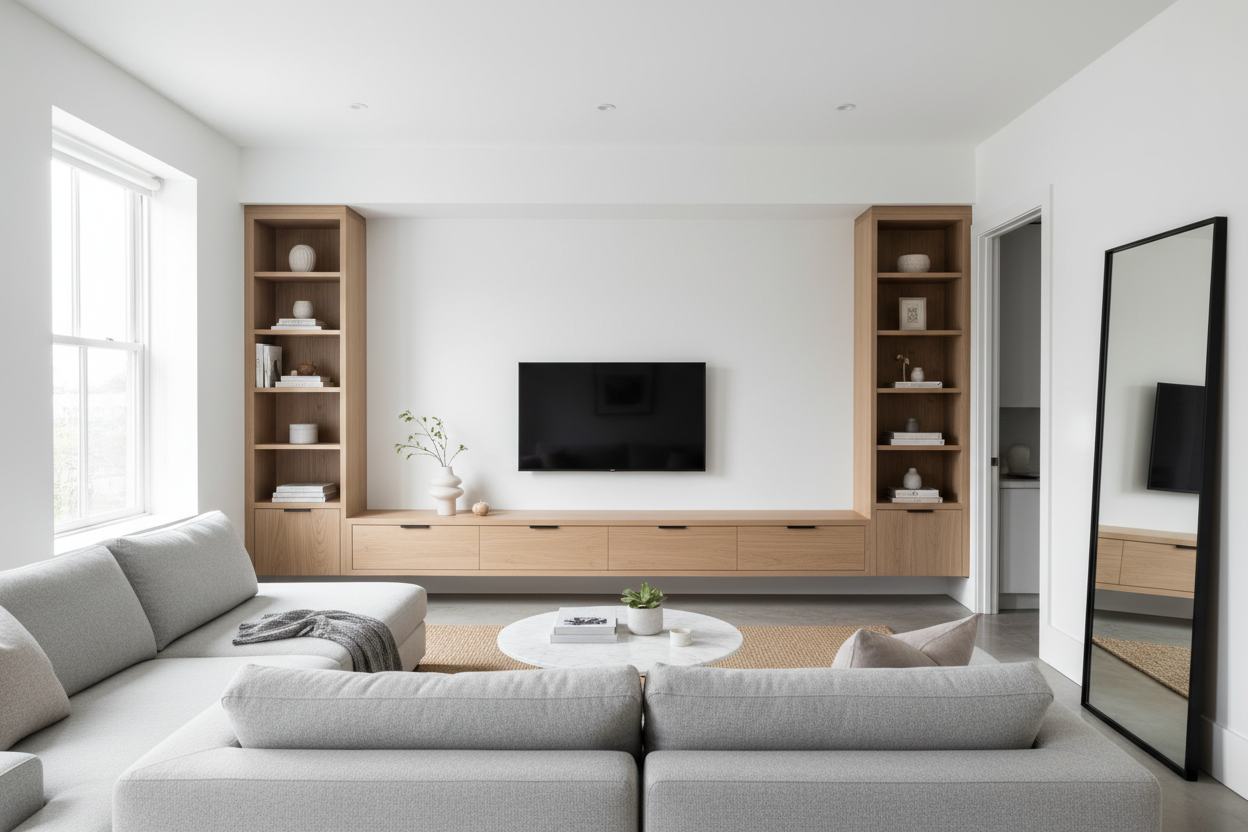
If I had a massive, sprawling Great Room with 20-foot ceilings, I might have opted for a modern 3 piece entertainment center to fill up a long wall and create a gallery feel. But in a real-world, narrow apartment or a cozy bungalow, that much furniture is a death sentence for flow. The corner unit is the tactical choice for people who actually want to live in their space, not just look at it. It’s the difference between a room that feels 'decorated' and a room that feels 'functional.'
How to Style the 'Dead Zone' Behind the Screen
The one downside people mention is the triangular gap behind the TV. Honestly? It’s a blessing for cable management. I tucked a multi-outlet power strip back there and used velcro ties to keep the HDMI cords from looking like a nest of snakes. Unlike a flat-wall console where you're constantly trying to hide wires against the wall, the corner unit provides a natural 'hidden' pocket. No more seeing a tangle of black plastic every time you walk by.
To keep the corner from looking empty behind the screen, I placed a tall, feathered faux-plant slightly to the side. It fills the vertical space and hides the cords from side angles. You could also use a small, upward-facing LED spotlight to wash the corner in soft light at night, which reduces eye strain. Just don't overstuff it with knick-knacks. A little breathing room makes the wood grain pop and keeps the aesthetic clean. It’s about working with the angles, not fighting them.
FAQ
Will a corner stand fit a 65-inch TV?
It depends on the width of the stand's front face. Most corner units are designed for 50-55 inch screens, but if the 'wings' of the stand are wide enough, a 65-inch will fit—just expect some overhang on the sides. Always measure the distance between the TV's feet before buying.
Is solid wood better than veneer for a TV stand?
Always. Veneer peels at the edges over time, especially with the heat generated by electronics like gaming consoles. Solid wood handles the weight better and can be lightly sanded and refinished if you scratch it during a move.
Does angling the TV cause more glare?
Actually, it often helps. By putting the TV in a corner, you have more flexibility to angle it away from windows that cause afternoon reflections on the screen. It gives you a much wider range of 'glare-free' zones compared to a flat-wall mount.

Leave a comment
This site is protected by hCaptcha and the hCaptcha Privacy Policy and Terms of Service apply.