










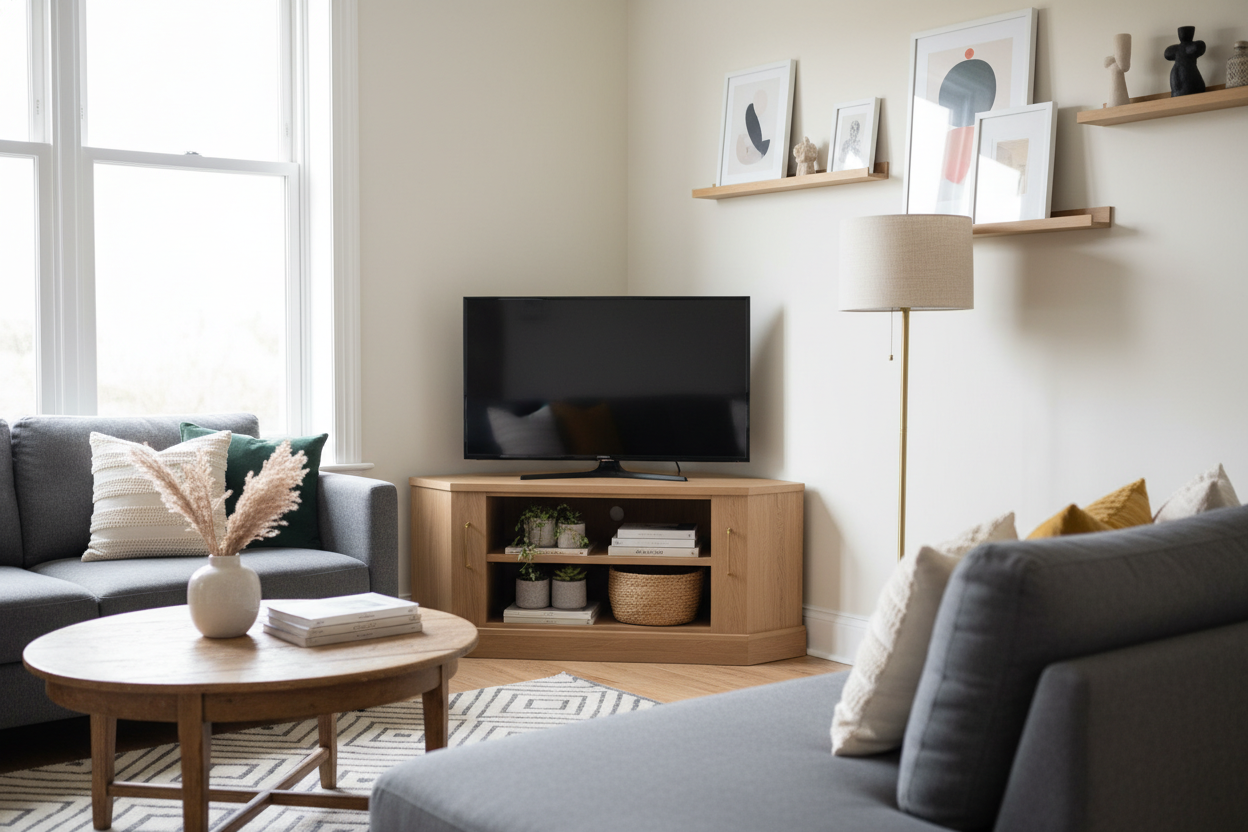
I remember staring at my studio floor plan for three hours, clutching a metal tape measure like a weapon. I had exactly one long, flat wall, and it was already claimed by a radiator and a closet door that swung out just far enough to ruin my life. I spent weeks scrolling through endless TV stands that were five feet long, slowly realizing that if I wanted a couch and a bed in the same zip code, the 'media center' had to go somewhere else.
- Saves Floor Space: Frees up the center of the room by utilizing dead corners.
- Perfect Proportions: Fits most 40-43 inch TVs without looking top-heavy.
- Cable Management: Corner units naturally hide the 'spaghetti' of wires behind the frame.
- Better Sightlines: Angled viewing often works better for studios where the 'living room' is also the bedroom.
The 'No Flat Walls' Problem in Tiny Apartments
The struggle of the modern studio is real. You’ve got windows on one wall, a kitchenette on the other, and a bathroom door cutting into the third. When I finally found a 36 inch corner tv stand, it felt like I’d discovered a cheat code. I had been trying to force a rectangular stand against a wall where it blocked my walkway by three inches—just enough to stub my toe every single morning.
Standard units assume you have a sprawling suburban living room. They don’t account for the weird nooks created by old-school architecture or poorly placed HVAC vents. By tucking the TV into the corner, I reclaimed nearly four square feet of floor space. In a 400-square-foot apartment, that’s the difference between having a coffee table and eating dinner on your lap.
Why the 36 Inch Corner TV Stand is the Magic Number
In my experience, 36 inches is the 'Goldilocks' zone for small-space media furniture. If you go smaller, like a 24-inch unit, the TV looks like it’s balancing on a toothpick. If you go much larger, the unit starts to jut out so far into the room that you lose the 'corner' benefit entirely. A three-foot width gives you enough surface area for a decent soundbar or a gaming console without the bulk.
I personally tested a 36-inch wood-veneer model and found it comfortably held my 43-inch Samsung. The screen was slightly wider than the stand, which actually looked quite modern—sort of a floating effect. Just make sure the stand's weight capacity is at least 50 lbs; even modern TVs have some heft, and cheap MDF can bow over time if you aren't careful.
Measuring for a Corner TV Stand 36 Inches Wide
Don't just measure the front face of the unit. You need to measure from the back corner of your room out along both walls. A corner tv stand 36 inches wide usually requires about 25 to 27 inches of 'wall run' on each side. I made the mistake of ignoring my baseboards the first time. If your baseboards are thick, your stand won't sit flush against the wall, leaving a weird gap where your remote will inevitably fall and disappear forever.
How to Style a Tiny Stand So It Doesn't Look Like a Dorm Room
Small furniture often gets a bad rap for looking like 'starter' pieces. To avoid the dorm room aesthetic, I suggest staying away from the open-wire shelving units. Go for something with doors to hide the clutter. I actually considered a 30 inch electronic fireplace with white TV stand because it adds a sense of permanence and 'built-in' architectural detail that a basic shelf just can't match.
Another trick? Paint the corner behind the TV a dark, moody charcoal or navy. This makes the TV screen blend into the wall when it's off, and it makes the 36-inch footprint feel like a deliberate design choice rather than a space-saving compromise. Also, use adhesive cable clips. Nothing ruins the look of a compact stand faster than a tangle of black power cords peeking out from the sides.
When You Finally Have the Space to Size Up
I eventually moved out of that studio and into a one-bedroom with an actual, honest-to-god living room. While I loved my compact setup, I realized that as your room grows, your furniture needs to grow with it to keep the scale right. If you find yourself in a larger space but still love that angled look, you might want to read about why I gave up my main wall for a 55 inch corner TV stand.
For now, though, if you're fighting for every inch of floor, trust the 36-inch corner unit. It solved my layout paralysis and finally let me stop moving my sofa every time I wanted to open the closet. It’s proof that good design isn't about how much space you have, but how you use the weird corners you're given.
FAQ
Will a 50-inch TV fit on a 36-inch corner stand?
Technically, yes, if the TV's legs are centered or narrow enough. However, the screen will overhang the sides by several inches. It can look a bit top-heavy, so I usually recommend sticking to a 43-inch screen for the best visual balance.
Are corner TV stands hard to assemble?
Most are fairly straightforward because they have fewer long spans than rectangular stands. Just be careful with the back panels—they are often the structural 'spine' that keeps the unit from wobbling, so don't skip those tiny screws.
How do I stop the stand from scratching my wood floors?
Most units come with cheap plastic feet. Toss those and buy a pack of heavy-duty felt pads. Since corner units are tucked away, you'll likely forget to clean behind them for months; felt pads make it easy to slide the unit out when you finally decide to tackle the dust.

Leave a comment
This site is protected by hCaptcha and the hCaptcha Privacy Policy and Terms of Service apply.