










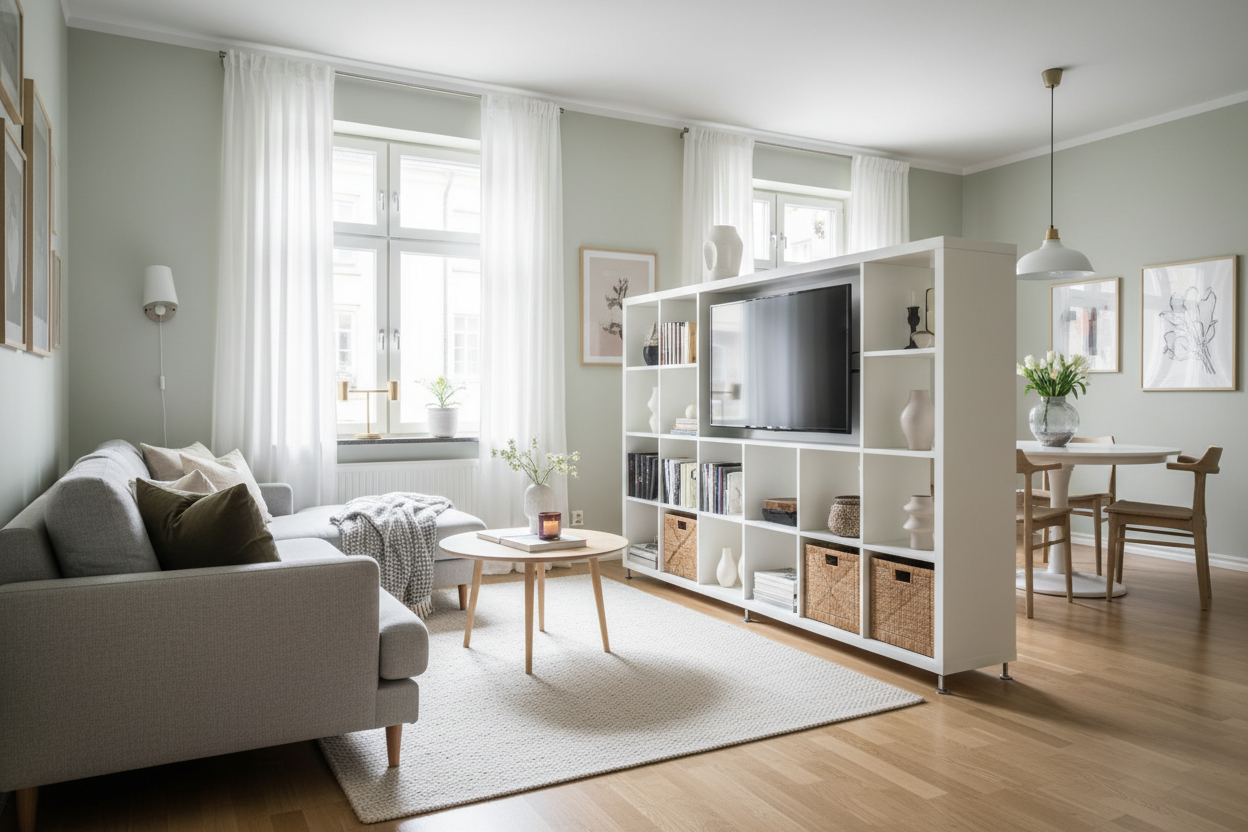
I recently moved into a 'luxury' loft that was essentially one giant, echoing rectangle of drywall and polished concrete. It looked great in the listing photos, but once my sofa was in, I realized I had a massive problem: there wasn't a single logical wall for the television. If I put it against the far wall, I’d need a telescope to see the screen. If I put it by the window, the glare would be blinding.
The solution was to stop thinking about walls and start thinking about zones. I needed a room divider tv stand ikea hack that could sit right in the middle of the room, look decent from behind, and not fall over if my dog got the zoomies. It sounds simple, but floating a TV is a high-stakes game of cord-hiding and structural integrity.
- Stability is non-negotiable: Floating units need a wider footprint than wall-moored ones to prevent tipping.
- The 'Ugly Back' Problem: Most cheap furniture has a raw particle board back that looks like a middle school art project.
- Cord Routing: You need a plan for the power cables, or you're just creating a literal tripwire in your living room.
- Height Matters: Keep it low to maintain sightlines and prevent the 'cubicle' feel.
The Open Concept Curse (And Why Walls Are Actually Great)
We’ve been sold this dream that open-concept living is the peak of modern design, but nobody tells you how hard it is to actually live in a room with no corners. Without walls to anchor your furniture, everything just floats in a sea of floor space like a bunch of lost life rafts. My living area bled into my dining area, which bled into my kitchen, and the whole thing felt like a furniture showroom rather than a home.
I spent three nights staring at my floor plan. Placing the TV against a wall meant my sofa would be 15 feet away—too far for a 55-inch screen. Bringing the sofa closer left a bizarre, unusable 'no man's land' behind it. I realized I had to use the TV stand itself to create a wall where one didn't exist.
Why I Decided to Float My TV in the Middle of the Room
By pulling the TV stand away from the perimeter, I finally carved out a dedicated 'media zone.' It created a visual boundary that told your brain, 'The living room ends here, and the dining room starts there.' The trick was choosing a low TV stand with storage to keep the room feeling expansive.
If I had used a tall bookshelf, I would have cut the natural light in half. Keeping the height around 15 to 20 inches allows your eyes to travel across the whole room while your body feels enclosed in a cozy nook. It’s a psychological trick that makes a 700-square-foot studio feel like a two-room suite.
The Room Divider TV Stand IKEA Hack That Saved My Layout
Here is the 'secret sauce' I landed on after three trips to the Swedish warehouse. I didn't just buy one unit; I bought two and slapped them together back-to-back. Specifically, I used two IKEA Besta frames. By joining them, I got a double-sided console that was nearly 30 inches deep—way more stable than a single skinny unit.
I bolted them together using simple binding screws. On the living room side, I added sleek doors to hide the PlayStation and the messy stack of board games. On the 'dining room' side, I left the shelves open to hold cookbooks and a few decorative bowls. It’s heavy, it’s sturdy, and it looks like a custom piece of architectural millwork rather than a $200 flat-pack project.
The Golden Rule: It Must Have a Finished Back
The biggest giveaway of a cheap hack is that flimsy, folded cardboard backing that comes in the box. If you float a standard unit, everyone sitting at your dining table is going to be staring at brown tape and silver staples. It’s a vibe killer. I fixed this by buying a thin sheet of 1/4-inch plywood, painting it to match the frame, and nailing it across the back of the units.
If you aren't handy with a hammer, you can use peel-and-stick wallpaper or even upholstered fabric panels. Compare that to a high-end mid century modern TV stand, which is designed with finished wood on all sides. If you’re hacking it, you have to put in that extra 10% of effort to hide the 'bones' of the furniture.
My Cord Management Nightmare (And How I Hid Them)
Floating a TV means your power source is likely several feet away. For the first week, I had a thick black extension cord snaking across my hardwood floor. It looked terrible and I tripped on it twice. To fix it, I ran a heavy-duty power strip inside the Besta units and then used a flat, paintable cord cover that matched my floor precisely.
I tucked the main power lead under the edge of a large area rug. Now, the only visible cord is a tiny three-inch stretch where it leaves the rug to meet the wall outlet. Inside the console, I used Velcro ties to keep the HDMI cables from becoming a bird's nest. It took four hours of sweating and swearing, but the result is a clean, wireless look that actually works.
Not Up for a DIY? Alternative Freestanding Consoles That Work
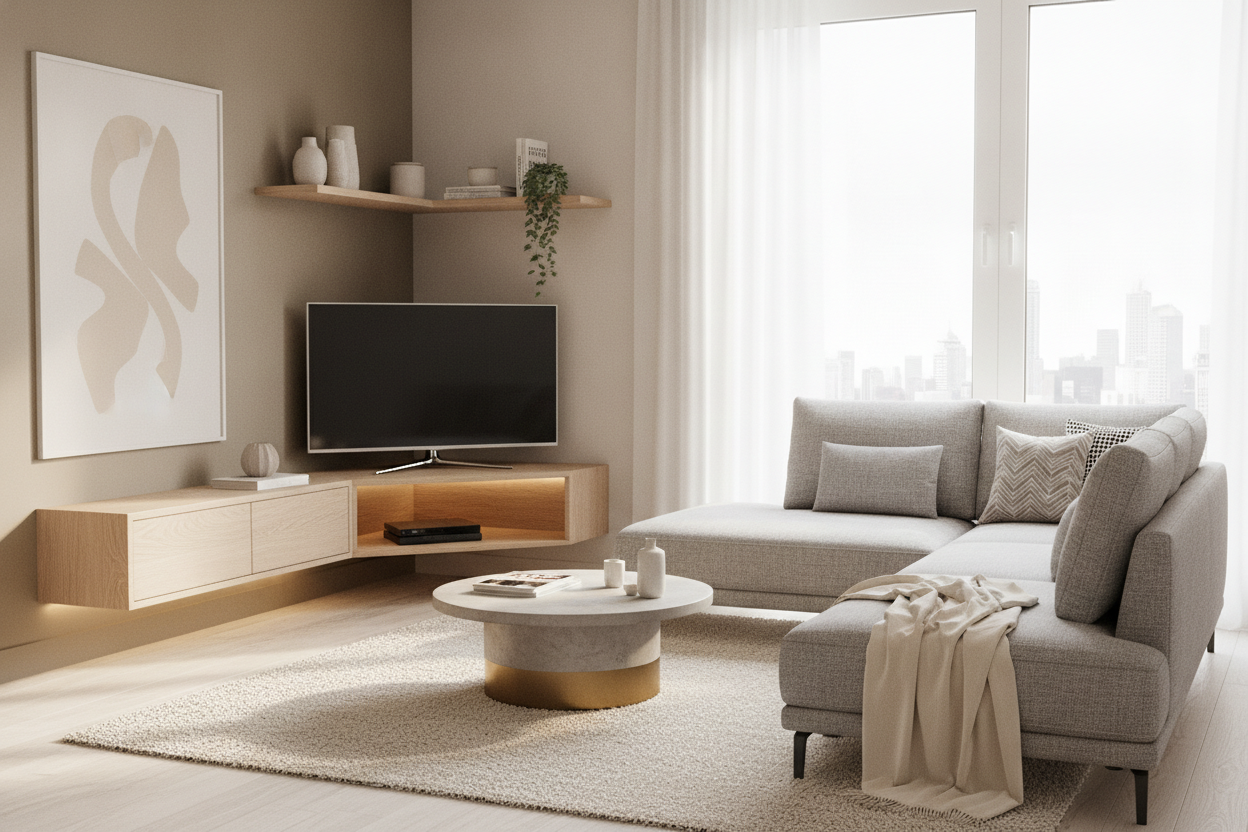
I get it—not everyone wants to spend their Saturday afternoon bolting Swedish cabinets together and painting plywood. If the thought of a 'hack' makes you break out in hives, you can explore dedicated freestanding TV stands that are built for 360-degree viewing right out of the box.
Look for 'island' style consoles or units described as 'finished on all sides.' These usually feature integrated cable management channels that run down the legs, saving you the headache of the rug-and-tape routine I had to endure. Whatever you choose, just remember: measure your floor space twice, because a floating unit takes up way more visual real estate than one tucked against a wall.
FAQ
Is a floating TV stand safe for homes with kids or pets?
Only if it has a wide base. A skinny, top-heavy stand is a tipping hazard. By joining two units back-to-back (like my Besta hack), you create a massive footprint that is very difficult to knock over.
How do I hide the gap between the two units?
A single, long 'topper' is the best way. I used a piece of stained pine from the hardware store that spanned both units, which hid the seam and made the two separate pieces look like one solid island.
Can I do this with a Kallax?
Yes, but the Kallax is 'open,' meaning you'll see all your cords through the cubes. You'll need to use the specific Kallax insert drawers or boxes to hide the electronic guts of your setup.

Leave a comment
This site is protected by hCaptcha and the hCaptcha Privacy Policy and Terms of Service apply.