










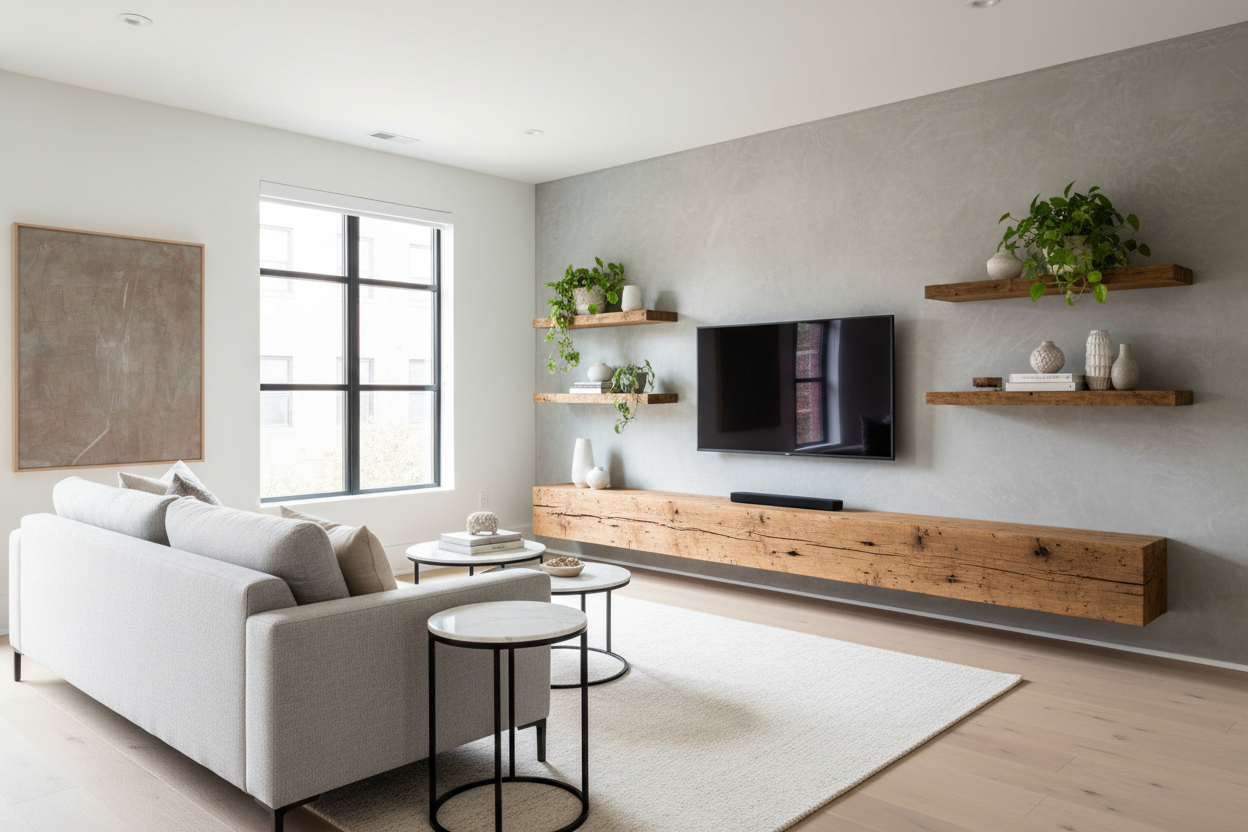
I spent three weeks staring at a 70-inch media console that made my 12-foot wide living room feel like a narrow hallway. It was a bulky, veneer-covered box that did nothing but collect dust and hide a tangled nest of HDMI cables I hadn't touched since 2019. I finally ripped it out and decided to mount a chunky wood beam under tv instead.
- Floor space is precious; stop wasting it on empty cabinets you don't actually need.
- Solid timber adds a raw, organic texture that plastic and MDF can't replicate.
- In-wall cord management is the make-or-break factor for this minimalist look.
- Weight is a major factor—studs are mandatory, not optional.
The Problem With Traditional Media Consoles
Most traditional TV stands are built for a world where we still have DVD players, VCRs, and massive cable boxes. They are usually 18 to 22 inches deep, which is a massive footprint in a small apartment or a narrow den. When I ditched mine, I gained back nearly 10 square feet of floor space. It was like the room could finally breathe.
Standard consoles also create a 'heavy' visual line at the bottom of the wall. They anchor the room in a way that feels cluttered, especially if you have a rug that already covers a lot of the floor. By floating a beam, you see the floor extending all the way to the baseboard, which trick your brain into thinking the room is much larger than it actually is.
Why the Floating Wood Beam Aesthetic Actually Works
It is all about the contrast. Your TV is a cold, black rectangle of glass and plastic. Putting it above a raw, hand-hewn wood beam tv stand creates a visual anchor that feels architectural rather than like an afterthought. It brings a bit of the 'outdoors' into a space dominated by tech.
I am a big believer in investing in solid wood because you simply cannot fake the grain, the knots, or the sheer weight of real timber. A hollow shelf looks like a cheap prop from a home staging kit. A 6x6 or 8x8 beam feels permanent and intentional. It turns a boring wall into a feature without the need for expensive wallpaper or a full-blown renovation.
The Cord Conundrum: Where Does Everything Go?
If you have wires dangling from your beam, you have failed. I know that sounds harsh, but the entire minimalist vibe relies on the absence of clutter. This project requires you to get comfortable with routing wires behind the drywall. I used a recessed media box behind the TV to hide the power outlet and the 'brain' of the TV.
I also moved all my peripherals—the gaming consoles and the mesh router—to a closet nearby. If you can't move them, consider a beam that is deep enough (at least 8 inches) to hide a small streaming stick behind the wood. I switched entirely to smart TV apps to kill the need for a bulky cable box sitting on the shelf. If you can't hide the cords, don't do the beam.
Picking the Right Timber Tone for Your Space
Don't try to match your floors perfectly. You will likely miss the mark by a shade or two, and it will look like an accident. Go for contrast instead. If you have light oak floors, go for a dark walnut or even black wood finishes to create a moody, high-end focal point.
I went with a reclaimed pine that had some gray undertones to offset my warm wood floors. It worked because the textures were different enough to feel like a choice. Also, consider the sheen. A matte or oil finish looks much more 'bespoke' than a high-gloss polyurethane that reflects the light from the TV screen.
Installation Reality Check: This Thing is Heavy
My beam weighed 45 pounds before I even put a candle on it. You cannot use drywall anchors and a prayer for this. I used 8-inch lag bolts driven directly into three different studs. If you miss a stud, that beam is eventually coming off the wall, and it will take a chunk of your drywall with it.
My biggest mistake? Not checking the level after every single bolt. I thought I had it, but once the full weight was on the brackets, the beam settled about an eighth of an inch on one side. It drove me crazy for a week until I took the whole thing down and shimmed it. Measure twice, drill once, and use a four-foot level.
How high should I mount the beam?
Usually, 4 to 6 inches below the bottom of the TV is the sweet spot. It provides enough separation to look intentional but keeps the two pieces visually connected.
Can I use a hollow mantel instead of a solid beam?
You can, and it is definitely easier to install. However, hollow mantels often sound 'thin' when you set things down on them. If you want that high-end, architectural feel, solid timber is the only way to go.
Is a beam deep enough for a soundbar?
Most beams are 6 inches deep, which fits many modern slim soundbars. Just make sure to measure your soundbar's 'feet' before you buy the timber to ensure it won't overhang.

Leave a comment
This site is protected by hCaptcha and the hCaptcha Privacy Policy and Terms of Service apply.