










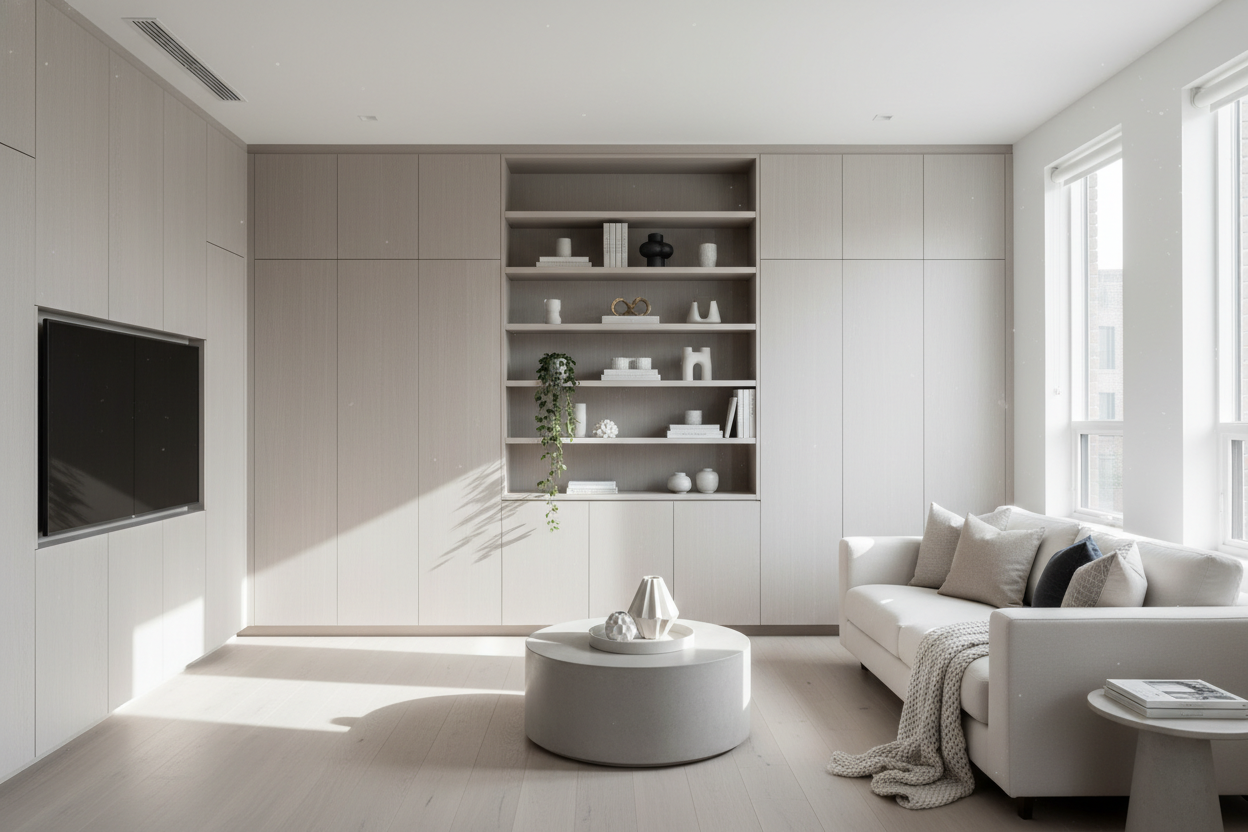
I spent three weeks staring at a $6,400 quote for custom living room built-ins before I finally hit 'delete.' It wasn't that the carpenter was overcharging; it was just that I couldn't justify spending the price of a used Honda on some shelves and doors. I wanted that seamless, floor-to-ceiling look that makes a room look 'architectural,' but my budget was firmly in the flat-pack territory. That is when I started looking into full height storage cabinets as a viable workaround.
- Height is Everything: Aim for units that get within 6-10 inches of your ceiling to maximize the visual 'lift.'
- Anchor for Safety: Tall units are top-heavy; always use wall anchors to prevent tipping.
- Trim the Gap: Use crown molding or a simple header board to hide the space between the cabinet top and the ceiling.
- Check Your Baseboards: Measure the thickness of your baseboards before buying to ensure the cabinet can sit flush against the wall.
The Custom Millwork Dream vs. My Actual Budget
We all want that Pinterest-perfect library wall, but the reality of local labor costs is a cold shower. When I realized that custom millwork would require a 50% deposit and a six-week lead time, I pivoted. I needed something that looked intentional, not like a temporary fix. The goal was to find full-height storage cabinets that felt substantial—think 3/4-inch thick shelving rather than that flimsy 1/4-inch plywood that bows the second you put a hardcover book on it.
I realized that by buying three identical units and lining them up, I could mimic the footprint of a custom install for about $1,200 total. That left me with $5,200 to spend on things that actually matter, like a sofa that doesn't feel like a park bench or a rug that isn't made of scratchy plastic fibers.
Why Going Vertical is the Ultimate Decor Cheat Code
If your furniture stops at five or six feet, you are cutting your room in half. It makes the ceiling feel lower and the floor feel more cluttered. By choosing units that scrape the ceiling, you draw the eye upward, which is a classic designer trick for making small apartments feel like grand estates. I’ve spent a lot of time reading what designers actually think about freestanding tall storage, and most agree that the scale of the piece is more important than whether it is literally attached to the studs.
Maxing out your vertical space also solves the 'dust bunny' problem. Those few inches on top of a standard wardrobe are just a graveyard for dust and forgotten holiday decor. When you go full-height, you eliminate that dead space entirely, turning a cleaning nightmare into actual usable storage for things you only need once a year, like the heavy winter coats or the good china.
The 'Anchor and Trim' Trick for a Seamless Look
The biggest giveaway that your furniture is freestanding is the gap at the top and the sides. To fix this, I recommend using stackable modular storage cabinets. You can buy a base unit and a topper, which allows you to get much closer to the ceiling than a single 80-inch unit would. Once they are in place, head to the hardware store and buy some simple pine trim. If you paint the trim the exact same color as the cabinets, you can bridge that 4-inch gap at the top, and suddenly, it looks like a permanent part of the house.
Safety is the non-negotiable part here. I once tried to skip anchoring a tall pantry because I didn't want to 'ruin the drywall.' Three days later, I opened two heavy drawers at the same time and the whole thing lurched forward like a falling tree. Buy the heavy-duty L-brackets. Screw them into the studs. It takes ten minutes and saves you a trip to the ER.
Repurposing Bedroom Furniture in the Living Room
Don't get bogged down by the 'room' labels on retail websites. Some of the best storage I've found for my living room was actually tucked away in the bedroom section. For example, a modern white wardrobe armoire with top cabinet offers way more utility than a standard bookshelf. It has doors to hide the visual clutter of my printer, my router, and my embarrassing collection of 90s DVDs.
Using an armoire in a main living area feels bold, but if the lines are clean and the hardware is high-quality, it just looks like a high-end storage wall. I opted for a model with a sleek, handle-less design. It disappears into the wall, providing massive amounts of storage without making the room feel like a warehouse. It is the ultimate 'hide the mess' solution for people who don't live in a minimalist showroom.
Measurements You Need Before Buying Anything Tall
Before you go browsing for standard freestanding storage cabinets, grab a laser measure. You need to know your ceiling height at three different points along the wall. Floors are almost never perfectly level, especially in older buildings. If your floor slopes by even half an inch, a tall cabinet will lean visibly away from the wall, or worse, it won't fit under the ceiling at one end.
Also, check your door clearances. A 24-inch deep cabinet sounds great for storage, but if it sits right next to a doorway, it might make the entrance feel cramped or block the path of the door swing. I learned the hard way that a 15-inch depth is usually the 'sweet spot' for living rooms—it's deep enough for bins and books but shallow enough that it doesn't eat up your entire floor plan.
How do I make cheap cabinets look expensive?
Change the hardware. Swap out the generic plastic or silver knobs for solid brass or matte black pulls. Also, add a 'toe kick' or base molding at the bottom to hide the adjustable feet. It makes a $300 cabinet look like a $1,500 designer piece instantly.
Can I use these in a rental?
Absolutely. Just be prepared to patch a few small holes from the wall anchors when you move out. It is a much better solution than asking a landlord for permission to install permanent shelving that you can't take with you.
What material should I look for?
If you can afford it, go for a mix of solid wood and high-density MDF. Avoid the super-lightweight particle board if you plan on moving the unit frequently, as the joints tend to crumble under stress. Look for a weight capacity of at least 40 lbs per shelf.

Leave a comment
This site is protected by hCaptcha and the hCaptcha Privacy Policy and Terms of Service apply.