










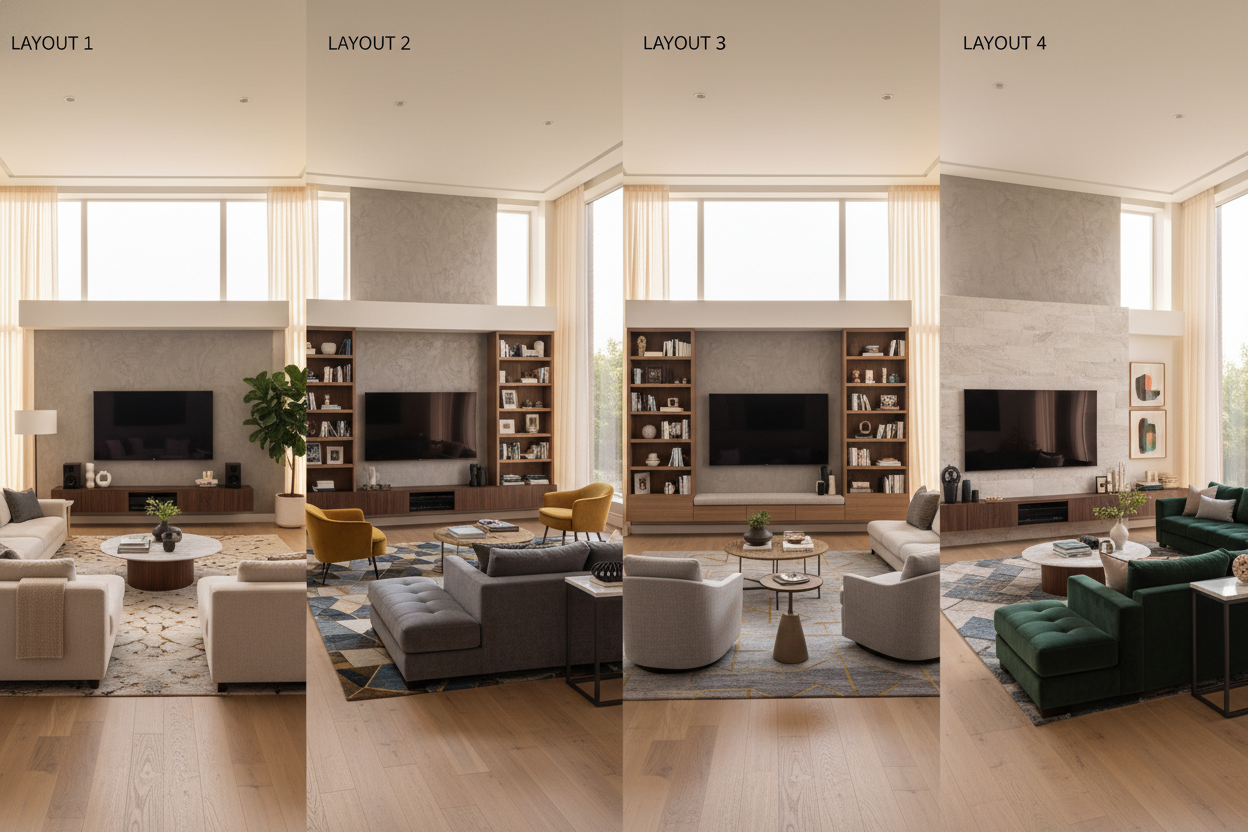
I spent three months staring at a 14-foot stretch of beige drywall in my living room. It was paralyzing. I’d buy a plant, move a chair, then spend four hours scrolling through Pinterest only to realize my room still felt like a waiting room at a mid-tier car dealership. The problem wasn't the furniture I had; it was the massive, echoing void where my TV lived. I finally realized that an entertainment center on wall is the only way to anchor a room that lacks architectural character.
Quick Takeaways
- Scale is everything—if your console is narrower than your TV, it’ll look top-heavy and awkward.
- Wall-mounted units create the illusion of more floor space, making small rooms feel significantly larger.
- Hidden cable management isn't a luxury; it’s a requirement for a clean look.
- Modular systems allow you to grow your storage as your collection of tech and decor expands.
The Problem With a Giant, Empty Drywall
Most modern homes come with what I call the 'Great Wall of Nothing.' It’s that one massive, uninterrupted expanse of drywall that builders expect you to just figure out. For a long time, I thought a 65-inch screen was a design statement in itself. It’s not. It’s just a big, black rectangle that sucks the life out of the room when it’s turned off. Without proper wall entertainment, the TV looks like a temporary fixture rather than a part of the home.
I tried to ignore it by focusing on the rug and the sofa, but your eyes naturally gravitate toward the largest vertical surface in the room. If that surface is bare, the whole space feels unfinished, no matter how much you spent on your velvet sectional. You need something with visual weight to push back against the emptiness.
Layout 1: The Sad, Lonely Floating Screen
My first attempt was the minimalist approach. I mounted the TV directly to the studs, tucked the wires into a plastic raceway (which I poorly painted to match the wall), and called it a day. It was a disaster. It didn't look 'clean'—it looked like a sports bar that had run out of budget. There was no storage, no depth, and absolutely zero soul.
Standing back, I realized the TV was just floating in space with no context. This is when I learned that even a sleek screen needs a wall mounted media console to provide a visual baseline. Without that horizontal line underneath, the TV feels untethered. It needs a 'landing pad' for your eyes to rest on, otherwise, the proportions of the entire wall feel skewed.
Why Wall Entertainment Needs Actual Structure
Design is about balance. A TV is a heavy object, visually speaking. If you don't surround it with wall entertainment units that have some substance, the room feels lopsided. You need shelves, cabinets, or at least a substantial ledge to break up the verticality of the drywall. It’s about creating a 'zone' for your tech so it doesn't just feel like an appliance slapped onto the wall.
Layout 2: The Cluttered Gallery Wall Mistake
After the 'sports bar' failure, I went the opposite direction. I surrounded the TV with about fifteen different-sized frames, two small floating shelves, and a decorative clock. I thought I was being clever by 'hiding' the TV in a gallery wall. I wasn't. I was just creating visual noise.
Every time I tried to watch a movie, my eyes were distracted by a crooked photo of my dog or a tiny succulent sitting three inches from the screen. It felt messy, not curated. Real wall entertainment requires a bit of breathing room. Trying to fill every square inch of drywall with small items just makes the room feel smaller and more chaotic. You need intentionality, not just more stuff.
Layout 3: The 'Too-Small' Floor Console
Next, I tried a standard, 50-inch wooden TV stand I found on clearance. It was a beautiful piece of furniture, but it was completely wrong for the space. Because it sat on the floor and left a three-foot gap between the top of the stand and the bottom of the TV, it created this awkward 'dead zone' where dust bunnies and stray HDMI cables went to die.
Using a tiny stand for a large wall is like wearing a tuxedo with flip-flops. The scale is just wrong. I was wasting all that vertical real estate that could have been used for books, speakers, or actual storage. It also made the ceiling feel lower because it cut the wall off at a weird height. If you have the space, you have to use it.
Layout 4: The Winner (An Entertainment Center on Wall)
The breakthrough happened when I stopped trying to piece things together and committed to a cohesive system. Installing an integrated entertainment center on wall changed the entire geometry of the room. By using modern entertainment center wall units, I was able to hide the clutter of my gaming consoles and soundbar while creating a focal point that actually looked like it belonged there.
The floating design is the key. Because you can see the floor underneath the unit, the room doesn't feel cramped, but the wall itself feels 'full' and intentional. It turned a flat, boring surface into a three-dimensional feature. I opted for a mix of closed cabinetry to hide the ugly stuff (routers, controllers) and open shelving for the things I actually want people to see. It’s functional, but it also looks like I hired a designer.
When You Actually Need a Large Wall Entertainment Unit
If your living room is over 15 feet wide, a tiny console isn't going to cut it. You need a large wall entertainment unit that spans at least two-thirds the width of the wall. This isn't about being extra; it's about basic math. A large unit anchors the room and prevents your furniture from looking like it's 'drifting' in a sea of carpet.
Before you buy, measure your wall twice. Then measure your TV. Then measure the distance from your sofa. You want the center of the screen to be at eye level when seated—usually about 42 inches from the floor. A modular wall system allows you to adjust the height of the components so you don't end up with 'TV neck' from looking too high or too low.
FAQ
Does a wall-mounted entertainment center damage the drywall?
If you use the right anchors or hit the studs, no. I always recommend finding the studs for the main support. If you're renting, look for 'no-stud' high-capacity hangers, but for a full unit, hitting wood is the only way to sleep soundly at night.
How high should I mount my floating console?
Usually, 8 to 12 inches off the floor is the sweet spot. It’s high enough to let a robot vacuum pass underneath but low enough that it still feels grounded and connected to the rest of the furniture.
Can I hide all my wires inside the wall?
Yes, provided you aren't dealing with a fire-rated wall or weird insulation. I use a simple recessed media box kit. It lets you plug everything in behind the TV and run the power down to the console without a single cord showing. It's a Saturday afternoon project that makes a $500 setup look like a $5,000 one.

Leave a comment
This site is protected by hCaptcha and the hCaptcha Privacy Policy and Terms of Service apply.