










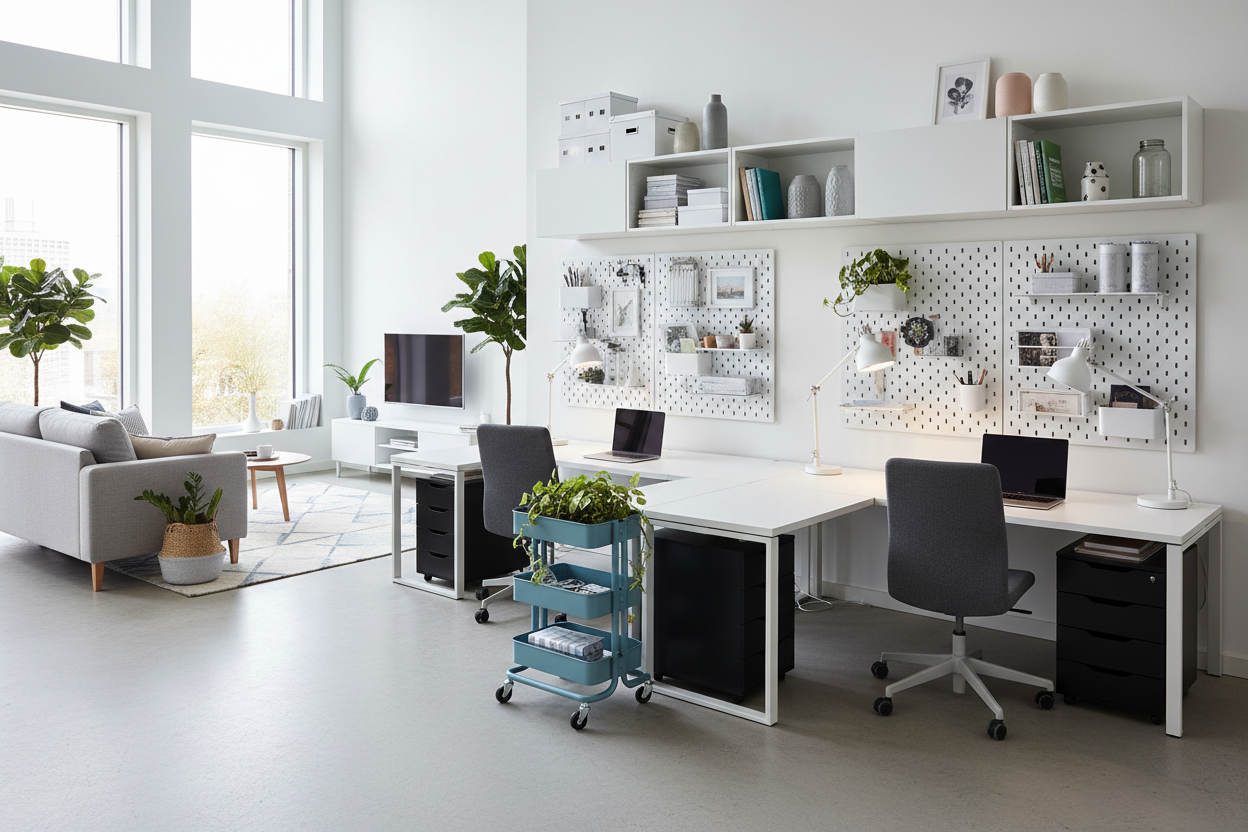
We have all been there: two people, one tiny spare bedroom, and a chaotic tangle of laptop cords stretching across a flimsy folding table. When you share a workspace, the friction is real. Someone is always bumping elbows, stealing the good pen, or accidentally joining a Zoom call in the background. If you are trying to design an ikea home office for two, you are likely looking for a way to restore peace without spending thousands on custom cabinetry.
You can absolutely create a high-functioning, beautiful shared workspace using off-the-shelf pieces. In this guide, I will walk you through the exact layouts, product combinations, and spatial rules you need to build a dual workspace that feels intentional and looks expensive.
Quick Decision Guide
- Respect the 60-inch rule: Each person needs a minimum of 60 inches of linear desk width to comfortably fit dual monitors, a keyboard, and negative space for writing.
- Anchor with storage: Use drawer units in the center of a shared desk to create a physical boundary and shareable storage.
- Mind the depth: A standard 23 5/8-inch deep Ikea tabletop is fine for laptops, but if you use heavy monitor arms, upgrade to a 25-inch or deeper kitchen countertop.
- Manage cables immediately: Use wire management racks bolted directly under the desk before you place any monitors on top.
Space Planning & Layout Configurations
The Long Wall vs. The T-Shape Layout
In a standard North American 10x12 foot spare bedroom, you generally have two layout options for a shared office. The most popular is the 'Long Wall' approach, where a single continuous surface spans an entire wall. This requires at least 10 feet of uninterrupted wall space to accommodate two chairs comfortably. It keeps the center of the room open, making the space feel larger and allowing room for a small reading chair or floating shelves.
If your room is square or has multiple doors and windows, consider the 'T-Shape' layout. You place a main storage unit against the wall and run the desks outward into the center of the room, facing each other. This creates distinct zones and prevents you from staring directly at a blank wall, though it does eat up more floor space and requires careful cable management down the central leg.
Style & Coordination
Hacking the Custom Built-In Look
When clients ask me for ikea home office ideas for two, they usually show me photos of seamless, wall-to-wall wood desks. The secret to this high-end look is mixing office components with kitchen components. Instead of buying standard desk tops, which lack visual weight and can bow under heavy equipment, use a kitchen countertop.
Pair a warm walnut veneer countertop with matte black or crisp white drawer units. The contrast in textures grounds the room. To make it look truly built-in, leave a one-inch gap between the edges of the desk and the side walls, allowing the architecture of the room to breathe. Fill the negative space above the desk with matching floating shelves to draw the eye upward and balance the heavy footprint of the desk below.
Value & Longevity
Where to Save and Where to Invest
Not all flat-pack furniture is created equal. If you are building a shared workspace, spend your money on the structural supports and the seating. A hollow-core tabletop will dent if you drop a coffee mug on it, and it cannot safely support clamp-on monitor mounts. Invest in solid wood or thick veneer surfaces.
Similarly, do not compromise on ergonomics. While a trendy dining chair might look beautiful tucked under the desk, your back will pay the price after a 40-hour work week. Invest in highly adjustable task chairs. You can save money on the secondary storage, like wall cubes or a basic bookcase, which do not take daily physical abuse.
Designer's Honest Take
A few years ago, I designed a massive dual workspace for a couple in a 1940s colonial home. We used two 74-inch walnut countertops resting on three navy blue drawer units to span a 12-foot wall. It looked stunning on installation day, but I learned a hard lesson about older houses: the floors are never level.
Because the center drawer unit was bridging two separate countertops, the slight slope in the floor created an agonizing 1/4-inch lip right in the middle of the desk. We had to retrofit adjustable feet onto the bottom of the drawer units to level the surface perfectly. Furthermore, when the client clamped a heavy dual-monitor arm to the back of the desk, the pressure actually cracked the underside of the veneer. I now always insist on using a solid block of scrap wood between the clamp and the desk to distribute the weight. Store-bought hacks are fantastic, but you have to respect the limitations of engineered materials.
Frequently Asked Questions
How much space do you need for a two-person desk?
For two adults to work side-by-side without feeling cramped, you need a minimum of 10 feet (120 inches) of total desk width. This allows for 60 inches per person, giving enough room for monitors, a mousepad, and a comfortable chair clearance.
Which Ikea tabletop is best for dual monitors?
Skip the standard office tabletops and look in the kitchen department. The thicker kitchen countertops are heavier and much more resistant to bowing under the weight of multiple monitors and heavy mounts.
How do you hide cables in a shared setup?
Mount a cable trunking rack under each workstation. Run all monitor and power cables into the trunking, then route a single heavy-duty surge protector down the back of the central drawer unit to the wall outlet. Use adhesive zip-tie mounts to keep the cords tight against the underside of the desk.


Leave a comment
This site is protected by hCaptcha and the hCaptcha Privacy Policy and Terms of Service apply.