










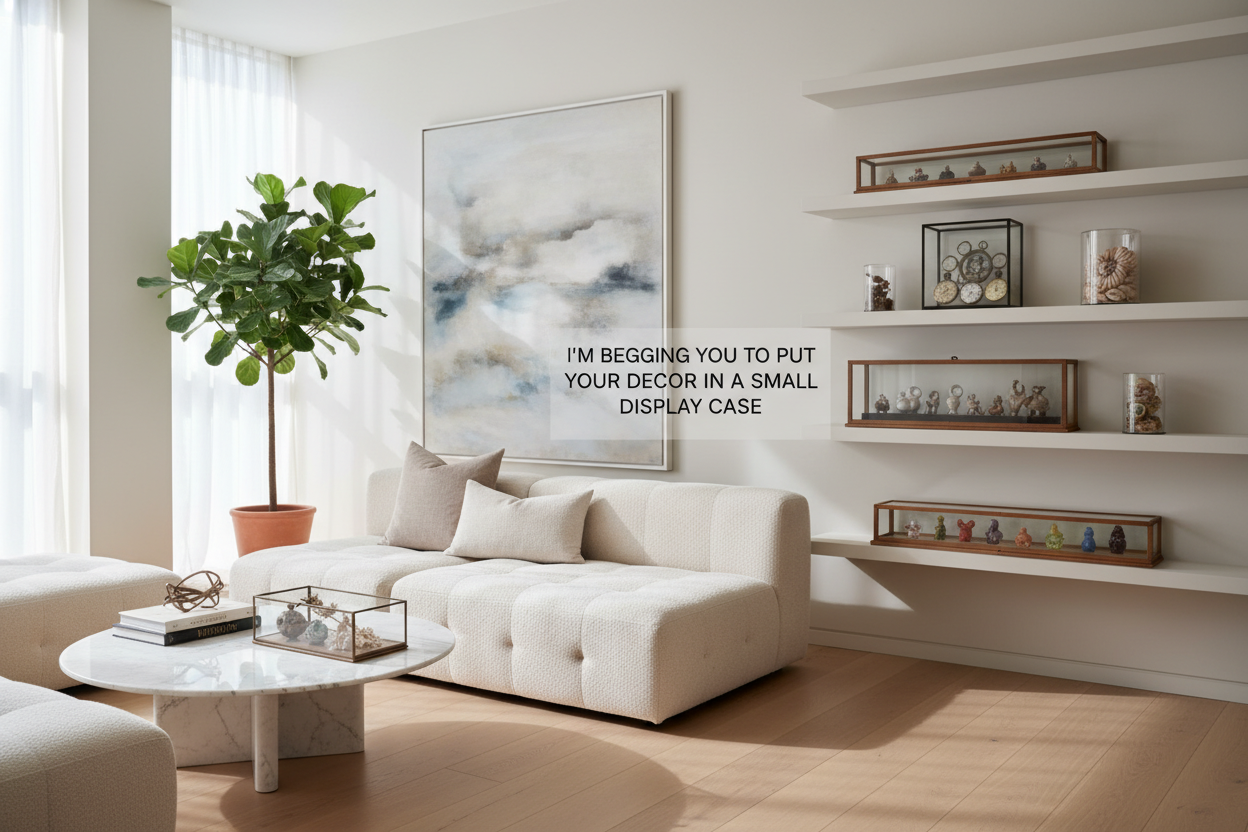
I’ve spent half my life dusting ceramic match strikers and tiny brass animals. For years, I subscribed to the 'sprinkle' method of decorating—one little vase on the bookshelf, a crystal on the nightstand, a vintage tin on the coffee table. I thought it made my apartment look lived-in and soulful. In reality, it looked like my house was losing a game of Tetris.
The turning point was when I finally bought a small display case. Suddenly, those random objects stopped looking like forgotten clutter and started looking like a deliberate collection. It turns out, your treasures don’t need more space; they need a frame.
- Visual boundaries turn 'stuff' into 'art' instantly.
- Glass enclosures cut your dusting time by about 90 percent.
- Vertical shelves maximize small footprints in tiny apartments.
- Material choice dictates whether your room feels modern or historic.
The Problem With 'Sprinkling' Tiny Decor
When you scatter small items across every flat surface, you create visual noise. Your eyes never get a break. Every time you look at your TV stand, you see five different tiny things competing for attention. It’s exhausting for your brain, even if you don't realize it. I used to think I was 'styling' my surfaces, but I was actually just making it impossible to find a place to put down a coffee mug.
By corralling these items, you create a visual boundary. It’s the difference between a pile of clothes on the floor and a neatly packed suitcase. The suitcase has a perimeter. A display case tells the viewer, 'Look here, and only here.' It gives your decor a place to live so it doesn't have to wander all over your furniture. It’s about creating a 'destination' for the eye rather than a series of distractions.
Why a Small Item Display Case Changes Everything
The moment you put an object inside a dedicated small item display case, it gains instant prestige. I have a chipped porcelain bird I found at a flea market for three dollars. When it sat on my windowsill, it looked like trash I forgot to throw away. Inside a glass box? It looks like a museum piece. There is something psychological about glass—it signals that whatever is behind it is worth protecting.
This grouping effect works because it creates a singular focal point. Instead of ten tiny distractions, you have one significant piece of furniture. If you’re dealing with a particularly dark or cramped corner, I usually recommend a white display cabinet. The lighter frame helps the unit blend into the wall, making the items inside appear to float while keeping the room feeling airy and open. It’s a trick I learned after buying a dark mahogany case that made my tiny studio feel like a Victorian funeral parlor.
The Magic of a Small Display Case With Shelves
If you have more than three items to show off, you need a small display case with shelves. Going vertical is the only way to avoid the 'glass junk drawer' look. I’ve seen people cram twenty things onto a single base level, and it just looks like a clear box of chaos. You want layers, not a pile-up.
Use the shelves to create 'mini-scenes.' Put your heaviest, largest item on the bottom to anchor the look. On the higher shelves, mix textures—maybe a rough stone next to a smooth glass bottle. If you want something that feels a bit more grounded and traditional, a wooden display cabinet adds a layer of warmth that purely glass or metal cases lack. The wood acts like a picture frame for your life, adding a bit of organic texture to the room.
Wood vs. Acrylic: Picking the Right Small Display Box
I’ve tried both, and they serve completely different masters. A heavy wood and glass small display box feels permanent. It’s a piece of furniture. It’s what you use for your 'forever' items—the stuff you want to pass down. It adds a sense of history to a room, even if the apartment itself is a generic new-build. I prefer wood when I want the case to feel like part of the architecture.
Acrylic boxes, on the other hand, are for the minimalists. They are virtually invisible, which is great if you want the focus to be 100 percent on the object. Just be warned: acrylic scratches if you even look at it wrong. I once used a paper towel to clean an acrylic box and left a permanent haze of micro-scratches. Stick to microfiber. Also, if you have kids or cats who like to bat at things, stick to tempered glass. It’s harder to clean fingerprints off acrylic than glass, too.
Spotting a Good Small Display Case for Sale
When you’re hunting for a small display case for sale, don't just look at the price tag. I once bought a cheap one online that arrived with hinges so flimsy the door sagged every time I opened it. It was infuriating. Every time I walked past it, the glass would rattle like a loose window in a storm.
Check the hardware first. You want hinges that feel substantial and a door that snaps shut with a magnet or a firm latch. Also, look at the glass thickness. Anything under 3mm feels like a lightbulb waiting to shatter. If you’re shopping at antique stores, check if the shelves are adjustable—older cases often have fixed heights that might not fit your specific treasures. And please, check the gaskets. If there’s a gap between the glass and the frame, dust will find its way in, defeating half the purpose of the case.
FAQ
Is a glass display case hard to keep clean?
Honestly, it’s easier than cleaning the items themselves. I’d much rather wipe down one flat glass door once a week than individually dust fifteen tiny figurines. Use a microfiber cloth and a bit of ammonia-free cleaner, and you’re done in thirty seconds.
Where is the best place to put a small display case?
Entryway consoles or end tables are prime real estate. You want it somewhere at eye level when you're sitting or standing nearby. Avoid putting it in high-traffic 'bump zones' where a stray elbow could cause a disaster—glass and hallways are a nervous mix.
Can I mix different styles of items in one case?
Absolutely. In fact, it looks better if you do. Mix a vintage book with a modern brass object or a piece of dried coral. The contrast is what makes the collection feel curated rather than just a set of matching toys. Just keep a common thread, like a similar color palette, to keep it cohesive.


Leave a comment
This site is protected by hCaptcha and the hCaptcha Privacy Policy and Terms of Service apply.