










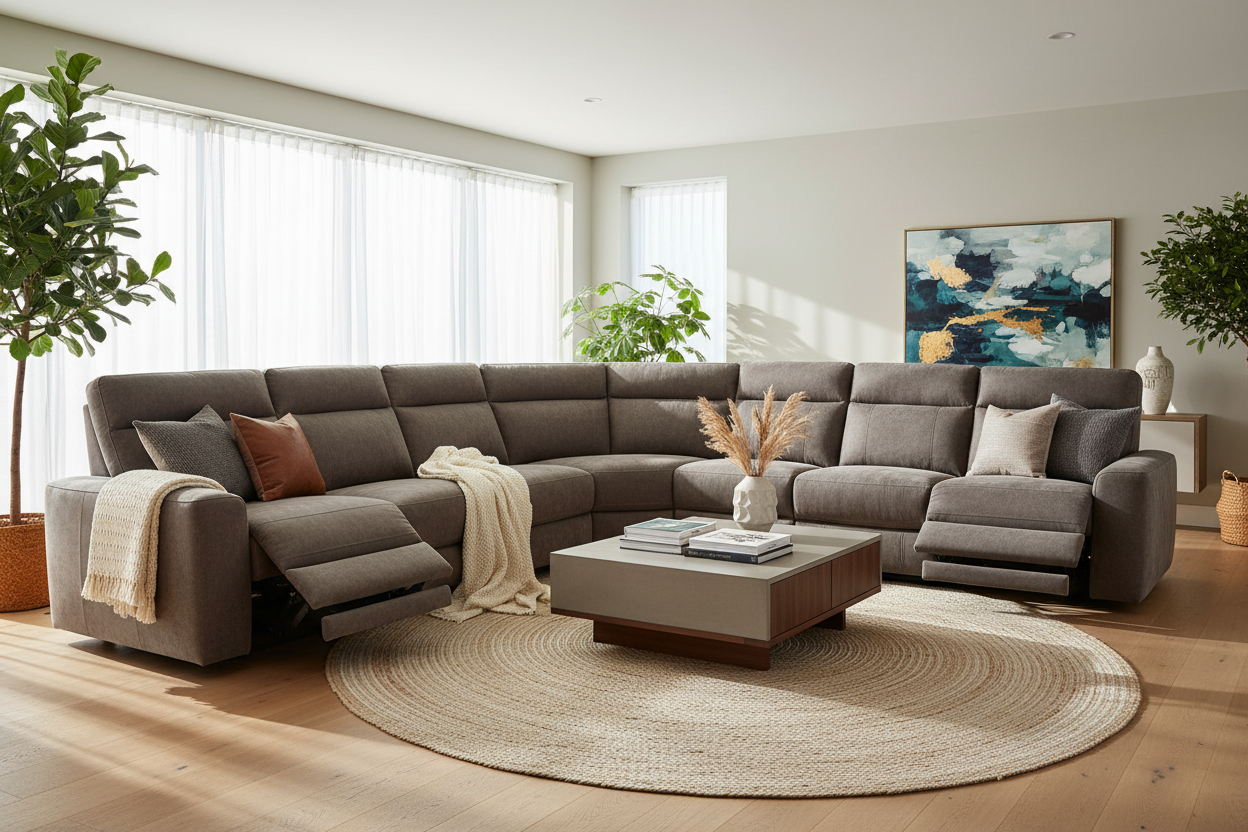
There is often a disconnect between the furniture we admire in glossy magazines and the furniture we actually want to live on. Clients frequently come to me wanting a sleek, low-profile aesthetic, yet they secretly crave the enveloping comfort of a movie theater seat. This is where the **deep reclining sectional** enters the conversation. It bridges the gap between high-end design and absolute relaxation, but it is a significant commitment—both financially and spatially. Before you dedicate a large footprint of your living room to one, let's analyze if this heavyweight of the furniture world is the right anchor for your home.
Key Features to Look For
- Wall Clearance: Ensure the mechanism is a "wall-hugger," requiring only 2-4 inches of back clearance, rather than a foot or more.
- Seat Depth: True deep seating starts at 40 inches total depth (approx. 24-26 inches interior seat depth).
- Suspension System: Look for 8-way hand-tied springs or heavy-gauge sinuous springs to prevent sagging over wide spans.
- Power Options: Opt for battery packs if you plan to float the sofa away from walls to avoid unsightly cords.
- Upholstery: High-rub count performance fabrics are essential for deep loungers that see heavy daily use.
Analyzing the Deep Seat Reclining Sectional
When we discuss a deep seat reclining sectional, we are talking about changing the ergonomics of the room. Unlike a standard sofa where you sit on the cushions, a deep seat invites you to sit in them. This creates a casual, lounge-heavy atmosphere.
Material Selection and Durability
Because these pieces have moving parts and encourage sprawling, the stress on the upholstery is higher than on a stationary tuxedo sofa. If you are leaning towards leather, insist on top-grain or full-grain. Bonded leather will peel at the friction points of the reclining mechanism within a few years. For fabric, I almost exclusively recommend Crypton or high-performance weaves. The deep seats mean people will be eating, drinking, and sleeping here; stain resistance is not a luxury, it is a necessity.
Layout and Visual Weight
A deep sectional sofa with recliner functionality is visually heavy. It grounds the room, but it can also overwhelm it if not balanced correctly. In my design practice, I follow the "2/3rds Rule." The sectional should not take up more than two-thirds of the wall it rests against, nor should it block natural traffic flow.
The Silhouette Challenge
Recliners traditionally suffer from bulky silhouettes. However, modern motion furniture has evolved. Look for designs with track arms rather than rolled arms to save horizontal space. Additionally, ensure the headrests are adjustable or articulating. When not in use, a low-profile headrest keeps the sightlines across the room open, maintaining that sophisticated, airy feel.
Lessons from My Own Projects
I want to share a specific realization I had while installing a custom deep reclining sectional for a client in a downtown loft. We focused heavily on the leather grade and the motor speed, but we completely overlooked the "gap" issue. When you buy a deep sectional, you assume you can lie across the seats horizontally for a nap.
However, on this specific model, the reclining mechanism created a hard, structural gap between the modular pieces that wasn't noticeable when sitting upright but was incredibly uncomfortable when lying across multiple seats. I learned the hard way that if you plan to use the sectional as a makeshift guest bed or for horizontal lounging, you must test the "bridge" between the seats. Now, I physically run my hand between the modules in the showroom to check for hard framing or gaps before specifying it for a family room. It’s a small, tactile detail that dictates whether you'll love or hate the piece six months later.
Conclusion
Investing in a deep reclining sectional is about prioritizing lifestyle without sacrificing elegance. If you choose a piece with the right scale, a hidden mechanism, and durable upholstery, it will serve as the heart of your home for a decade. Measure twice, check the power source, and prioritize the quality of the suspension.
Frequently Asked Questions
How much space do I need behind a reclining sectional?
It depends on the mechanism. Standard recliners need 10-14 inches. However, I highly recommend "zero-wall" or "wall-hugger" designs which extend forward rather than backward, requiring as little as 2 to 4 inches of clearance.
Can deep reclining sectionals fit through standard doors?
Usually, yes. Most high-quality sectionals are modular, meaning they ship in individual seat or corner pieces. Furthermore, the backs of many reclining sofas are removable (KD or "Knock Down" backs), allowing them to fit through narrow 30-inch doorways.
Is a deep seat uncomfortable for shorter people?
It can be. If the seat depth exceeds 24 inches, shorter individuals may find their feet dangling or their posture compromised. In these cases, I recommend using substantial lumbar pillows to artificially shorten the seat depth when needed, giving you the best of both worlds.


Leave a comment
This site is protected by hCaptcha and the hCaptcha Privacy Policy and Terms of Service apply.