










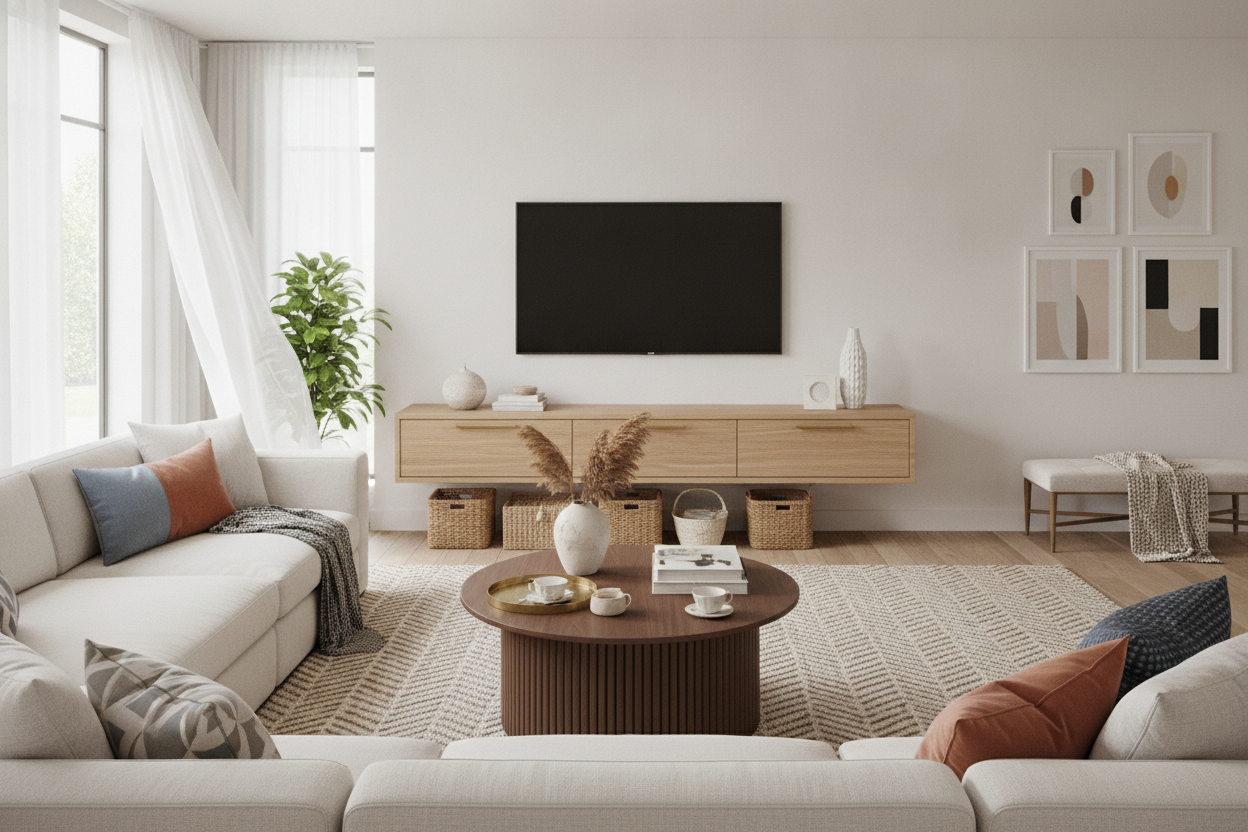
I have spent far too many nights staring at 47 open browser tabs, comparing three different shades of oak that all look identical under studio lighting. We have all been there: you find a floating tv stand overstock deal that seems too good to be true, and your thumb hovers over the 'Buy' button while your brain screams about the potential for crumbling particleboard. It is the furniture equivalent of a blind date where the person is 20% shorter than their profile said.
The dream is a sleek, wall-mounted unit that makes your living room look like a high-end architectural digest spread. The reality is often a 60-pound box of IKEA-adjacent puzzles that might—if you are not careful—rip a hole in your drywall. I have assembled enough of these to know that the difference between a 'steal' and a 'waste' comes down to checking the specs before you click checkout.
Quick Takeaways
- Material is King: If the description says 'paper laminate,' run. Look for 'melamine' or 'real wood veneer' for better durability.
- Hardware Upgrade: Toss the included wall anchors immediately. They are almost always insufficient for the weight of the unit plus your electronics.
- Weight Limits: A standard 60-inch floating console usually caps at 50-75 lbs. Don't expect it to hold your 1990s CRT collection.
- Stud Finder is Mandatory: If you aren't hitting at least two studs, you are asking for a disaster.
The Allure (and Anxiety) of Discount Furniture Deals
There is a specific rush that comes with scoring a massive discount on a piece that looks like it belongs in a $5,000 custom built-in. Overstock sites are the wild west of home decor. You can find genuine solid wood pieces mislabeled by some warehouse in Ohio, or you can end up with a console made of what is essentially compressed sawdust and hope. The anxiety is real because once that 70-pound box hits your porch, returning it is a logistical nightmare that involves trying to fit a jigsaw puzzle back into a cardboard box that is now held together by three rolls of packing tape.
I once bought a console that looked stunning in the renders, only to find out the 'wood grain' was actually a low-resolution sticker that repeated every six inches. It looked like a 1970s station wagon. That is the risk. But when you find that one unit with the right weight capacity and a decent finish, it changes the entire vibe of your room without costing a month's rent. The key is knowing how to read between the lines of a product description.
How to Spot the Good Ones (And Skip the Flimsy MDF)
When you are scrolling through dozens of options, you need to be a detective. Look for the words 'engineered wood'—that is fine, but you want to see 'high-density' or 'MDF with veneer.' Avoid anything that mentions 'paper foil.' If you are hunting for a walnut floating tv stand, zoom into the corners of the product photos. On cheap units, the 'wood' pattern won't wrap around the edge naturally; you will see a sharp, artificial seam where the sticker ends.
Check the thickness of the panels. Anything less than 3/4 of an inch (about 18mm) is going to sag the moment you put a soundbar on it. I prefer units that use a French cleat mounting system—it is a long wooden or metal bracket that runs the length of the unit. This distributes the weight across multiple studs rather than putting all the stress on four tiny screws. If the listing doesn't show the back of the unit or the mounting hardware, that is a massive red flag.
The Mandatory Hardware Swap You Have to Make
Here is my biggest piece of advice: throw away the plastic wall anchors that come in the box. I don't care how 'heavy duty' the manual says they are. Those little yellow or green plugs are designed for hanging picture frames, not a wall mounted media console entertainment center that weighs 40 pounds on its own. If you use the stock hardware, you will eventually hear a terrifying 'crunch' in the middle of the night as the unit slowly peels away from the wall.
Go to the hardware store and buy 1/4-inch toggle bolts or 'SnapSkru' anchors. Better yet, buy 3-inch cabinet screws and drive them directly into your wall studs. Most homes have studs spaced 16 inches apart; a decent floating stand should be wide enough to hit at least two of them. I once ignored this rule in a rental apartment because I didn't want to drill big holes. Three weeks later, my console was leaning at a 5-degree angle, and I spent the weekend patching a fist-sized hole in the drywall. Learn from my laziness.
Styling Your Budget Find to Look Custom
The biggest giveaway that you bought a budget stand is the 'rat's nest' of wires hanging underneath it. To make a mid century modern floating tv stand look like a custom piece, you have to master cord management. Buy a plastic cord channel, stick it to the wall, and paint it the exact color of your wall paint. It disappears instantly. If you are feeling fancy, stick a $15 LED light strip to the back of the console to create a 'halo' effect on the wall; it hides minor surface imperfections and makes the piece look expensive.
Don't over-style the top. These units have weight limits, and people love to pile them with heavy coffee table books and ceramic vases. Keep it light. A single plant, a slim soundbar, and maybe one decorative bowl are all you need. If the unit looks cluttered, it looks cheap. If it looks airy and intentional, people will assume you paid triple what you actually did.
Should You Just Splurge Instead?
So, is the gamble worth it? If you are handy with a drill and have the patience to read 200 reviews to find the 'hidden gem' with the best finish, then yes. You can save $400 easily. However, if the thought of hunting for studs or swapping out hardware makes you break out in a sweat, you might be better off saving up for a pre-assembled solid wood piece. Cheap furniture is only a 'deal' if it doesn't fall off the wall and break your TV.
If you are still on the fence about whether to go for the discount route or invest in something more substantial, take a minute to browse various tv stands across different price points. Sometimes seeing a $200 unit next to an $800 unit makes the quality differences in the joinery and finish much more obvious. My rule of thumb? If it's for a high-traffic living room, spend a bit more. If it's for a guest room or a basement setup, play the overstock lottery.
FAQ
Can I mount a floating TV stand on plaster walls?
You can, but it is much trickier than drywall. You absolutely cannot use standard anchors. You need to find the lath or use specialized toggle bolts, and I highly recommend professional help if you haven't worked with plaster before—it cracks easily under the weight of a console.
How high should I mount my floating console?
Most people mount them way too high. Aim for the bottom of the unit to sit about 10 to 12 inches off the floor. You want your TV to be at eye level when you are sitting on the sofa, and the console should frame it, not sit halfway up the wall like a shelf.
Will a floating stand hold my 75-inch TV?
The stand shouldn't be holding the TV at all. Your TV should be mounted to the wall separately. The floating stand is for your components (Apple TV, PS5, soundbar). If you plan to sit a 75-inch TV directly on a floating stand, you are asking for a structural failure.



Leave a comment
This site is protected by hCaptcha and the hCaptcha Privacy Policy and Terms of Service apply.