










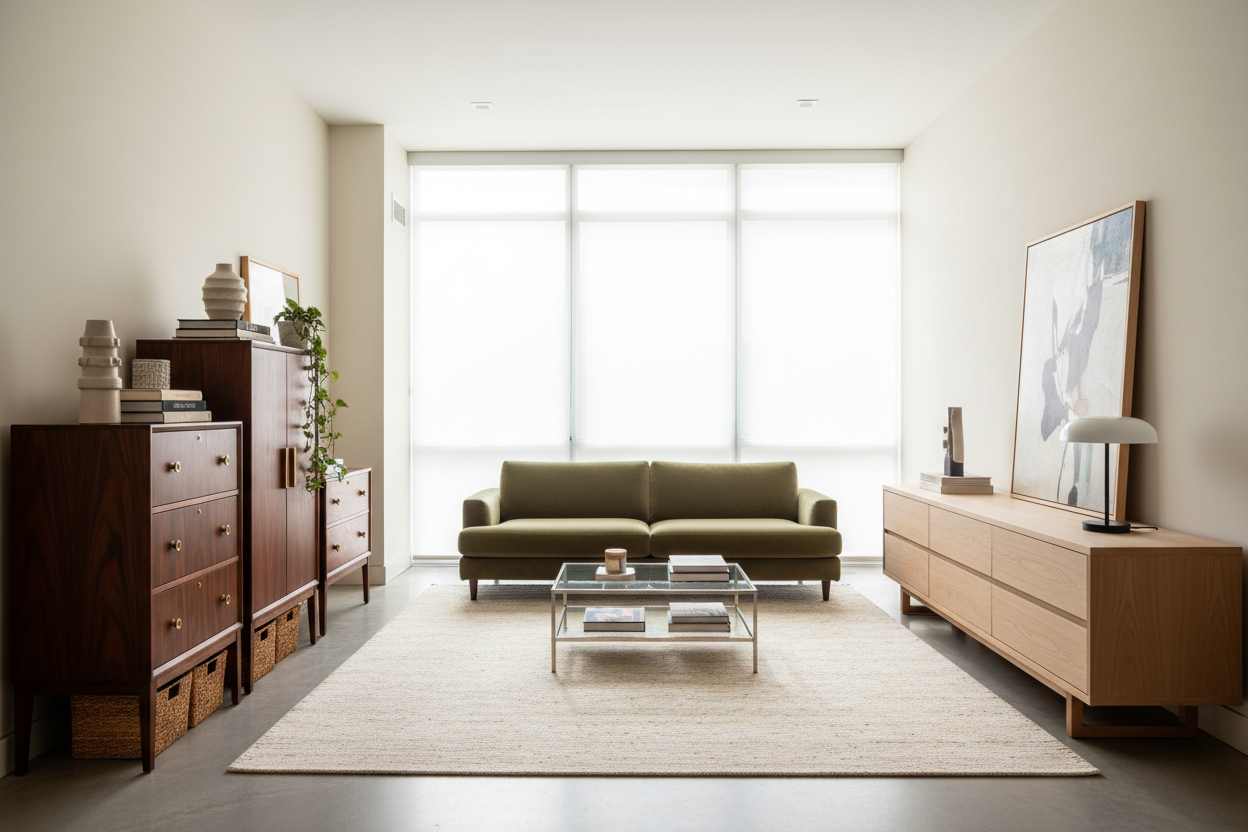
I spent twenty minutes last Tuesday wrestling with a drawer that refused to close because a single Fisherman’s sweater had staged a coup. It’s that familiar, low-grade household stress—the sound of wood scraping against wool as you try to force a cabinet chest storage solution out of a piece of furniture that just isn't built for it. I realized my traditional six-drawer dresser wasn't an organizer; it was a vertical trash compactor for my clothes.
- Drawers are built for small, flat items; shelves are built for volume.
- Cabinet doors prevent the 'overstuffing' that leads to broken drawer glides.
- Hybrid chests allow you to hide the mess while keeping bulky items accessible.
- Vertical storage saves floor space in cramped urban bedrooms.
The Day I Realized My Dresser Was Ruining My Clothes
We’ve all been there. You have that one drawer—usually the middle one—that requires a specific, rhythmic jiggle to open because a stray sleeve is caught in the track. For years, I forced my heavy winter knits into shallow, horizontal dresser drawers. The result? Stretched necklines, permanent creases, and a growing resentment toward my furniture.
Standard dressers are designed with a specific depth that works for t-shirts and socks, but they fail miserably when confronted with anything substantial. When you jam a chunky wool sweater into a drawer, you aren't just storing it; you're compressing the fibers and risking a snag on the underside of the drawer above it. I finally hit my breaking point when I pulled out a cashmere blend only to find a 'dresser bite'—a tiny, jagged hole where the wood track had chewed through the fabric during a particularly aggressive tug-of-war.
What Makes a Cabinet Chest So Different?
The magic of a cabinet chest lies in its anatomy. Unlike a dresser, which is just a stack of boxes, a cabinet chest usually incorporates a mix of doors and drawers. It’s the hybrid SUV of the furniture world. You get the shallow drawers for your intimate apparel and accessories, but you also get the open shelving behind doors for the big stuff.
Designers often lean into a Cabinet With Doors and Drawers — The Designer's Secret to Storage That Actually Conceals and Organizes because it handles the visual chaos better than a uniform grid of handles. By having fixed shelves behind a door, you eliminate the mechanical failure of a drawer slide. There are no tracks to bend and no bearings to lose. You just stack, shut the door, and the room looks instantly curated.
The 'Fold vs. Stack' Denim Test
I decided to run an experiment: my entire denim collection vs. a standard drawer. In a drawer, you either file-fold them (which takes forever) or stack them (which means you can only see the top pair). In a cabinet chest, I can stack five pairs of heavy 14oz denim on a single shelf. I can see every wash and every hem without digging.
If you have the wall real estate, something like this Modern Chest Of 9 Drawers Wood Dresser Storage Cabinet For Living Room works surprisingly well in a bedroom because it mimics that high-capacity verticality. Heavy knits and denim don't slide around or get lost in the 'back-of-the-drawer' abyss because the shelf provides a stable, non-moving base. It’s a literal weight off your shoulders—and your furniture's hardware.
Solving the Nightstand Dilemma
Not everyone has room for a massive armoire, but the cabinet chest concept scales down beautifully. Most people waste the space next to their bed with a tiny table that holds a lamp and a half-empty glass of water. That is prime real estate being squandered.
For bedside needs, a Storage Nightstand Chest 3 Drawers Cabinet In Bedroom With Metal Legs gives you that extra height and hidden storage without the bulk of a full-sized dresser. I switched to a taller, chest-style nightstand last year, and it changed the entire vibe of my room. Suddenly, my Kindle, my chargers, and my extra pillowcases had a home that didn't involve a messy pile on the floor.
When You Actually Shouldn't Make the Swap
I’m a convert, but I’ll be the first to tell you that cabinets aren't a universal fix. If your wardrobe consists of 90% gym clothes, thin cotton tees, and socks, a deep cabinet is going to be your worst nightmare. You’ll end up with 'fabric landslides' every time you try to pull a shirt from the bottom of a stack.
Deep shelves can be a black hole for small items. I learned this the hard way when I lost a favorite pair of running shorts for six months—they had migrated to the dark corner behind a stack of hoodies. Deep Storage Is A Trap Try A Short Cabinet With Drawers Instead if you're mostly storing small items. If you don't have the bulk to fill the depth, you're just creating a hiding spot for dust and lost socks.
Is a cabinet chest more expensive than a dresser?
Usually, yes. Because you're dealing with hinges, doors, and often more robust internal shelving, the construction cost is higher than a simple box-and-slide dresser. However, the hardware (hinges) tends to last much longer than cheap ball-bearing drawer slides.
Can I use a cabinet chest in a small room?
Absolutely. In fact, they are often better because they use vertical height. Look for a 'tallboy' style cabinet that has a small footprint but stands 50-60 inches high.
How do I stop clothes from falling over on shelves?
Shelf dividers are your best friend. Even in a high-end cabinet, a simple acrylic or wire divider keeps your stacks of sweaters from leaning like the Tower of Pisa.


Leave a comment
This site is protected by hCaptcha and the hCaptcha Privacy Policy and Terms of Service apply.