










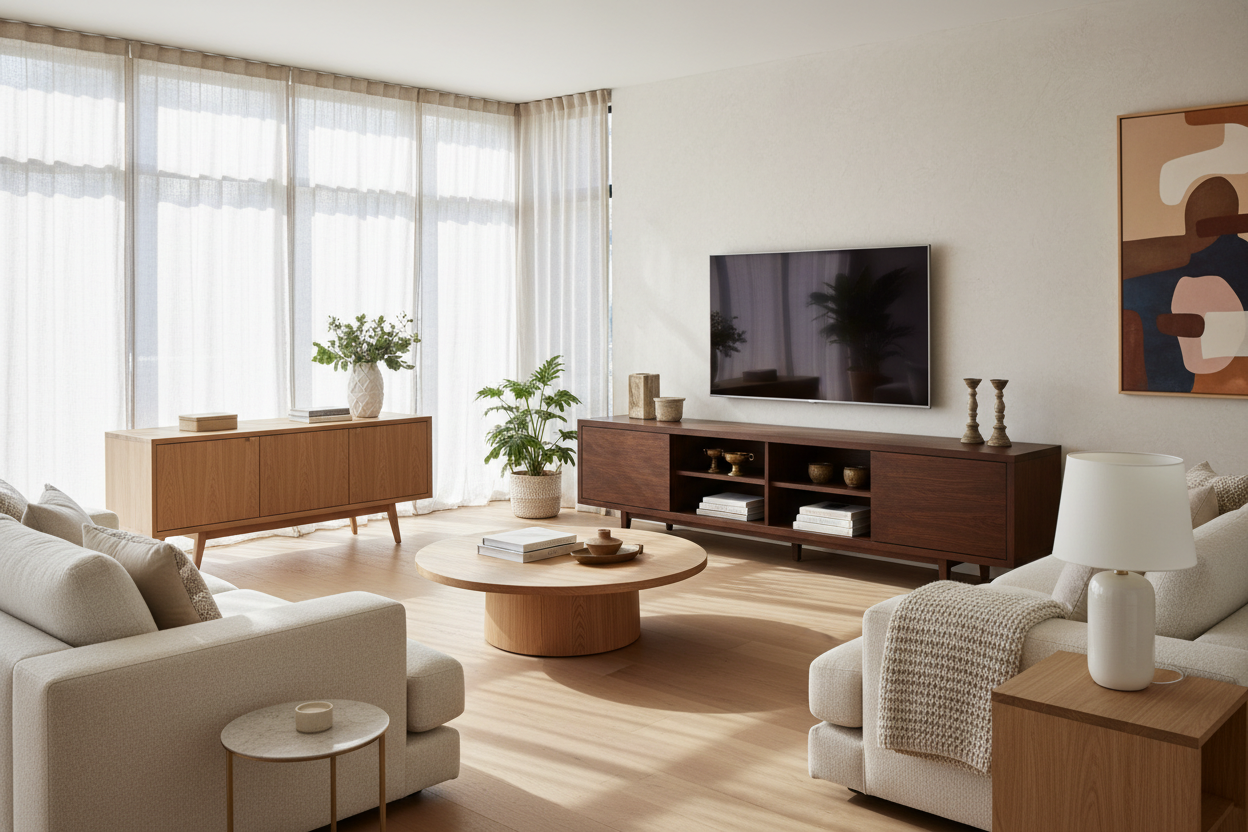
I spent three years staring at a living room that looked like a generic Airbnb. You know the vibe: white walls, a grey sofa, and a sea of pale ash wood that felt like it might float away if I opened a window too fast. It was clean, sure, but it was also incredibly boring. It lacked weight. It lacked a soul.
I finally hit a breaking point after my third 'scandi-minimalist' coffee table arrived looking more like a piece of balsa wood than actual furniture. I realized that the secret to a room that feels custom and expensive isn't more white-washing—it's depth. I started looking into dark oak tv stands, and the shift in the room's energy was immediate. It’s the difference between a flimsy hotel room and a library you actually want to spend time in.
- Dark oak provides a visual anchor that light woods simply can't match.
- Modern finishes are matte and cool-toned, avoiding the 'orange' look of the 90s.
- Negative space (slats and legs) prevents dark furniture from feeling too heavy.
- Mixing wood tones is better than buying a matching set.
The Pale Wood Fatigue is Real
We’ve been living in a beige-and-bleached-oak bubble for a decade. While that airy look worked for a while, it’s left our homes looking a bit like generic showrooms. When everything is the same mid-tone or light-tone wood, nothing stands out. The room feels unanchored, like the furniture is just hovering in space rather than living in it.
If you've been shopping for modern media consoles lately, you’ve probably noticed that the most high-end designers are pivoting. They’re moving toward woods with character. A dark oak piece provides a 'grounding' effect. It tells the eye where to land, which is exactly what you need in a living room where the TV is usually the focal point anyway. It makes the space feel intentional rather than accidental.
Why Modern Dark Oak Doesn't Look Like 1995
When I mention dark wood to my friends, they immediately think of their parents' 1990s entertainment centers—those chunky, glossy, orange-tinted monsters that took up half a wall. Trust me, I’m not advocating for that. A 2024 dark oak tv stand is a completely different animal. We’re talking about deep, charcoal undertones and wire-brushed textures that let the grain show through without the high-gloss shine.
The silhouettes have changed, too. Instead of bulky cabinets, we're seeing incorporating curved oak silhouettes and tapered legs that keep the piece feeling light on its feet. The goal is a matte finish that looks like the wood was stained by hand, not dipped in plastic. It’s about texture and depth, not just 'being dark.'
How to Keep Your Room From Feeling Like a Cave
The biggest fear people have with dark wood is that it will suck the light out of the room. I get it. If you put a massive, solid black block in a small room with one window, it’s going to feel cramped. But you can easily avoid the cave vibe by being smart about the 'air' around the furniture. It’s all about balance.
Let the Legs Breathe
If you’re worried about the weight of dark oak, look for pieces that aren't solid to the floor. You want to see the floor underneath the stand. I’m a huge fan of designs featuring slatted doors because they create a sense of transparency. The slats break up the dark surface area, letting bits of light and shadow play across the front so it doesn't look like a giant black hole under your television.
The Art of High-Contrast Styling
Dark wood needs a 'foil' to look its best. If you have a dark oak console, don't put a dark rug under it. Pair it with a cream boucle rug or a light-colored plaster wall. I recently styled a dark oak piece against a terracotta-toned wall, and the tension between the warm paint and the cool, dark wood made the whole room look five times more expensive. Add some brass hardware or a ceramic lamp on top, and you’ve got a look that feels curated, not catalog-bought.
Please Don't Match Your Coffee Table to It
The fastest way to make a room look cheap is to buy the matching 'set.' If your TV stand, coffee table, and side tables all come from the same collection, your room will look like a furniture store floor model. It lacks personality. Instead, use your dark oak stand as the anchor and mix in other materials.
Try layering dark walnut tones or even a glass-topped coffee table with metal legs nearby. Oak has a very specific, open grain that plays beautifully against the tighter grain of walnut or the smooth surface of stone. Mixing these elements makes it look like you’ve collected your furniture over time, which is the ultimate hallmark of good design.
My Honest Mistake
I once bought a 70-inch dark oak console for a tiny 10x10 den. It was beautiful, but it was a solid-to-the-floor plinth style. Within a week, the room felt half its size. I realized that in small spaces, the 'dark' part isn't the problem—it's the lack of negative space. I swapped it for a model with 8-inch legs and slatted doors, and suddenly the room felt huge again. Lesson learned: the darker the wood, the more you need to see the floor and the air around it.
FAQ
Does dark oak show more dust than light oak?
Yes, absolutely. If you’re the type of person who hasn't dusted their TV stand since 2019, dark wood will call you out. A quick swipe with a microfiber cloth once a week is the price you pay for looking this good.
Can I mix dark oak with light oak floors?
Yes, and you should! High contrast between your floor and your furniture is actually a great way to make the furniture pop. Just make sure the undertones are similar—don't mix a very 'yellow' oak floor with a very 'purple' dark stain.
What size TV stand should I get for a 65-inch TV?
Don't make the mistake of getting a stand that is the exact same width as your TV. You want at least 6 to 10 inches of 'overhang' on each side. For a 65-inch TV (which is usually about 57 inches wide), look for a stand that is at least 70 inches wide. It looks more balanced and expensive.


Leave a comment
This site is protected by hCaptcha and the hCaptcha Privacy Policy and Terms of Service apply.