










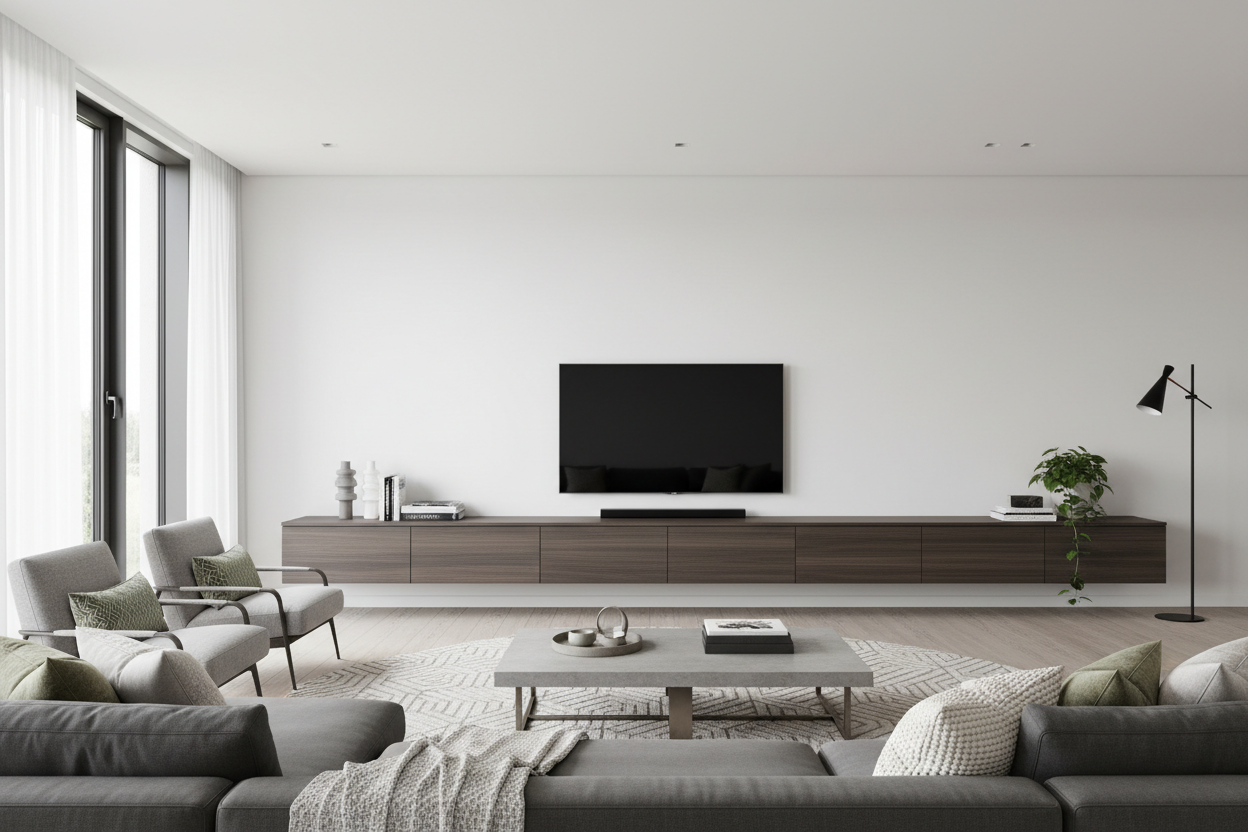
I remember standing in the middle of my new living room, staring at a fifteen-foot expanse of drywall that felt less like a home and more like a high school gymnasium. I’d moved my old 55-inch console into the space, and it looked hilariously small—like a piece of dollhouse furniture someone had accidentally left behind. To fix the 'blank wall syndrome,' I realized I didn’t just need a place for my remote; I needed a modern tv stand long enough to actually anchor the room.
- Scale the furniture to the wall, not just the television screen.
- Aim for a unit that is at least 20% wider than your TV to avoid a top-heavy look.
- Longer consoles provide much-needed horizontal lines that make a room feel wider.
- Low-profile units keep the 'modern' aesthetic without blocking sightlines.
The 'Dollhouse Effect' of Standard Consoles on Giant Walls
Most people buy a media unit based on the size of their TV. If you have a 65-inch screen, you buy a 60-to-70-inch stand. On a small wall, that’s fine. But on a massive 15-foot wall, that standard console looks like a postage stamp. It creates a visual disconnect where your furniture seems to be floating in space rather than grounded.
This 'dollhouse effect' makes even expensive furniture look cheap. When the proportions are off, the whole room feels unfinished. I spent weeks wondering why my living room felt cold despite the plush rug and the velvet sofa. It was because the eye had nowhere to rest on that giant wall. A long tv stand modern in its proportions creates a continuous horizontal line that mimics the architecture of the room.
Why I Finally Committed to a Massive Footprint
I used to be afraid of 'big' furniture. I thought a massive footprint would make the room feel cramped. I was wrong. In reality, modern large tv stands act as an architectural anchor. They take a sprawling, purposeless wall and turn it into a focal point. It’s the difference between a room that feels like a hallway and a room that feels like a lounge.
I finally stopped scrolling and committed to an extra long barn door TV stand that stretched nearly eight feet. The moment it was assembled, the room clicked into place. It didn't just hold the TV; it filled the negative space that had been bothering me for months. If you have the square footage, don't be afraid of the 90-plus inch units. They provide a sense of permanence that smaller pieces just can't match.
How to Decorate the Extra Surface Space Without Cluttering
Once you have all that surface area, the temptation is to fill every single inch with candles, frames, and succulents. Resist that urge. The key to keeping a long console looking sleek is asymmetrical styling. You don't want a perfectly symmetrical line of 'stuff'—that just looks like a retail display.
Try placing your TV slightly off-center and balancing the other side with a tall floor lamp or a leaning piece of oversized art. This breaks up the horizontal plane. If you need more specific ideas, you can learn how to style wide media consoles to keep the vibe intentional. I personally like to group items in threes: a stack of coffee table books, a sculptural vase, and maybe a small tray for remotes. Leave plenty of 'white space' on the wood or lacquer surface so the piece can breathe.
The 3 Measurement Rules for Pulling This Scale Off
Before you hit 'buy,' you need to check your math. First, leave at least 12 to 18 inches of breathing room between the ends of the stand and the adjacent walls or corners. You want it to look like it was chosen for the space, not shoved into it. Second, check the depth. If the stand is too deep, it will eat into your walkway and feel like a barricade.
Finally, ensure your TV isn't swallowed by the console. If you have a 50-inch TV on a 100-inch stand, the TV will look tiny. In that case, wall-mounting the TV slightly above the stand can help bridge the gap. Once you’ve mapped out your floor plan, you’re ready to shop for new TV stands and finally kill that blank wall for good.
How much wider should a TV stand be than the TV?
Ideally, you want at least 5 to 10 inches of clearance on either side of the television. This prevents the 'top-heavy' look where the TV seems like it’s about to tip the stand over.
Can a TV stand be too long?
Only if it blocks a natural walkway or touches the baseboards of the perpendicular wall. As long as you have 12 inches of 'dead space' on either side, longer is almost always better for aesthetics.
Is a long TV stand harder to assemble?
Not necessarily harder, just more tedious. Expect more cam-locks and a lot more screws. Definitely have a friend help you flip it over once it's built, as an 8-foot MDF or solid wood unit is heavy enough to snap its own legs if you tilt it solo.


Leave a comment
This site is protected by hCaptcha and the hCaptcha Privacy Policy and Terms of Service apply.