










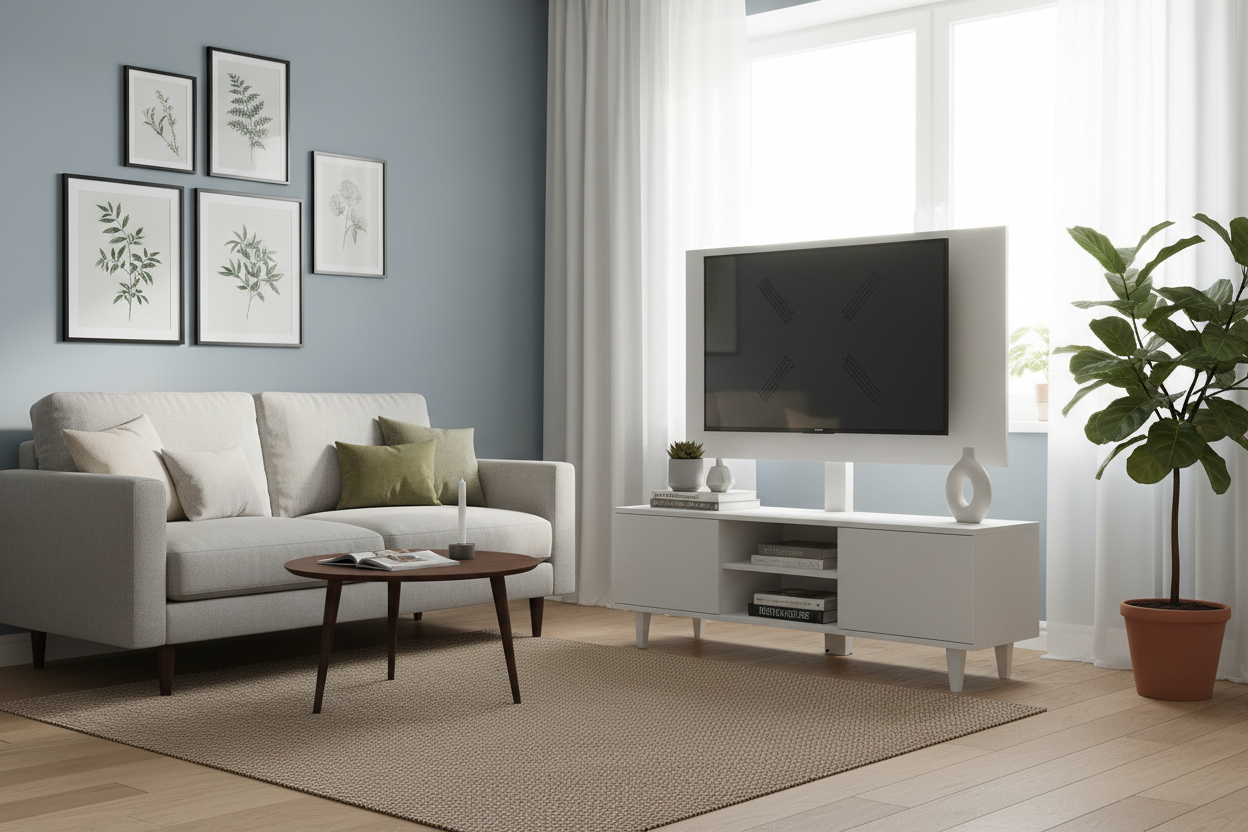
I stood in my new living room, staring at the 1920s crown molding and the 'No Holes Larger Than a Thumbtack' clause in my lease. If I even looked at a power drill, I felt like my landlord would materialize behind me to revoke my security deposit. My 65-inch screen was sitting on its pathetic plastic feet, taking up the entire surface of a temporary bench, looking like a tech-bro's first dorm room. I wanted that clean, floating look you see in every architectural digest spread, but my walls were made of crumbly plaster and spite. That is when I found the cabinet with tv mount.
Quick Takeaways
- Achieve the floating TV look without touching a drill or finding a stud.
- Integrated metal spines hide all those hideous dangling power cords.
- Perfect for renters with plaster walls or strict lease agreements.
- Freestanding design means you can rearrange your room layout in minutes.
- Provides actual storage space that a simple wall mount lacks.
The 'No Drilling' Clause That Ruined My Living Room Plans
Moving into a pre-war apartment is a dream until you try to hang anything heavier than a calendar. These walls aren't modern drywall; they are layers of horsehair, lath, and plaster that have been drying out since the Coolidge administration. One wrong move with a masonry bit and you aren't just making a hole—you're triggering a structural landslide. My landlord made it very clear: no wall mounts, no heavy anchors, no exceptions. I was devastated because I hate the look of a TV sitting on its legs. It’s clunky, it’s a dust magnet, and it eats up all the surface area where I should be putting my actual decor.
I spent weeks browsing those spindly floor stands that look like they belong in a corporate boardroom or a hospital waiting room. They were functional, sure, but they had zero soul. They didn't solve the problem of where to put my PlayStation, my router, and my growing collection of 4K discs. I needed a piece of furniture that felt intentional, not a piece of medical equipment holding up my Netflix machine. The struggle was finding something that provided the height and 'float' of a wall mount while still feeling like a real part of the room's design. I almost gave up and accepted my fate of a low-profile stand until I realized there was a middle ground I hadn't considered.
Enter the TV Mount Cabinet (My Security Deposit's Savior)
The discovery of the tv mount cabinet was a total lightbulb moment. It’s essentially a hybrid piece of furniture: a solid, stylish base cabinet with a heavy-duty metal spine bolted directly into the frame. The TV attaches to a VESA plate on that spine, hovering at whatever height you choose. Because the weight of the TV is supported by the furniture's center of gravity rather than your questionable walls, it’s incredibly stable. I’ve seen some cheap versions that felt top-heavy, but a well-constructed unit with a wide base is surprisingly sturdy, even with a 75-inch panel attached.
I eventually settled on a modern storage TV cabinet that didn't look like it belonged in a 2004 electronics store. The beauty is in the integration. The spine isn't just a pole; it's usually hollow or channeled, allowing you to run every single HDMI and power cable through the back and directly into the cabinet below. No more plastic cord covers stuck to the wall with adhesive that will definitely peel the paint off in three years. It looks like a professional installation, but I can take it with me when I move. The first time I slid the back panel into place and saw zero wires, I actually cheered. It’s the cleanest my setup has ever looked, and I didn't have to use a single drywall anchor.
Why This Setup Actually Beats Standard Wall Mounting
Honestly, even if I owned this place, I might never go back to traditional mounting. Unlike a TV that is permanently mounted to the wall, this unit gives me total flexibility. If I decide the sofa looks better on the opposite wall next month, I just unplug the main power strip and slide the whole unit over. Try doing that with a wall mount—you’d be left with four massive holes to patch and a weekend of sanding and painting. The 'floating' effect is identical, but the commitment level is zero.
There is also the 'stud' problem. In older buildings, studs are rarely where you actually need them. You end up having to buy expensive toggle bolts or mount the TV off-center from your seating because the wood behind the wall is two inches to the left of where it should be. With a cabinet mount, the TV is always perfectly centered on the furniture. You don't need a level, you don't need a stud finder, and you don't need to pray that your wall won't crumble under the weight of a 60-pound screen. Plus, the height is adjustable. If you buy a new, taller sofa, you just unscrew four bolts on the back and slide the screen up a few inches. It's the kind of adaptability that makes living in a small, evolving space actually manageable.
How to Style the Base So It Doesn't Look Like a Dorm Room
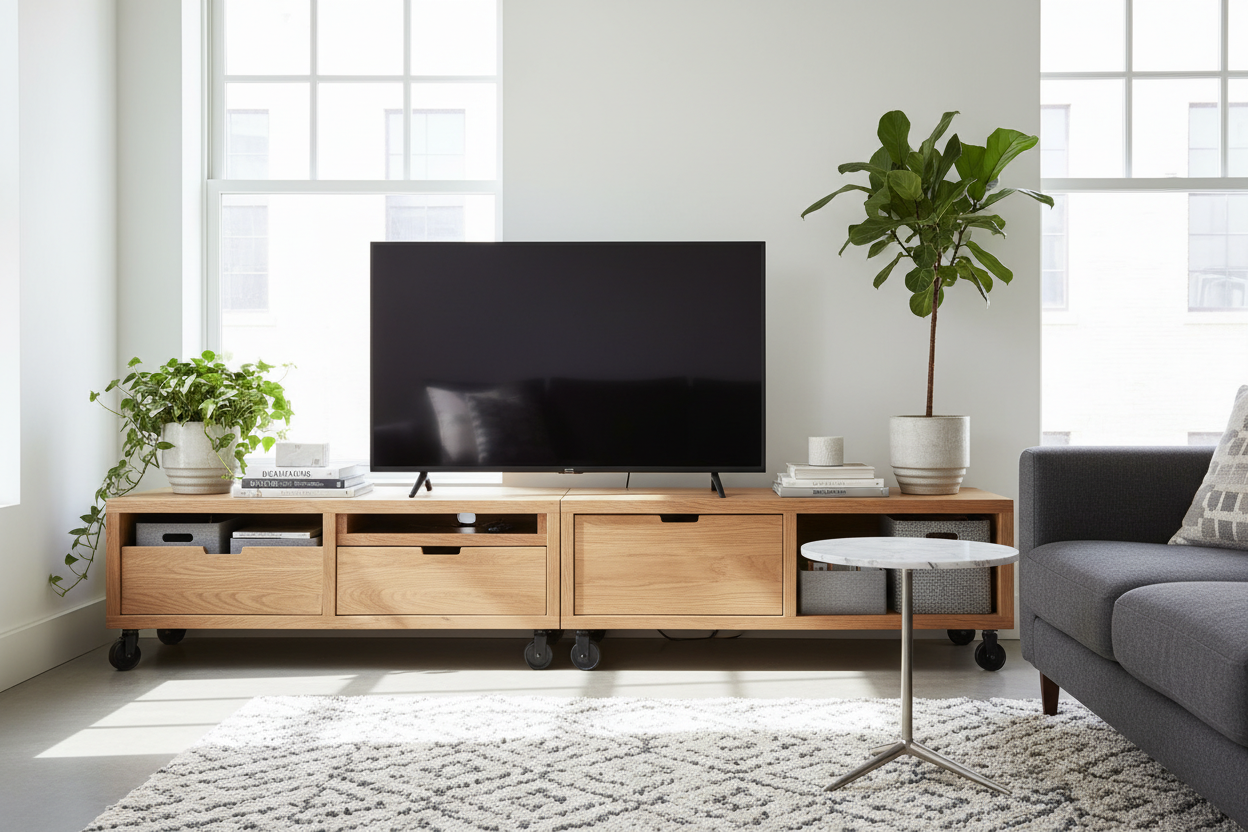
The best part of this setup is that the top surface of your cabinet is now completely empty. Usually, the TV's legs take up the prime real estate, leaving you no room for anything else. By choosing a wide storage cabinet with drawers, you gain a massive staging area for decor that makes the tech feel less dominant. I like to place a few coffee table books and maybe a low-profile ceramic bowl under the screen. It grounds the TV and makes it look like a curated part of the room rather than a black mirror floating in a void.
If you want something a bit more sophisticated, a black cabinet with glass doors is a fantastic choice. It allows you to showcase some nice glassware or books while keeping the dust off your electronics. Just make sure the cabinet has some ventilation in the back so your receiver or game console doesn't overheat in the enclosed space. I personally use the drawers for all the 'ugly' stuff—extra cables, controllers, and that one remote I still don't know what it does—while keeping the top surface clean with a single sculptural vase. It creates a visual balance where the 'floating' screen feels light and airy, while the solid base provides the storage every renter desperately needs.
FAQ
Is a TV mount cabinet stable enough for a large TV?
Yes, provided you choose a unit rated for your TV's weight. These cabinets are designed with a low center of gravity. As long as the base is wider than the screen and you aren't trying to mount a 100-inch monster on a tiny stand, it’s incredibly secure. Many also come with a small safety tether for the back, just in case you have a very energetic dog or a toddler.
Can I hide all my wires inside the mount?
That is the main selling point. Most of these units feature a hollow support column. You feed the wires through an opening behind the TV and they pop out inside the cabinet. It’s actually easier than fishing wires through a hole in the wall because you have direct access to the back of the furniture.
Will it work with any TV?
It works with any TV that is VESA-compatible, which is virtually every flat screen made in the last 15 years. Just check the VESA pattern (the distance between the four holes on the back of your TV) against the specs of the cabinet mount to be 100% sure before you buy.


Leave a comment
This site is protected by hCaptcha and the hCaptcha Privacy Policy and Terms of Service apply.