










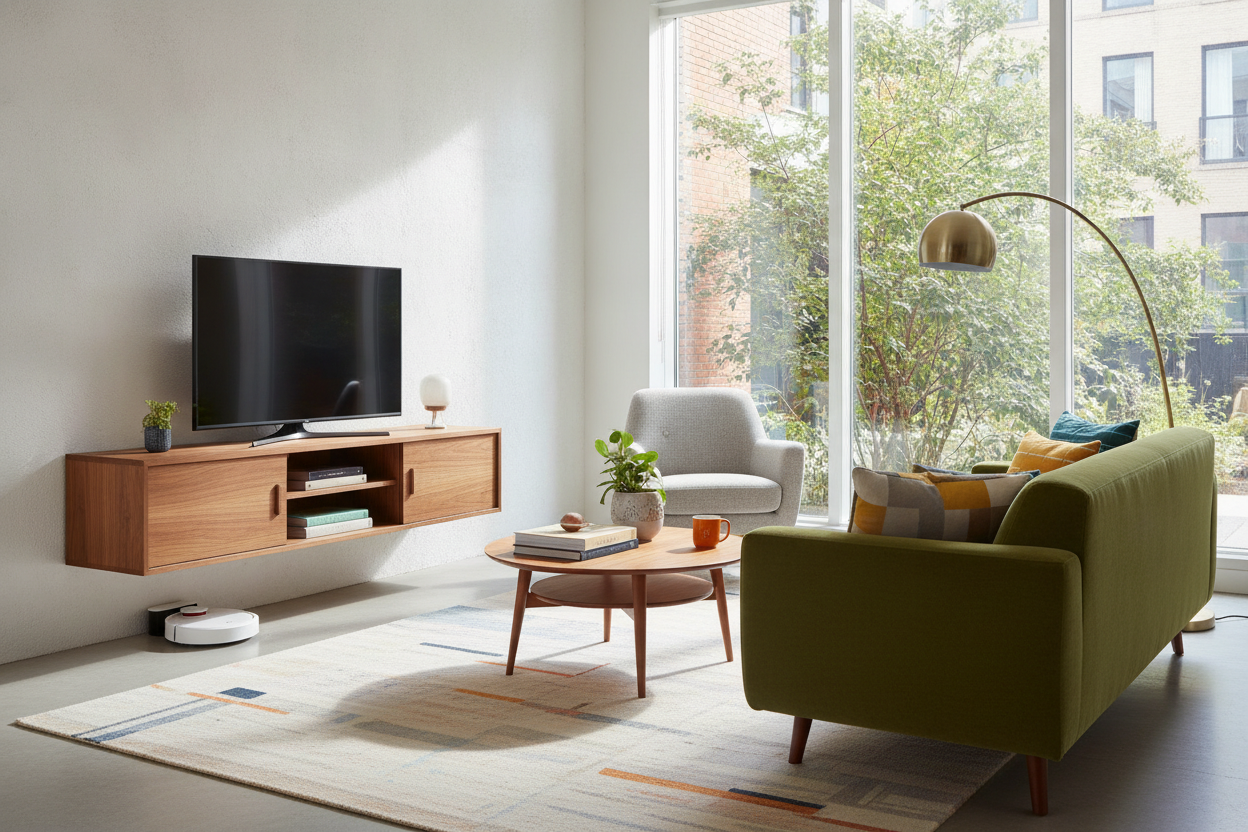
I spent three hours last Saturday on my hands and knees with a yardstick, trying to fish a rogue AirPod out from under my media cabinet. My robot vacuum, 'Sir Dust-a-Lot,' had already given up, beeping piteously after getting wedged under the solid oak base for the fourth time that week. That was the moment I realized my chunky, floor-hugging furniture was basically a high-end dumpster for dog hair. I needed a mid century floating media console, and I needed it yesterday.
- Zero Floor Contact: Your robot vacuum can actually clean the entire room without getting stuck.
- Visual Space: Seeing the baseboards makes a small 12x15 living room feel twice as large.
- Custom Height: You can mount it at the exact ergonomic eye level for your specific sofa height.
- Cable Stealth: It forces you to deal with your cord nightmare once and for all.
The Dust Bunny Situation Was Ruining My Life
If you own a golden retriever or a cat that sheds like it's getting paid for it, you know the struggle. Traditional media consoles usually sit on four-inch legs or, worse, a solid plinth base. These designs create a literal 'no-man's-land' where dust bunnies, lost remote batteries, and pet hair go to thrive. Every time my HVAC kicked on, a tumbleweed of fur would come rolling out from under the TV like a scene from a suburban western.
Standard vacuums are too tall to get under there, and most robot vacuums just bump into the legs and move on, leaving a two-inch strip of filth around the perimeter. By switching to a wall-mounted unit, I cleared eight inches of vertical space. Now, the vacuum glides underneath effortlessly, and I haven't seen a dust bunny in three weeks. It’s the kind of small win that makes you feel like you actually have your life together.
Why 'Hovering' Furniture Makes Your Room Look Huge
There is a psychological trick to interior design: the more floor you see, the bigger the room feels. When you have a heavy piece of furniture sitting on the ground, it acts like a visual anchor, stopping your eye and making the floor plan feel cramped. By mounting a console to the wall, you expose the line where the floor meets the baseboard. This creates an unbroken visual plane that makes the room feel airy and breathable.
I spent weeks debating if the tapered legs of the 50s were better than the chunky silhouettes of the 80s, much like when I Traded My Mid-Century Console for a Post Modern TV Stand, but the floating look won out for pure utility. The walnut veneer of a mid-century piece adds warmth without the 'heavy' feeling of a traditional sideboard. It’s about getting the storage you need without sacrificing the square footage you don't have.
Pairing It With a Mid Century Modern Floating TV Shelf
Once the console was up, the wall above the TV felt a little naked. I didn't want to go back to the cluttered look of a full entertainment center, so I grabbed a matching mid century modern floating tv shelf. I mounted it about 20 inches above the television to hold a few lightweight items—a trailing pothos plant and a couple of vintage books.
This setup draws the eye upward, highlighting the ceiling height rather than the floor clutter. Just make sure you don't overdo it. The goal is a clean, 'hovering' aesthetic. If you pile ten pounds of equipment on a floating shelf, you're just asking for a midnight disaster involving falling drywall and broken electronics.
The Installation Reality Check (Praying for Studs)
Let's be real: mounting a 60-pound walnut box to your wall is terrifying. You aren't just hanging a picture frame; you're hanging a piece of furniture that might hold a $1,000 television. I spent forty minutes with a stud finder, triple-checking every mark. If you miss the studs and rely on cheap plastic anchors, that console is going to end up on the floor, and your security deposit is going with it.
I ended up using heavy-duty lag bolts into three different studs. I won't lie, I had a minor panic attack when I realized my stud finder was lying to me about a metal conduit. It is the same feeling I had when Why I Risked My Deposit for a Mid Century Modern Floating TV Stand became a reality in my rental. But once those bolts bit into the wood, that console was solid as a rock. If you're a renter, just buy a tub of high-quality spackle now—you're going to need it when you move out, but the clean floors are worth the repair work later.
Hiding the Cords When Your Furniture Has No Legs
The biggest downside of floating furniture is that you can't hide a tangled mess of black wires behind a leg. If you have cables dangling from a floating unit, it looks like your TV is on life support. You have two real options: go behind the wall or use a raceway. Since I didn't want to cut massive holes in the drywall, I used a paintable cable raceway that runs straight down the center.
Inside the console, I used 3M Command strips to mount a power strip to the interior 'ceiling' of the unit. This keeps the floor completely clear. All the bulky power bricks and HDMI excess are tucked away inside the cabinets. When you look under the console now, all you see is clean hardwood and a very happy robot vacuum doing its job. It’s a level of organization that feels almost illegal.
FAQ
How much weight can a floating console actually hold?
If you hit the studs with lag bolts, most can easily handle 50 to 75 pounds. Always check the manufacturer's rating, and never rely on drywall anchors alone for the main unit.
How high should I mount it?
The sweet spot is usually 10 to 12 inches off the floor. You want enough room for a vacuum to pass under, but low enough that your TV stays at a comfortable viewing height without causing neck strain.
Can I install this alone?
Technically yes, but I wouldn't. You need one person to hold the level and the weight while the other person drives the first two screws. Save your back and call a friend.


Leave a comment
This site is protected by hCaptcha and the hCaptcha Privacy Policy and Terms of Service apply.