










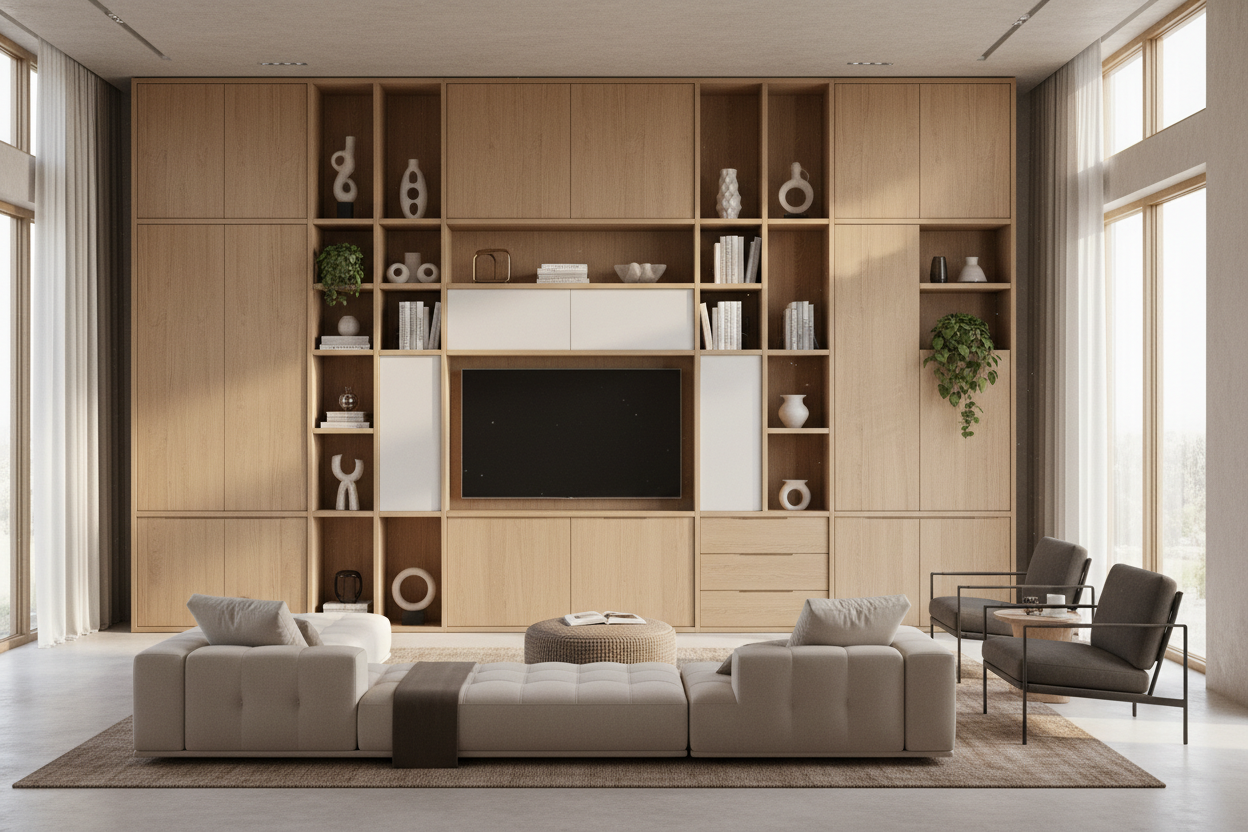
I used to be the queen of the 'accent cabinet.' If I saw a cute mid-century console or a tiny apothecary chest on sale, I bought it. My living room ended up looking like a waiting room for a furniture thrift shop—lots of little pieces, none of them doing the heavy lifting. Eventually, I realized that a massive wall storage unit isn't just for people with mansions; it's for anyone tired of seeing their mail pile up on four different surfaces at once.
- One large unit creates a single focal point instead of five points of clutter.
- Closed storage is the only way to truly hide the chaos of real life.
- Vertical storage maximizes your square footage without eating your floor.
- Cohesive lines make a small room feel intentional and architectural.
The 'Death by a Thousand Cabinets' Trap
We've all been there. You need a place for books, so you buy a small shelf. Then you need a place for the TV, so you buy a media console. Then you need a place for the printer, so you grab a little side cabinet. Before you know it, your walls are lined with disparate pieces of furniture that don't talk to each other. It’s visual static.
The real problem isn't just the look; it's the surfaces. Every low cabinet you buy is another horizontal landing pad for junk. Keys, loose change, and half-empty coffee mugs gravitate toward these flat spots. Buying multiple wall storage units that don't match just spreads the mess around. One cohesive piece of storage wall furniture eliminates those extra 'junk drops' and forces you to organize vertically.
Why Going Big Actually Expands Your Space
It sounds counterintuitive, but a large storage wall unit actually makes a small room feel bigger. When you have five small pieces of furniture, your eye has to stop and start a dozen times as it moves across the room. It feels choppy and cramped. One massive, full wall storage unit creates a long, continuous line that draws the eye upward and across.
When you consolidate all your miscellaneous storage furniture into one architectural piece, the room suddenly breathes. You’re trading 'bits and pieces' for a singular, bold statement. It’s the difference between a messy closet and a built-in wardrobe. The visual calm that comes from unified storage wall furniture is worth every penny of the initial investment.
Hiding the Real-Life Mess Behind Closed Doors
I love a well-styled open shelf as much as the next person, but let’s be real: most of our stuff is ugly. We have tangled chargers, board games with ripped boxes, and a collection of manuals for appliances we don't even own anymore. A full wall storage unit with actual doors is the ultimate stress-reducer. It allows you to be messy behind the scenes while appearing perfectly curated to the world.
If you have kids or pets, this is non-negotiable. Open shelving at floor level is just an invitation for a toddler to 'reorganize' your library. A large wall storage unit with solid lower cabinets keeps the fragile or messy items out of reach and out of sight. You can shove the plastic toys away in five seconds and actually feel like an adult again once the kids are in bed.
How to Style a Giant Unit Without Looking Like a 90s Library
The fear of the 'heavy' look is real. Nobody wants their living room to feel like a dusty law library from 1994. The trick is to mix your textures and leave some breathing room. You don't have to pack every inch of a wall unit with storage. Use the 'rule of thirds'—one-third books, one-third objects, and one-third empty space to let the eye rest.
To keep the piece grounded, I often suggest using a large sideboard display buffet as the base. This provides deep drawers for heavy items like linens or electronics. If the vertical mass feels like too much for your specific room, you can break it up by using a sideboard cabinet buffet on the bottom and pairing it with floating shelves or smaller wall-mounted cabinets above. This creates the 'storage wall' effect without the monolithic weight of a single solid piece.
The 3 Measurements You Cannot Mess Up
Before you click 'buy' on those large wall units for storage, you need to get intimate with your measuring tape. First, check your baseboard thickness. If the unit doesn't have a cutout for baseboards, it won't sit flush against the wall, leaving an annoying gap where pens and dust bunnies go to die. You might need to remove a section of trim or choose a unit with adjustable feet.
Second, measure your walking depth. You need at least 36 inches between the front of the unit and any other furniture (like your sofa or coffee table) to walk comfortably. Finally, check your ceiling height. A full wall storage unit should either go all the way to the ceiling or leave at least 10-12 inches of gap. Anything in between looks like an accidental misfit rather than a design choice.
Personal Experience: The Particle Board Disaster
I once tried to save money by buying four 'matching' $150 bookshelves to create a DIY wall unit. It was a nightmare. The particle board started sagging under the weight of my cookbooks within three months. Because they weren't perfectly square, they leaned away from each other, creating these awkward V-shaped gaps between the units. I eventually hauled them to the curb and invested in one solid, large wall storage unit. It cost more upfront, but it’s been through three moves and still looks like it was built for the space.
Frequently Asked Questions
How deep should a wall unit be?
For books and standard decor, 12 to 15 inches is plenty. If you want to hide a printer or large bins, look for a base section that is 18 to 24 inches deep. Anything deeper than 24 inches starts to eat too much floor space in a standard living room.
Will a dark wall unit make my room feel small?
Not necessarily. If you paint the wall behind it the same dark color, the unit will actually recede and feel like part of the architecture. If you're worried about light, stick to a white or light oak finish that matches your wall tone.
Do I have to anchor these to the wall?
Yes. Absolutely. No exceptions. Large storage wall units are heavy, but they can still tip if a child climbs a drawer or during a minor tremor. Always use steel anti-tip kits and find the studs in your wall.

Leave a comment
This site is protected by hCaptcha and the hCaptcha Privacy Policy and Terms of Service apply.