










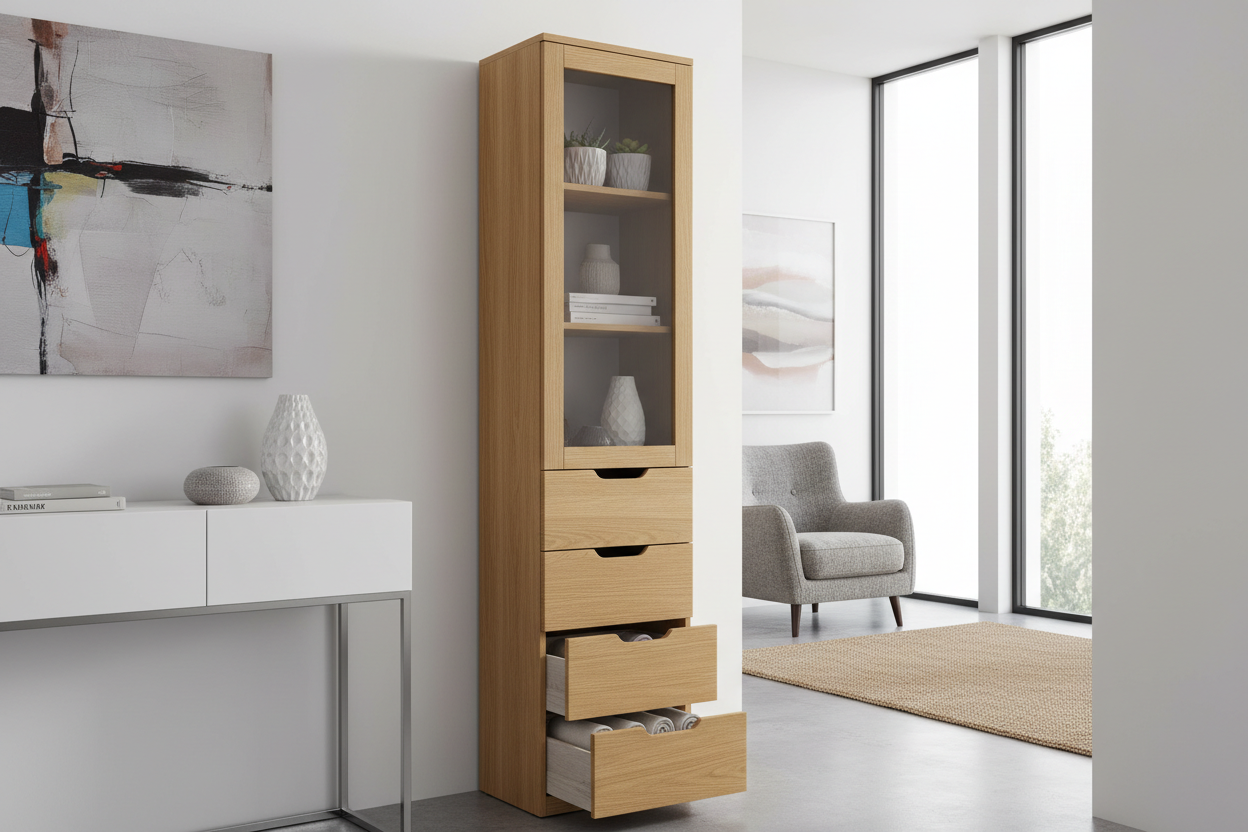
Living in a home with limited square footage often feels like a constant battle against clutter. You have items that need a home, but standard furniture is simply too bulky for your walkways. The solution usually lies in finding a narrow depth storage cabinet with doors. These specific pieces of furniture are designed to hug the wall, protruding only 10 to 13 inches into the room, allowing you to maximize storage in hallways, small bathrooms, and entryways without blocking the flow of traffic. By utilizing vertical space or running along a corridor, these cabinets turn dead zones into functional organizers.
Understanding Dimensions: Depth vs. Width
When shopping for storage, terminology can get confusing. Most people search for "narrow" when they actually mean "shallow." A standard cabinet might be 16 to 20 inches deep, which is far too intrusive for a tight hallway or a small powder room. The magic of a dedicated narrow depth storage cabinet with doors lies in its profile. These units are specifically engineered to store items like shoes, toiletries, linens, or pantry goods in a single row, keeping the footprint minimal.
Before you buy, grab a tape measure and check your floor space. Account for baseboards, which can push a cabinet an extra inch off the wall, and ensure that swinging doors won't hit the opposite wall or a doorframe when opened. If the swing radius is a concern, sliding doors or open shelving components might be a better fit for your specific layout.
The Versatility of Low Profiles
Not every space can accommodate a tall tower. Sometimes, the only available spot is under a window, beneath a wall-mounted TV, or behind a sofa. This is where a low narrow storage cabinet shines. These units often function as dual-purpose furniture. In an entryway, they serve as a landing strip for keys and mail while hiding shoes inside. In a dining area, they act as a buffet for serving dishes without cramping the table space.
Low cabinets also help maintain visual openness. Tall furniture in a small room can sometimes feel oppressive or "heavy." Keeping the furniture line low allows the eye to travel across the room uninterrupted, making the space feel larger than it actually is. You can style the top surface with a lamp, a mirror, or plants to integrate the storage piece into your decor seamlessly.
Aesthetics and Modern Design
Gone are the days when utility furniture looked like cheap plastic bins. Current design trends have embraced the need for compact living, resulting in the rise of the modern narrow storage cabinet. These pieces often feature clean lines, handle-less push-to-open mechanisms, and legs that lift the unit off the floor, contributing to an airy aesthetic. Fluted glass doors, rattan inlays, and matte finishes are currently popular, allowing these practical items to stand out as design statements rather than just utility boxes.
Color choice plays a massive role in how much visual space a cabinet consumes. A white narrow cabinet with doors is a classic choice for tight quarters because it blends into white walls, effectively disappearing from sight. This monochromatic approach reduces visual clutter, which is essential in small apartments. However, don't be afraid of darker tones if you want to ground the space; a charcoal or navy shallow cabinet can create a sophisticated focal point in an otherwise plain hallway.
Balancing Storage Needs: Drawers vs. Shelves
Doors are great for hiding general chaos, but they aren't always enough. For a truly organized life, you might need a narrow cabinet with drawers and shelves. This configuration offers the best of both worlds. The drawers are perfect for small, loose items that tend to get lost on deep shelves—think batteries, chargers, keys, or makeup. Meanwhile, the shelved sections behind doors can handle bulkier items like towels, books, or cleaning supplies.
When evaluating a unit with drawers, pay close attention to the internal dimensions. In shallow cabinets, drawers can sometimes be surprisingly short. Ensure they extend far enough to be useful for your specific needs. Adjustable shelves are another feature to prioritize; being able to move a shelf up or down by an inch can be the difference between fitting a standing bottle of cleaner or having to lay it on its side.
Real-World Application: My Hallway Transformation
I once lived in a railroad-style apartment where the hallway was the only thoroughfare connecting the bedroom to the living area. It was notoriously tight, and for months, piles of mail, dog leashes, and winter accessories accumulated on a dining chair because there was simply nowhere else to put them. Standard console tables were too deep and made the hallway feel like an obstacle course.
I eventually hunted down a shallow cabinet that was only 11 inches deep. It was a game-changer. It had two tilt-out compartments for shoes (which I actually used for scarves and gloves) and a small top drawer for keys. The difference wasn't just in cleanliness; the psychological relief of walking through a clear hallway changed how I felt coming home. Anchoring it to the wall was a necessary step—shallow cabinets can be top-heavy—but the effort was worth every second of assembly.
Installation and Safety Considerations
Because these cabinets have a shallow center of gravity, they are more prone to tipping than deeper furniture, especially when doors are open or drawers are pulled out. Wall anchoring is not optional; it is a requirement. Most reputable manufacturers include anti-tip hardware, but if yours doesn't, pick up a simple L-bracket or furniture strap kit from a hardware store.
Regarding assembly, shallow cabinets can sometimes be tricky because working in tighter spaces means less room for screwdrivers and hands. Laying all parts out on a flat surface and identifying the orientation of the side panels is critical. Many people accidentally assemble the sides backward, only realizing the mistake when the drawer runners don't align. Take your time with the diagram before turning the first screw.
Choosing the Right Material for the Room
The environment where the cabinet will live dictates the material you should choose. If you are placing a unit in a bathroom, look for moisture-resistant materials. Engineered wood with a sealed veneer or painted finish performs better against humidity than untreated solid wood or open-grain particle board. For living rooms or dry hallways, you have more freedom to explore natural wood finishes or metal accents.
Ultimately, the goal is to find a piece that solves your storage problem without creating a new problem of overcrowding. By focusing on depth dimensions and selecting a configuration that matches your inventory, you can turn even the narrowest sliver of wall into a valuable asset.
Frequently Asked Questions
What is the minimum depth for a functional narrow storage cabinet?
Generally, 10 to 12 inches is considered the minimum depth for a cabinet to be truly functional. At this depth, you can store shoes (often at an angle), folded towels, books, and general pantry items. Anything shallower than 10 inches is typically reserved for media storage or spice racks.
Can I use a narrow shoe cabinet for general storage?
Absolutely. Many narrow shoe cabinets feature tilt-out doors that are excellent for storing non-shoe items. They work perfectly for organizing rolled towels, winter accessories like scarves and gloves, pet supplies, or even reusable shopping bags.
How do I stop a shallow cabinet from wobbling on carpet?
Shallow cabinets are inherently less stable on plush surfaces. The most effective solution is to anchor the unit securely to the wall studs, which prevents tipping and eliminates wobble. If wall anchoring isn't possible, using shims under the front legs can help lean the unit back toward the wall for better gravity distribution.

Leave a comment
This site is protected by hCaptcha and the hCaptcha Privacy Policy and Terms of Service apply.